
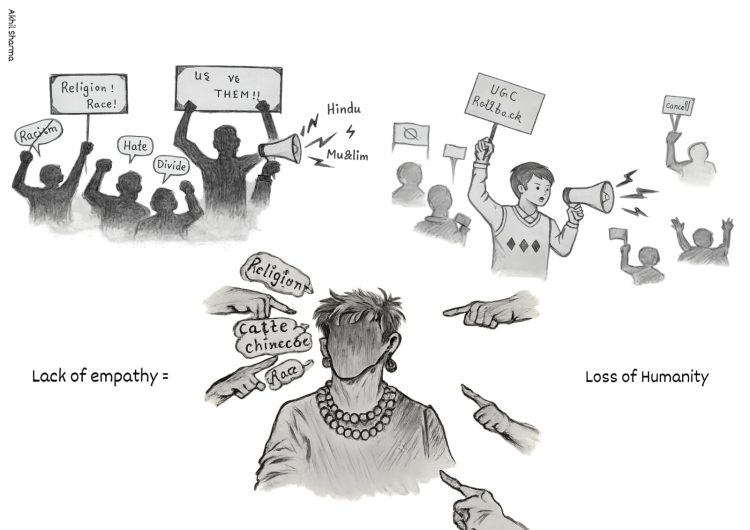
The state of the world right now can only be described as a hot mess – wars, calamities, global crises and much more. During these trying times, fear and polarization often take hold. However, it manifests in varied ways. Sometimes, it’s from self-fulfilling prophecies and sometimes; it’s extremism decorated and presented as the “logical next step” or “solution”.
But, the real cost of all these crises in my opinion is the erosion of empathy and compassion for one another. Let me explain, with a few examples. Whenever some major incident happens which has parties belonging to different faiths, communities or backgrounds, all the noise and buzz surrounding the incident becomes very narrative-driven. Media houses are quick to push a certain narrative, often hyperfocusing on certain details like the faith of the parties involved and then presenting them in a sensationalized manner. This shifts the focus from the incident itself and turns it into a debate of all the background details. ‘Hindu vs. Muslim’ is a common narrative presented by the media, we all know it and frankly, I think we’re all quite tired of it. This ‘us versus them’ tactic only seeks to divide and it dilutes, even violates the basic sensibility of anything it is tacked on. Now, instead of scrutinizing the individuals, we scrutinize every attribute of them and in turn, lose empathy towards each other as humans and rather see each other as representations of a collective whole. But, is human consciousness and even human existence really that simple? Absolutely not. Generalisation on such a level only achieves one thing: division. It prevents critical thought, it prevents a critical insight into the events and we latch onto whatever narrative aligns with our bias.
This is wrong because it strips us of the very thing that makes us see nuance: Empathy. And the consequence of all this? Individuals belonging to those aforementioned communities or faiths are villainised, attacked and targeted. It makes their very existence a nightmare and a challenge and it often leads to communal violence. It reduces their humanity and it reduces ours. It’s a net negative for everyone involved because in turning to violence and radicalisation, we lose pieces of ourselves and become mindless robots. Of course, justifications exist everywhere but how long will we hide behind those justifications and ignore what it does to us, our mindset, our way of seeing things and our moral sensibilities?
The next example would be racism. It’s common in India, whether we like to admit it or not. And it has become scarily common on the global stage too. Every time someone tries to defend Indians online, the justification of “But they’re racist to themselves” is often heard. The worst part? It’s absolutely true. But does it justify the racist attitudes? Absolutely not. We are quick to call people out on this and we definitely should but where we fail is when we turn a blind eye to the racism problem we have within our country. Northeast Indians are often taunted with racist comments like “Chinese”, Indians with darker skin tones are often looked down upon as less attractive or even unappealing. Hell, even our media industry, like Bollywood, often whitewashes the main leads involved in films. And once again, what is the consequence of all this? People who are being discriminated against start being viewed less as a human and more as a label, a checkmark, a collective whole representing their entire race or culture.
And when we reduce them to such blanket statements or umbrella terms, we grow a boldness within ourselves to view them as “lesser” or “less important” and develop an irrational superiority complex. It’s not even that it’s targeted. No, In some ways it has become so common nowadays that people say such things without even understanding or realising the weight of their words and its consequences. I’ve seen kids calling people with narrow eyes as “Chinese” and they just laugh about it. That’s what such ignorant compliance does. It makes something irrational, unjustifiable and unjust into something that’s common and widely accepted even though it should never be that way.
And an even broader consequence of all this is that it not only divides us but also disarms us in terms of solidarity and in having a collective identity. When people from outside view such things, they see how we discriminate against ourselves and they find it much easier to discriminate against us. A house divided against itself cannot stand. Once more, this is not a justification for racist attitudes but a consequence of having them.
All these examples show one thing extremely clearly: Lacking empathy dehumanizes us and the ones we target through our actions. As with all things, there’s a lot of nuance and complexities involved in the things I’ve chosen to mention. And there are a lot more examples that I could’ve included but the point is: Empathy or lack thereof is at the core of all these things. People often get confused between critique and hatred. Being critical of something is fine but when it turns into hatred, it is extremely hard to justify and leads to irrational attitudes and actions. We never stop to think and ask ourselves, “Where does the line blur when it comes to being critical and being hateful? Where does the line blur between the logical and the irrational?”
How do we practice or even recognise empathy? Well we can start by first recognising each other as fellow humans and nothing more. Understanding that someone has a background just as vast as ours does wonders to our understanding of each other. It’s the willingness to accept and recognize someone else’s existence as meaningful and consequential. It’s the willingness to come out of our tunnel vision and our tendency to think in ‘me, myself and I’ and try to understand how things might be for someone else, how they must feel, how they deal with things and go about their life. We build connections, relationships and bonds with the people close to us because we understand them. We know who they are, what their struggles are, what kind of people they are and this connection and understanding is at the core of being empathetic.
It’s very easy to drift towards negative attitudes, stereotypes, having a false sense of superiority etc. because it’s easy and convenient. It’s convenient because we can just accept it without thinking of the consequences. It’s easy because it doesn’t force us to think about the weight of it all and how it would pan out in front of us. It’s much more difficult to stop and say, “No, I will not conform” and reject it in favour of trying to understand something fundamentally. I’m not asking you to do a deep dive but rather, asking you to just understand. Just the simple act of thinking before we speak makes a world of difference for the people we’re speaking to, doesn’t matter if they recognize it or not. What matters is that we tried. And we need to keep trying if we want to rid ourselves of such polarisation and negativity.
Is this a perfect solution? Of course not. No such thing exists. But can empathy lead to a better life and a better world for all of us? Well, I’d like to think so. It’s the small steps that count towards building a better life for ourselves and others because really, if we strip back everything and just focus on each other, we all are just fellow humans. And this act of being just human is what gets lost in the buzz of hatred and prejudice.
Sometimes it’s impossible to practice empathy because there are moments of genuine conflict, harm and targeted attacks which erode our sense of self and our identity. But even in these times, it’s the willingness to stay true to ourselves and our ideals and still try to be good to ourselves and others, cementing our empathy as a core tenet of our existence.
And this is why Empathy. Is. Radical. Because it’s not convenient and hard fought. It’s the constant willingness to be better, not just for oneself but for others. It’s a lifelong process.