
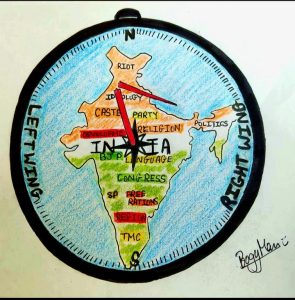
In Western politics, it is easy to divide parties into two clear groups: Left and Right. The Left focuses on welfare, equality, and state control, while the Right supports free markets, cultural conservatism, and smaller government. This binary works there because their political journey is shaped by class conflict and economic ideology.
But India is completely different. Here, trying to fit politics into simple Left–Right boxes is almost impossible.
India Has a Party-Based System, Not an Ideology-Based One
In India, people don’t vote for ideology first—they vote for parties, leaders, caste groups, regional identity, and local issues. Even the parties we call Left or Right regularly mix decisions from both sides. That is why the Western “Left vs Right” framework cannot be applied to the Indian political landscape. It oversimplifies a system that is far more complex.
BJP: Considered Right, But Often Takes Left-Leaning Decisions
The BJP is usually labeled a right-wing party, mainly because of its cultural and nationalist stance. But many of its major policies leave a Left footprint, such as:
– Large welfare schemes like free rations and Ujjwala
– Strong government involvement in development projects
– Protectionist economic steps like promoting Make in India
In the West, these policies would be seen as left-leaning.
Congress: Considered Left, But Has Strong Right-Leaning History
Congress is often called a left-leaning party, but many of its major reforms were actually right-oriented, for example:
– The 1991 economic liberalisation
– Privatisation and support for foreign investment
– Market-friendly reforms in telecom and banking sectors
In a Western frame, these would be considered Right.
The Role of Regional Parties Makes the Western Model Impossible
Unlike the Western two-party system, India is heavily shaped by regional parties. DMK, TMC, BJD, SP, RJD, Shiv Sena (original), TDP, TRS/BRS, and many others hold huge influence. Their politics is based on:
– Regional pride
– Caste identity
– Language
– Local development
These parties are not Left or Right. They are regional forces, and their voter bases also think in regional terms, not ideological terms.
Conclusion
India’s political reality cannot be understood through Western Left–Right ideology. Here, parties mix both left and right policies, regional parties dominate, and voters choose based on ground realities rather than ideology. Indian politics is not an ideological battlefield — it is a party-driven and region-sensitive system, unique to India and shaped by its own social and political history.