
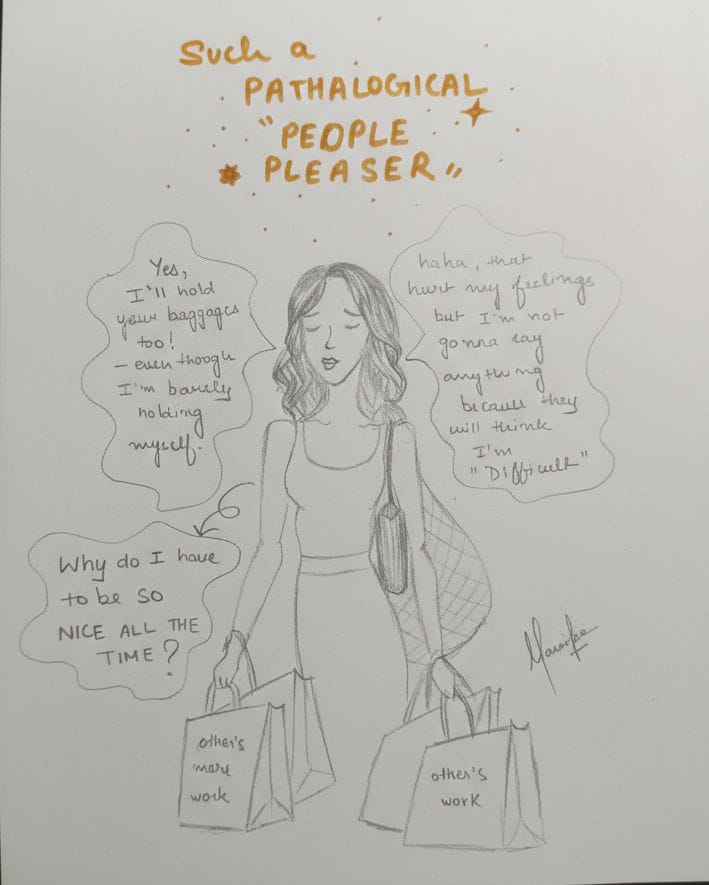
Are you a NICE person, or are you TOO NICE?
The kind of person who lets others walk all over you and take you for granted?
For a long time, I was the person with zero boundaries, enduring the “sweetest torture” of putting everyone on a pedestal while I lived in the basement of my own life : (
We often mistake this chronic people-pleasing for a virtue, but the reality is that the “nicer” you are, the more likely you are to be interrupted, talked down to, or treated like the punchline of a bad joke.
This cycle persists because respect is not a gift others grant you.
It is a reflection of HOW YOU TREAT YOURSELF.
We teach people how to treat us through “modeling” – a fancy psychological term for giving others a blueprint of our self-worth. When we say YES but our soul is screaming NO, or when we stay silent while someone is being blatantly rude, we’re essentially handing them an instruction manual on how to take advantage of us.
To stop “shapeshifting” our personalities just to get a thumbs-up from the crowd, we have to embrace our authentic selves.
When your real self and your public self finally decide to be friends, you command a level of trust and confidence that makes you appear powerful without having to throw a single punch. You can start this shift with a small, assertive tweak, like cutting out the “autopilot sorry” for every minor inconvenience.
Instead of shrinking into a puddle and saying, “Sorry I’m late,” try a confident, “Thank you for waiting for me”. It’s a simple switch that moves the focus from your mistake to your dignity.
In the beautiful halls of the University of Lucknow, where culture and tradition are part of everyday life, we sometimes confuse silence with being graceful. While we celebrate the stunning architecture and rich history around us, it’s important to remember that respect doesn’t mean letting others walk all over us.
Setting boundaries might lead some people to think you’ve become “difficult,” especially if they’ve been used to the old version of you who was always accommodating. It’s okay to let them adjust, and it’s okay to let yourself blossom into someone new, someone more self-determined and confident. But if someone just doesn’t get the hint, relying on silence or words alone may no longer work. In those situations, taking a step back and focusing on yourself can be the best move. By walking away and conserving your energy, you’re sending a clear message that your presence is special and should be valued, not taken for granted.
For the women walking these halls, this “sweetest torture” often comes dressed as elegance. We are taught to be the softest version of ourselves, but there is a distinct power in being a woman who knows when to stop being “sweet” and start being certain.
You don’t have to lose your grace to gain respect.
You just have to stop apologizing for existing. There is nothing more feminine than a woman who is unapologetically herself, who protects her energy like a sanctuary, and who understands that her “softness” is a gift for those who deserve it, not a commodity for those who demand it.
I speak of this from my own experience:
If you’ve ever spent a sunny afternoon at the University of Lucknow, you know that the canteen is more of a social courtroom than an eatery. For the “too nice” students, it can be a DANGER ZONE. I used to be the one holding bags, ordering tea for everyone, and apologizing to the waiter for forgotten snacks. It felt like the “sweetest torture.” I constantly shaped my personality to be seen as the reliable one.
Then, I decided to set boundaries. When a persistent acquaintance tried to borrow my notes without a greeting, I stopped apologizing and asked, “Why would you assume I’ve finished them?” The silence that followed was refreshing.
I realized that being “agreeable” at LU often means being invisible. Now, when a senior interrupts me, I pause and continue calmly. If someone makes a joke at my expense, I ask them to explain it. Nothing halts rudeness faster.
Setting boundaries hasn’t made me “difficult”; it has made me the curator of my own energy. If my message doesn’t get through, I walk away from the drama.
It’s time we act like the main characters in our own stories.
Respect means knowing when to leave a table that isn’t serving you. At LU, we value grace, but don’t let it lead to your erasure.
We are the authors of our own stories; don’t settle for being a sidekick when you should be the lead. By setting boundaries and walking away from those who don’t value you, you reclaim your
time, energy, and self-worth.