
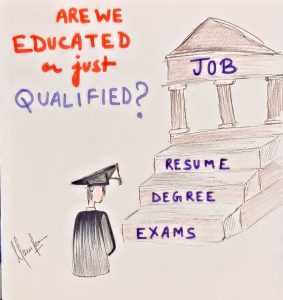
India is a country brimming with ideas, innovation, and youth, and it is one of the fastest-growing economies in the world. Yet despite this progress, problems like unemployment remain at a peak. India has one of the largest youth populations, capable of changing the face of the world. But is the youth being directed in the right way? As the saying goes, “Sailing in the wrong boat will never take you to the right destination.” This metaphor captures a core dilemma: are we using education to grow, or merely to collect certificates?
Does our traditional method of education really help us? Are the degrees that we are pursuing truly useful, or do they resonate with our interests? Or are we just pursuing them to be qualified enough to be a part of society? Therefore, I have this one question: Are We Educated or Just Qualified?
In modern society, there is a growing emphasis on degrees, diplomas, and certificates. People often measure success by how many qualifications they have. But this raises a critical question: are we truly educated, or just qualified on paper?
Being qualified means you have completed a course or training and can perform specific tasks. It shows you have passed exams and met academic or professional standards. For example, a person with a degree in engineering is qualified to work in that field. However, qualification alone does not guarantee wisdom, creativity, or ethical judgment.
If engineers are so well-qualified and educated in their subjects, then why do we still see so many accidents and tragedies happening around us? How does a bridge built by a qualified engineer collapse within a month of construction?
This shows that qualification without true education and practical application is not enough, because education means more than just a certificate. We need to focus on learning that builds character, critical thinking, and problem-solving skills, not just paper qualifications. Only then can we direct ourselves in the right way and achieve true progress.
Unfortunately, the ground reality is quite harsh. I have seen many of my fellow students pursuing a subject not because they are interested in it, but because they find it easy or simply want the tag of being a graduate. The same story applies to many aspirants of government jobs; often their motive is not to improve or contribute to society, but to live an easy life under the tag of a government officer. This pattern has continued for so long that we have normalised many things that should never have been normalised in the first place. In some institutions, unethical practices are even casually discussed as “perks” of certain positions.
Students are often trained to memorize and repeat information to pass exams rather than to explore and think independently. As a result, we see graduates who can secure jobs but struggle to solve real-world problems or act responsibly in society.
To bridge this gap, we need a shift in how we view learning. Schools and universities should aim to nurture curiosity, ethics, moral values, and innovation- not just exam results.
At the same time, individuals must take responsibility for their own growth by reading, reflecting, and questioning beyond the classroom. Being independent and morally grounded within oneself is one of the few things we can truly control. Yet I am scared of the fact that slowly and gradually we are also becoming part of this system where we normalise things that were never meant to be normalised. We may try to act righteous, but sometimes we twist the virtues of rightness according to our own convenience.
In conclusion, qualifications may open doors, but education builds the foundation for a meaningful life. We must strive not just to be qualified, but to be truly educated- capable of thinking, feeling, and contributing to the world with purpose.