
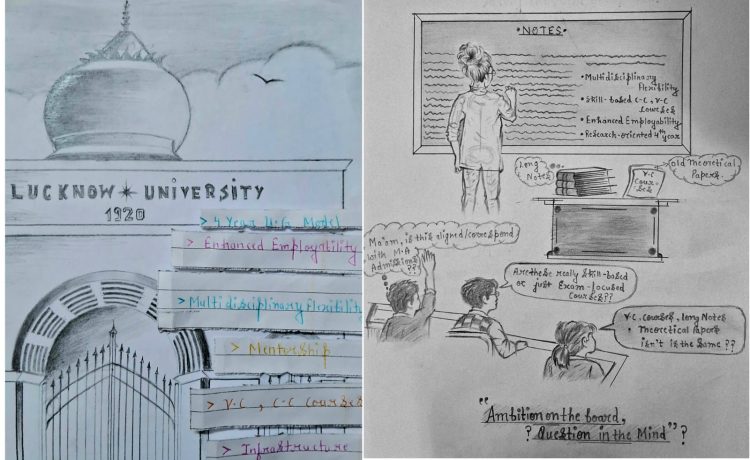
A university is not a space for rushed experimentation. It is an institution that shapes futures — and decisions affecting it demand preparation, not publicity. When Lucknow University swiftly adopted the four-year undergraduate model under NEP, it positioned itself as progressive — ”among the first to implement the reform”. The promise was expansive: multidisciplinary flexibility, a research-oriented fourth year, and “job-creating skills” through CC and VC courses.
But policy jargon is not the same as institutional readiness.
Students were assured that the new structure would enhance employability. Instead, many found themselves managing additional theoretical papers under rebranded titles — courses they never consciously signed up for. CC and VC components, presented as skill-driven and industry-relevant, often remain classroom-heavy, assignment-based, and exam-focused. The language signals transformation but the academic experience frequently feels unchanged. The reform does sound ambitious, even visionary but the execution remains conventional.
The fourth-year research provision exposes deeper structural gaps. A meaningful research year requires mentorship systems, faculty bandwidth, funding support, and alignment with postgraduate pathways. Yet the rollout appeared rushed, and the fourth-year syllabus does not clearly correspond with MA structures at most of the established central universities. Across the country, postgraduate programmes continue to function within the traditional 10+2+3 framework. If MA admissions still operate around three-year undergraduate degrees, the tangible academic or professional advantage of an added fourth year becomes uncertain.
The student response has been revealing. When the first eligible batch had the option to pursue the fourth year, enrollment was virtually nonexistent. Students chose not to continue. That silence reflects doubt — about clarity, value, and long-term feasibility.
Meanwhile, both professors and students shoulder the burden of transition. Faculty were required to redesign syllabi within compressed timelines. Students had to navigate evolving credit systems and academic combinations without clear guidance or stable roadmaps. The reform felt rushed and unprepared for.
Nevertheless, change in higher education can be necessary and progressive. But being first to implement is not the same as being prepared to sustain. When branding overtakes groundwork, achievement becomes symbolic.
Education is not about claiming a tag. It is about building a system that works — structurally, academically, and sustainably. A system built in haste rarely delivers on its promise.
