
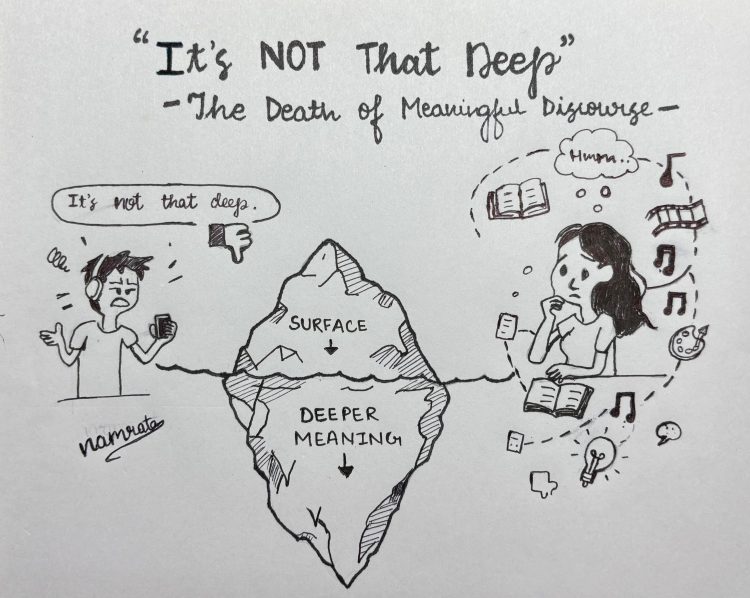
You and I, we’re no strangers to discourse. Whether it is online or offline, it has become a core tenet of our lives as we know them. And why shouldn’t it? Communication, as it stands, is more accessible than ever before and it has brought a revolutionary change to our lives. We are able to meet and engage with people we might’ve never met in a more traditional, in-person context. The internet is a boon. But it can also be a curse.
The curse is, in my opinion, a sentiment that’s all too common nowadays. I once saw someone online speaking at length about a movie they loved. And the first comment read: It’s not that deep. And this bothered me a lot. This phrase: It’s not that deep is just one example of how shallow discourse is becoming as time goes on. This phrase and the sentiment that it weaves with itself, threatens to curtail this leap in communication we’ve made and confine it to simple absolutes. The unfortunate reality of this phrase is that its continued use bleeds over into real life as well. It rewires how we think about art and life.
You might wonder, why is he having such a hissy fit over a simple phrase? Well, let me explain why. This phrase might seem harmless at a glance, but really, it’s deceptively simple in what it seems to be conveying and terrifyingly adequate at honing that meaning to such an extent that it instantly shuts down any discourse that ventures into depth. It forces us to only grace things at the surface level where it may not mean anything substantial to us because we never venture into the weeds of it. See, we as humans love to stay in our comfort zones, we thrive inside it and would like nothing more than to stay inside it forever because it’s familiar, safe and known. But life doesn’t work that way. We grow, learn and adapt when we throw ourselves out of that comfort zone, when we face the unknown and try to grapple with the unfamiliar and the unknown.
Conversations work on the same principle. You might brush against the surface level of any topic but it’ll never lead to any meaningful discourse because it’s just the bare minimum. Bare enough to make sense but not comprehensive enough to mean anything beyond what’s already known. People talk in depth about what they love because they care, want to learn more, want to understand it deeper and want its meaning to be more significant to them. Nowhere is this more true than in what we consume. What we love to call ‘Art’. That’s the beauty of life and art as a whole. Art can never be objective because the subjective nature of what it means to us elevates it beyond just simple creations.
And that’s exactly why this phrase threatens the very nature of art as a whole. It threatens this indulgence that we crave so much. Because it strips down all meaning, depth, nuance and complexity and makes us view things as either one dimensional or one note. Gone are the various shades of subtlety, in its place, something overt or objective reigns supreme. It thrives on the ‘What’ of things rather than the ‘Why’. But the way we make something our own relies on the ‘Why’ of it. Sure, there may be some arguments where this phrase might be appropriate but I’d still argue that we should use something more empathetic in its place. Something like, “I think you’re looking too much into it.” This statement acknowledges the person’s thoughts and words rather than dismissing them outright. It’s gentler and kinder.
What this phrase fails to grasp is that simplicity and complexity do not exist in vacuums and are not mutually exclusive. Both complement each other. We observe the simple to devolve into the complex. We step down from the complex into the simple to understand the crux of the matter. People use it willy nilly to shut down any hint of complexity because they’re either too afraid, too dismissive or too stubborn to understand the ‘Why’ of someone’s perspective. It makes them believe that their perspective or interpretation is superior/better somehow. But that’s the thing – every perspective is valid because it’s their interpretation of art based on how they feel about it and what it means to them. It cannot be absolute because the very nature of art defies absolutes and gives us the freedom to view art the way we want to. And rejecting depth is rejecting that freedom we have with art. Dismissal breaks this balance entirely. Some perspectives might be controversial, some might be misguided and some might be convoluted but we can have those perspectives because we allow people to express them freely. This is why I say that every perspective is valid even if I might disagree with some.
Think about it: Why do you get so excited when someone else likes something you do? It’s because you get a chance to share your perspective with them and understand their perspective. It can even lead to you attaining a greater appreciation for something you already love. In juxtaposition, look at this scenario when both parties share the exact same views. It becomes a whole lot less human and exciting and just turns monotone and robotic.
This is what we lose when we dilute meaning and depth within art. We lose that human touch that makes us love art, we lose that personal connection that moves us and makes us appreciate art. We lose the freedom to choose, think and analyse something of our own will rather than regurgitating the thoughts of someone else. Art is a celebration of life and by limiting it, we limit ourselves, our creativity, our thinking and our appreciation for life as a whole. This phrase reeks of anti-intellectualism.
That’s what this phrase utterly fails to acknowledge. And that’s why it’s so damaging to art and human consciousness. It’s also a symptom of how society is transitioning into more extremes, more absolutes rather than wanting to be comfortable with the middle ground or the unknown. To some extent, this has always been true but the fact of the matter is: It’s easier to dismiss someone as wrong rather than acknowledge their argument and deconstruct it. We’ve become too comfortable with how this particular aspect of society and discourse is in its nature. And I feel that’s precisely why this phrase has become so common now. That is why we must think of better ways to approach conversation, both on an intellectual and human level.. As it stands now, this sentiment is a stain on all things we love about life and art. Humanity has always been driven by the greater meaning of things. It’s why we love books, movies, games, music etc. so much. Because of what it means to us. Once more, I recognise that there are contexts in which this is appropriate but in those contexts, we must learn to choose empathy over hostility. Discourse is never about who’s right or wrong, it’s about understanding one another and engaging with each other on a deeper level.
