
“All happy families are alike; each unhappy family is unhappy in its own way.” Anna Karenina, Tolstoy
It’s in the quiet boredom of Holi after hours where we give in to our parents’ watch recommendations. So that’s exactly how I landed in this uncharted corner of youtube watching a show that I can’t believe more people aren’t talking about. By the end of the show, I understand exactly why– this is some of the most uninhibited jarring ways in which an Indian household has been presented on screen. What Pankaj Tripathi did was- take a seemingly normal family and put them through the chaos of getting to know themselves. Getting to know ourselves is one of the most violent tasks a human can be put through because imagine living in a dead haze of everyday life not knowing how everything we do has an effect on people we love most.That’s the cruel joke at the centre of Perfect Family. The Karkaria family isn’t broken. They’re not dealing with tragedy or crime or any of the dramatic scaffolding Indian storytelling has long leaned on. They’re just… living. And that, as it turns out, is the most dangerous condition of all.
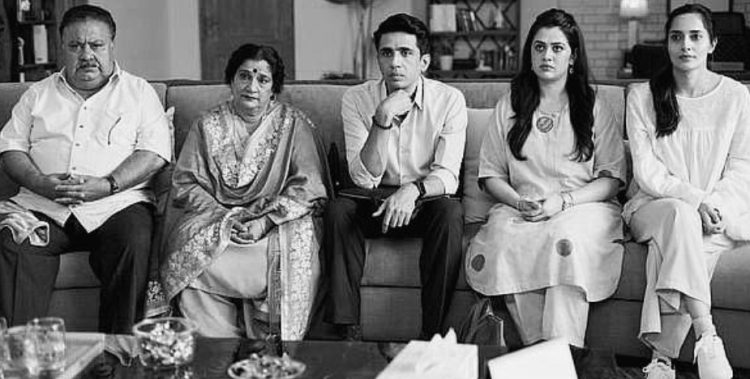
This show, which premiered in November 2025, follows the Kakaria’s after their youngest begins struggling at school. A child of 12 living in an increasingly volatile family dynamic begins experiencing paralyzing anxiety under pressure. The solution their circumstances lead them to? Family therapy. Eight episodes of watching a perfectly ordinary Indian family sit in a room being asked to peel back the layers of their hardened ego and forced to uncover parts of themselves that they hid even from their own shadows. Slowly chipping away at the surface, we see people in their personal spaces depicting what a sensitive audience might find revolting at first. But the brilliance of this show is captured within those uncomfortable scenes. It’s the truth that these individuals hide, almost to the point of actual self harm.
This show is gripping not just psychologically, but also in the ways in which it forces us to witness something we don’t see when smiles are plastered on for the people expecting a certain version of you. What makes Perfect Family so remarkable isn’t the premise, it’s the precision. Director Sachin Pathak and writer Palak Bhambri understand that in Indian homes, dysfunction doesn’t announce itself. It accumulates. It’s in the casual use of humor as a defense and practicing spirituality as a means to block feelings that quietly eat away at your mind. In the way a mother’s love comes wrapped so tightly it becomes suffocating. In the grandparents who confuse silence with dignity and call it wisdom.
So this recommendation and review comes with a warning, this is a show that forces you to wake up to the realities of our culture and identities that exist everywhere around us. We smile at them politely when we go for a walk and we clink our glasses with theirs at parties we attend.
The mental health conversation in India has been gaining traction slowly, and Perfect Family arrives at exactly the right moment to push it further. Therapy, for much of middle-class India, still carries the whiff of weakness, the idea that if you need to talk to a stranger about your family, your family has failed at something essential. The show doesn’t lecture this away. Instead, it places its characters inside that discomfort and lets them squirm, resist, deflect, and gradually, reluctantly — open up. The result is something that feels less like a TV show and more like watching a family exhale for the first time in years.
The show often goes back and forth in timeline to truly exhibit how our past shapes our present in the most profound way. A man of 60 is no less prone to this experience than a 30-something adult, and Perfect Family depicts this with a kind of unflinching honesty that catches you off guard. There are instances within the show where a sensitive audience would end up wincing; the graphic representation of the uglier aspects of being a dysfunctional human, of carrying problems you can’t articulate to the people sitting right across from you at the dinner table, hits with a dull, specific ache. What makes it more disorienting is how the show refuses to let you comfortably dislike anyone. The person who seems villainous in one scene becomes someone you understand and almost grieve for once the timeline folds back and shows you what made them that way.
The architecture of Perfect Family is worth pausing on. Its eight episodes move with the deliberate rhythm of a therapy arc, and their titles alone tell a story. There is a particular kind of Indian storytelling that has always preferred the epic over the intimate. The grand gesture, the dramatic confrontation, the emotional crescendo that releases everyone from the tension of saying something true. Perfect Family refuses all of that. It stays small. It stays honest. It makes you laugh and then, before you’ve finished laughing, it makes you uncomfortable in ways you’ll be untangling for days.
Pankaj Tripathi has spent years playing characters who exist on the margins of respectable society; gangsters, fixers, the quietly powerful men in the background. In producing Perfect Family, he has turned that gaze inward, toward the most respectable institution of all: the family. What he found there, and what this show so brilliantly excavates, is that respectability is often just the story we agree to tell each other so we don’t have to tell the truth.
By the time the final title card Family is Everything — appears on screen, you won’t read it the same way you would have eight episodes ago. That shift is the whole point. And it costs less than a cup of coffee.