
Tyeb Mehta, the Paintings That Distanced Me, and the Film That Brought Me Back
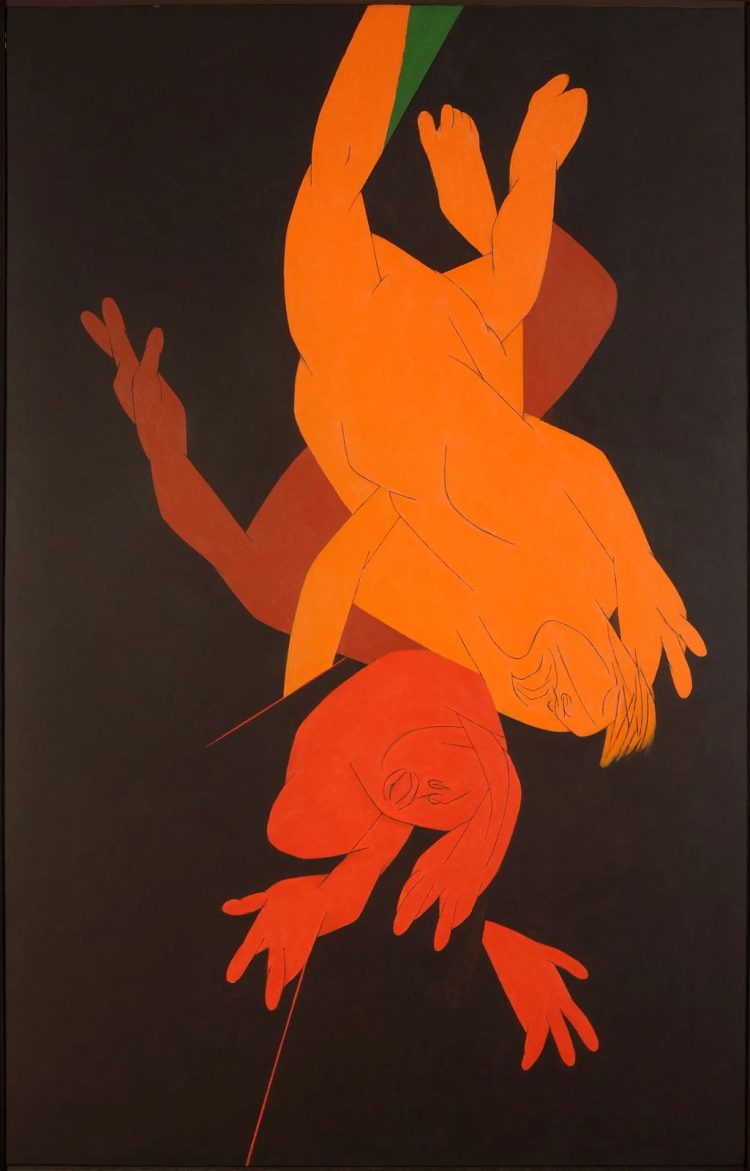
The first time I saw a Tyeb Mehta painting, I was too young to know what I was looking at. It was at a virtual tour of an exhibition in Mumbai, some corporate gallery in a high-rise, the kind with white walls and art that seems to float in its own importance. I remember a falling figure, truncated by the frame, suspended in permanent descent, and thinking: this is supposed to mean something, but what?
I stopped there longer than I should have, waiting to be moved. The painting was severe. The diagonals were exact, almost architectural, the flesh had been abstracted into planes of colour, stripped of everything except form. I wanted to feel the violence, the anguish, the weight of Partition history that everyone said lived in these canvases, but what I felt instead was distance. The figure was monumental but mute. It didn’t speak; it signified.
For the longest time after that tour, I carried this unease privately, as though I had failed some test of appreciation. The art world had canonised Mehta, rightly, I knew, and my hesitation felt like a failure of perception, not a legitimate response. When his “Celebration” sold for crores at auction, setting records, I told myself the market knew better than my confusion. When critics wrote of his formal innovations, his compression of trauma into geometry, I nodded along, hoping the feeling would arrive eventually.
It never quite did.
Then, earlier this year, I re-watched “Koodal” at the KNMA in Saket. The film was playing in a small room off the main exhibition space, projected on a wall with headphones hanging from hooks. I put them on and sat on the floor, alone except for a security guard who kept glancing at his phone.
Sixteen minutes and sixteen seconds later, I understood something I hadn’t known I was looking for.
The film opens with text: “Koodal” is a Tamil word meaning meeting point, union, assembly of images. The title appears first in Tamil script, then in English letters, spelt out in white blocks that seem to crowd each other, jammed close like commuters on a local train. Behind them, barely visible, is the eye of a bull, black, deep, reflecting something we can’t see. Then flayed cattle heads fill the frame, abstract and nearly illegible, their dead eyes burning through the image like holes burned in fabric, or like graves.
I have spent years trying to reconcile this Mehta with the one who painted “Falling Figure”, that suspended body, truncated by the canvas edge, frozen in a moment of eternal descent. The paintings have always disturbed me, not because they are violent, but because they seem so certain. The diagonals are exact, the flesh is abstracted into geometry, the anguish is monumental, but it is also curiously mute. These figures do not speak; they signify.
For a long time, I believed this was a limitation. The “common man” appears throughout Mehta’s canvases, yet he appears without biography, without context, without the textures that make suffering legible rather than merely visible. Was this empathy, I wondered, or aestheticisation? When pain becomes composition, when trauma is distilled into formal tension, does the subject survive the transformation? The charge of “poverty porn” hovered unspoken in my mind, not because Mehta sentimentalised suffering, but because he purified it. His figures are stripped of everything except their anguish. They become archetypes, and archetypes, for all their power, cannot answer back.
Mehta was trained as a cinematographer before he became a painter. His family was in the film business; he worked as an editor at Famous Cine Laboratories on Tardeo Road, cutting footage for Bombay cinema before quitting to study art at the JJ School in 1947. That year, commuting to work from his home on Mohamed Ali Road, he witnessed something that never left him: Partition-related street violence, a mob beating a man to death. He watched it happen, and although he couldn’t stop it, he carried it forever.
This is the story everyone tells about Mehta, and it’s true, but “Koodal” complicates it, because the film is not simply about violence. It’s about what surrounds violence, what precedes it, and what persists after. It’s about the ordinary life that somehow continues alongside the slaughter.
The slaughterhouse sequences are what most people remember. A bull mounts a cow in the meatyard, the act filmed from multiple angles, cut fast against a drone of tambura and mridangam. Calves suckle. Cattle crowd together. Then the scene shifts, and we’re inside the charnel house, double-pronged hooks hanging empty, waiting. The carcasses arrive, flayed and abstract, their dead eyes catching light. The editing accelerates. A ticking clock grows louder, seeming to move the handheld camera with its rhythm. At 9:49, cattle corpses tumble in blurred frames, rhyming with psychedelia, bringing us as close to the actual moment of killing as Mehta can bear. The violence corrupts the lens, burns the film. We see almost nothing, which is exactly what we deserve, but the film refuses to let this be the only truth. It cuts away to a woman backstage, applying makeup while her eyes water, to performers entertaining a crowd, to residents of what looks like a chawl, peering down from cramped balconies, their faces carrying visible judgment, irony, boredom, to Gandhi’s funeral procession, where hierarchy dissolves into mass grief, where the crowd that can become a mob becomes instead a congregation.
These are not symbols. They are people occupying time. They continue.
The woman with watery eyes, we never learn why her eyes water. Kohl, perhaps. Grief, perhaps. Nothing. The camera does not explain; it simply watches her continue her task, and in her continuing, she holds open a space that neither painting nor film can close. The space where life outlasts whatever we make of it.
This is what I had been missing, all that time in front of the paintings. Not the violence, that was always visible, distilled, purified into form, but the life that violence interrupts. The textures that context provides. The small, irreducible details that keep people from becoming symbols.
The paintings compress: a falling figure, trapped in a single eternal moment, a trussed animal, reduced to pure geometry. The canvas says: this is what suffering looks like when everything else is stripped away, and this is true, as far as it goes, but it’s not the whole truth.
On the other hand, the film releases. It allows duration and ambiguity. The woman with watery eyes is not an archetype of resilience or a stand-in for the masses. She’s just a woman, somewhere, doing her work, her eyes stinging, the camera watching without explanation. She doesn’t perform or signify anything. She simply continues, and in her continuing, she resists everything the slaughterhouse represents, not heroically or symbolically but by just being there, by living through the frame, by refusing to become metaphor.
Without the film, the paintings risk becoming too certain, beautiful monuments to pain that keep pain at a formal distance. Without the paintings, the film risks drifting, observations that never quite land, images that accumulate without weight.
Together, they hold something open. A question, not an answer.
Gieve Patel wrote of Mehta’s recurring bull motif that the animal represents both victim and aggressor: “man’s mute and uncomprehending victim” and also “an image of the aggressor’s own helplessness before forces he has released and cannot control.” This doubleness is “Koodal’s true subject. The double-pronged hooks echo the bulls’ horns. The crowd that mourns is the crowd that kills. The woman applying makeup continues, refusing resolution.
Mehta called the film an autobiography. At first, this seemed strange; there’s no narration, no linear story, no obvious self-portrait, but I think I understand now. The autobiography isn’t in the events. It’s in the seeing. The film watches the way Mehta must have watched that day on Mohamed Ali Road, unable to look away, unable to fully arrive, suspended between witness and participant. The camera is susceptible, interruptible, ready to pitch into feverdream. It knows its own vulnerability. It knows that watching violence implicates you in ways you can’t control.
Rene Girard wrote: “There is no culture without a tomb and no tomb without a culture; in the end, the tomb is the first and only cultural symbol. The above-ground tomb does not have to be invented. It is the pile of stones in which the victim of the unanimous stoning is buried. It is the first pyramid.”
The slaughterhouse in *Koodal* is a tomb. The flayed bodies are the buried, but the film keeps returning to the living, the woman, the crowd, the performers, the residents peering down from balconies. They are the pile of stones, too. They are what remains after the stoning. They are culture, in all its compromised, continuing mess.
What fascinates me, finally, is not that Mehta resolved the tension between witnessing and abstraction, but that he sustained it across media. He didn’t choose between the painter’s compression and the filmmaker’s duration. He held both, let them pull against each other, let the contradiction stand.
Instead of trying to complete each other, the paintings and the film interrupt each other. The canvas says: some truths require reduction. The film says: some truths require duration. Neither is wrong, nor is it sufficient. Together, they form a question that Mehta spent his career asking without ever answering definitively: How do you represent suffering without consuming it? How do you witness without appropriating? How do you make art about violence without becoming complicit in its aestheticisation?
I don’t think Mehta, or anyone for that matter, knows, but “Koodal” suggests he understood something about the stakes. The film is full of eyes, the bull’s eye reflecting light on wet stones, the dead eyes of flayed carcasses, the watery eyes of the woman applying makeup, the eyes of residents watching from balconies, the eyes of mourners in Gandhi’s funeral crowd. Eyes watching, eyes being watched, eyes that witness and eyes that are witnessed. The film is about seeing, and about the impossibility of seeing cleanly.
Adil Jussawala’s lines echo: “There’s trouble outside: / crowds, stammering guns, the sea / screaming from side to side.” The trouble is always outside, but the eyes are inside, watching, carrying it in.
I sat on the floor of that KNMA room until the film looped back to the beginning, and I kept rewatching it until I was sure that I had it etched behind my eyes so well that when I sleep, I’ll rewatch it in my dream. The security guard had stopped checking his phone and was watching me watch. I took off the headphones and walked back into the main exhibition space, where Mehta’s paintings hung in their severe, distilled silence.
The falling figures were still falling, the trussed bulls were still trussed, but something had shifted. I could hear the ticking clock now, and could feel the crowd pressing in. The paintings hadn’t changed, but I had. I had seen the life they compressed, the duration they arrested, the ordinary persistence they purified into form.
I return to that woman with watery eyes. She does not know she is being watched. She does not perform for the camera. She simply continues, and in her continuing, she holds open a space that neither painting nor film can close, the space where life outlasts whatever we make of it.
The crowd gathers; the bull’s-eye reflects a light somewhere off-screen, the woman applies makeup, her eyes watering, not performing, not signifying, and just living through the frame.
We watch. We keep watching. That’s all.