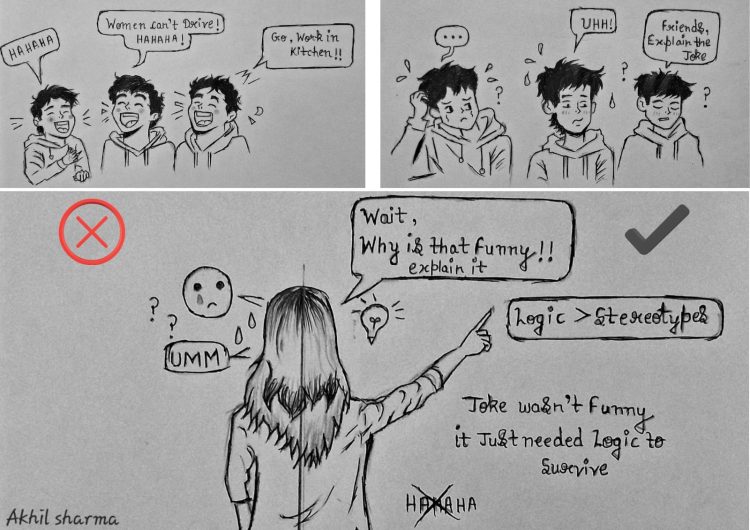
Apparently, feminism has ruined humour. Now the room is quieter. The jokes no longer have the same impact they used to have. Men are cautious because they fear that one poor joke will bring out a feminist who will ruin the mood by posing awkward questions.
It truly is a tragedy. Comedy used to be easy. You could use phrases like “women can’t drive,” and then high-five your friends or say “go back to the kitchen,”. You could ask the nearest woman to make you coffee, and if he is socially deprived human he can simply go in the comment section, and have rights to say whatever they wish to say , after all few rape “invites” are nothing. It’s not like they would actually do it- it’s just a harmless joke. Everyone chuckled, at least some did, which turned out to be enough evidence that this kind of humour was effective.
It was a simple formula: say something “funny”, wait for your friend to validate you by laughing, or by just staying quiet and smiling; it has been working for a while. However, it seems that feminism has now killed that joy.
A common grievance is that feminists have lost their sense of humour. They are overly serious about everything. Men maintain that the jokes were harmless, or “just the bitter truth”.
Because these remarks are simply valid. And the fact that the women didn’t laugh at the joke is the real issue, rather than the joke itself.
And then women who question, “Wait… why is that funny?” is the best way to ruin a punchline.
For many years, a particular kind of humour depended on a very straightforward formula: take a woman, turn her into a stereotype, and use the humiliation as wit. Women are not good drivers. Kitchens are where women belong. Women are dramatic, emotional, and illogical. When the woman in question is expected to play along and smile courteously, the joke works best.
This dynamic can even be seen in a classroom. In a chemistry lab once, when the male professor scolded the students for performing the experiment poorly. The class had almost an equal ratio of both genders, but the professor directed his frustration towards the girls- “If you can’t even perform a simple experiment, what will you do in life? Might as well go back to the kitchen.”
But of course, he was simply telling a joke.
The expectation is that the women will play along and smile courteously, because it’s the best way to act when the person is in authority or maybe because it is simpler that way.
When a woman makes a mistake while trying something, she becomes a lesson , a joke, and falls into stereotype narratives which have been putting women down. Whereas when a man makes a mistake, that is simply because he is human or because “boys will be boys”.
If we talk about the women drivers, Data has consistently showed that women are safer drivers than men, with significantly lower fatal crash rates, fewer accidents, and less involvement in high-risk behaviours like drunk driving and speeding. Studies indicate male drivers are involved in twice as many fatal crashes per mile. According to a 2020 study, men caused twice many as fatal accidents then women. Yet when a woman drives people tend to make jokes, or give her weird looks, as if an alien is driving.
When a woman responds in anger or frustration, or simply starts talking with a logic- the best way to shut her up is by saying “I guess it’s that time of the month”, or simply say “chill it’s just a joke”
Recently in a movie, ASSI, where a teacher gets raped , one of her students jokes that he wishes he had been “invited”. If one pauses and lets that sink in, they can understand how rotted we are from the core. That we have started considering abuse as dark humour. And still have a backbone to defend a joke as joke even when it hurts someone sentiments or gives that person nightmare.
Maybe the real issue isn’t that feminism killed humour. Maybe it exposed how fragile some men’s humour always was. When the punchline disappears the moment women stop politely laughing, what remains isn’t comedy – it’s insecurity.
So yes, if feminism keeps killing jokes that depend on stereotypes and humiliation, I sincerely hope it continues. Comedy will survive.
And frankly, women have been telling better jokes for a long time. They just didn’t need someone else’s dignity to land the punchline.