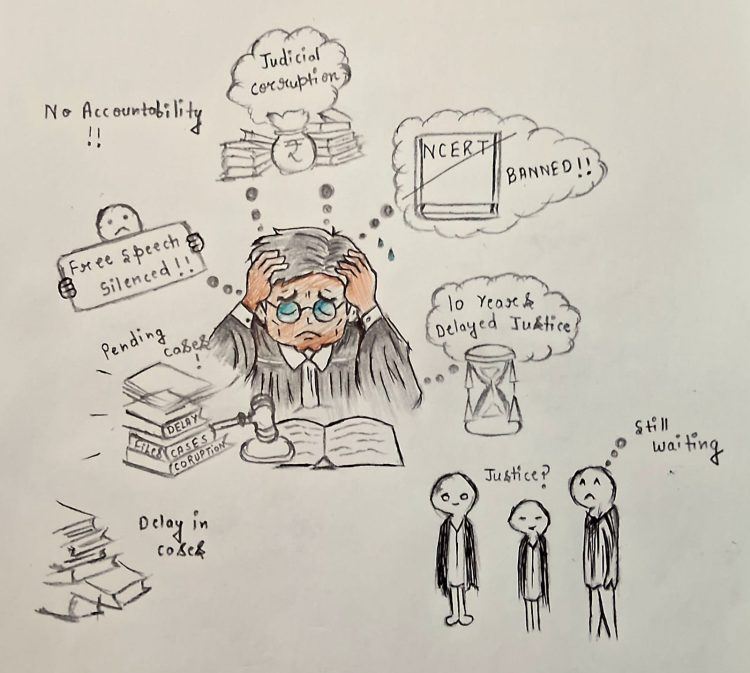
The Indian judicial system is a paradox: it is one of the most complex and slowest judicial system in the world, yet it remains one of the most trusted bodies of the country. Every Indian citizen holds an unspoken reliance on the courts, believing the judiciary is one of the few democratic pillars that function effectively to keep our vast nation on track. However, recent events have exposed deep loopholes and a growing sense of judicial monopoly. Certain cases have shaken public faith, highlighting a structural dominance that occasionally feels “overpowered.”
The NCERT Controversy
To understand this deeply, consider a recent addition to the NCERT Class 8 curriculum titled “The Role of the Judiciary in Our Society.” This 18-paged chapter enlists the importance and functioning of the system, but the final four pages address the judicial corruption and the massive case backlog.
In response, the Supreme Court of India reportedly registered a sua motu case and enforced a blanket ban on the book and its author. NCERT apologized, and the Court stated that any new version must be reviewed by an expert committee. The Court expressed concern that such content could destroy a student’s trust in the judicial system.
Freedom of Speech vs. Judicial Image
Following this incident, a law student posted a critique of the judiciary online. His college reportedly faced immense pressure from judges and lawyers to have the post removed. Such incidents call into question the very essence of the judicial system. If the Court is worried about “mistrust” among students, how does silencing a student practicing free speech build that trust?
The Paradox of Public Trust
The judiciary exists in a dilemma or perhaps it seeks to create one by maintaining the facade that it is functioning perfectly and standing up for our rights. However, it must face the harsh reality: for most citizens, the court is the last possible option. People only turn to the legal system when they have no other choice, primarily because they believe the system is incapable of resolving matters in a reasonable timeframe. A judiciary that was supposed to be the protector of our rights and free speech is now overusing its power to suppress the very speech that criticizes it. This is not a demonstration of firm policy; it is pure judicial hypocrisy.
The Myth of Accountability: The Justice Verma Case
We saw a clear example of this in the recent Justice Verma case. Despite significant evidence, an FIR was only filed after massive public backlash on the internet. Even then, the “punishment” was merely a transfer from the Delhi High Court to the Allahabad High Court. While he was facing the process of impeachment, he resigned on April 9th.
It is a telling fact that no sitting judge in the history of the High Courts or the Supreme Court has ever been successfully impeached. By resigning before the process is complete, these judges continue to receive their pensions and all the benefits afforded to a retired judge. These cases reveal a mindset of protected corruption within the judiciary. To state it bluntly: the system is designed to shield its own.
The Crisis of Accountability and Backlog
The statistics are startling. According to reports, nearly 8,600 cases of corruption have been filed against sitting judges, yet almost none have resulted in removal, and very few are even under inquiry. This type of misconduct is enough to erode public faith.
Furthermore, data shows a staggering crisis of mismanagement:
•Total Pending Cases: Nearly 5 crore (50 million).
• Chronic Delays: 40 lakh (4 million) cases have been pending for over 10 years.
• Economic Cost: This backlog is estimated to cost nearly 2% of India’s GDP.
• Judge-to-Population Ratio: There are only roughly 20 judges for every 10 lakh people.
Conclusion: Power and Responsibility
My motive is not merely to criticize the judiciary, but to provide a reality check. As the backbone of our society, the judiciary must have the guts to face scrutiny and backlash. It should be held responsible for the immense power it wields.
While we must admit that in a country as vast as India, some misconduct is inevitable, the judiciary cannot hold ultimate power without accountability. It is a part of a larger system and must face its reality and admit its mistakes. As the saying goes: WITH GREAT POWER COMES GREAT RESPONSIBILITY.