
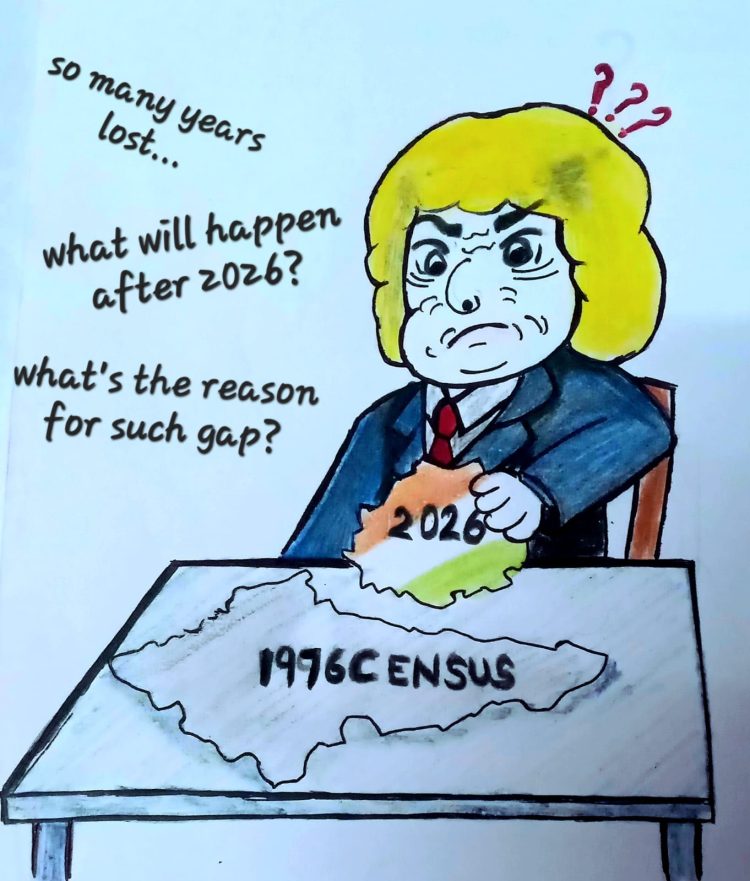
Lately, I’ve noticed that delimitation has become a topic many people are discussing, but not everyone sees it in the same way. On the surface, it sounds administrative – redraw boundaries, adjust constituencies, move on. But once you sit with it a little longer, it doesn’t feel that simple. It starts to raise uncomfortable questions about fairness, representation, and how different parts of India see themselves within the Union, especially southern states.
Reading recent discussions (especially in The Hindu), one thing stands out, southern states seem uneasy. And honestly, their concern is not hard to understand. If representation is recalculated strictly on the basis of current population, then states that controlled their population growth might actually lose relative political weight. Meanwhile, states where population kept increasing could gain more seats. It almost feels like a paradox… development not translating into representation.
When I tried to trace this back, I found the history quite important. Delimitation in India has happened four times, after the Censuses of 1951, 1961, 1971, and 2001. But what’s interesting is that only the first three exercises actually reshaped how many seats each state gets. The 2002 exercise (based on the 2001 Census) only adjusted internal boundaries. The bigger question, inter-state seat distribution, was left untouched.
That pause goes back to the 42nd Constitutional Amendment Act of 1976. At that time, there was a conscious decision that states that had taken population control seriously should not be politically disadvantaged. Later, this freeze was extended till 2026 through the 84th Amendment Act, 2002, and the 87th Amendment Act, 2003 allowed boundary readjustments without changing seat numbers.
From a constitutional perspective, the framework is quite clear, at least on paper:-Article 82 talks about readjustment of Lok Sabha seats after every Census-Article 170 deals with State Assembly constituencies and the actual exercise is carried out through laws like the Delimitation Commission Acts of 1952, 1962, 1972, and 2002.
Now with 2026 getting closer, that long standing freeze is about to end. And I think that’s why the conversation feels slightly tense, because this is not just a routine update. It’s more like reopening a compromise that was held for decades.
There are also some practical gaps. We still don’t have updated Census data, which feels like a basic requirement before any such exercise. Then there is the linkage with women’s reservation, something that adds urgency but also complicates sequencing. There is a lot of development going on simultaneously. Some basic points on delimitation (just to keep things clear):-
It is a constitutional process to redraw constituencies based on population. Conducted by an independent Delimitation Commission, whose decisions are final-Based on the principle of one person, one vote. Done 4 times so far (1952, 1963, 1973, 2002 Commissions). Seat allocation among states has been frozen since 1976, extended till 2026.The next exercise will happen after 2026, linked to a fresh Census.
When I think about the way forward, it doesn’t seem like a purely technical problem. Increasing the total number of Lok Sabha seats is often suggested, it sounds practical, maybe even necessary. But I feel the real issue is not numbers alone. It’s about whether states feel heard in the process. Because delimitation, at the end of the day, is not just about adjusting representation. It is about how India negotiates differences, slowly, sometimes imperfectly, and ultimately, how it sustains the spirit of cooperative federalism.
