
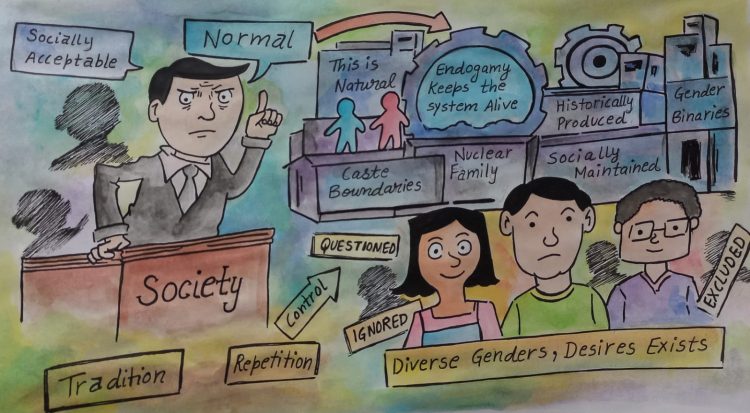
The claim that heterosexuality is “natural,” this essay argues, persists not because it is self-evident, but because it is continually reproduced as such. What often appears as common sense – that men and women are inherently different, that they are naturally drawn to each other, and that society is organized around this attraction through marriage and family – can also be understood as the outcome of historical and social processes.
From this perspective, while sexual reproduction exists across societies, the organization of life around compulsory heterosexuality, rigid gender binaries, and the centrality of the nuclear family does not automatically follow from biology. Rather, what is often described as heteronormativity can be seen as a system in which heterosexuality becomes a dominant framework for defining what is considered normal or legitimate.
This framework, as interpreted in various strands of social theory, aligns multiple aspects of life – biology, gender identity, desire, and family structure – into a single narrative. However, scholars have argued that these connections are not inherently fixed, but are shaped and maintained through social practices and institutions.
The essay further suggests that such norms are reinforced through everyday life, including family structures, education systems, media, and legal frameworks. These repeated patterns contribute to what appears as natural or inevitable social organization.
Drawing on thinkers such as Michel Foucault and Judith Butler, this perspective views gender and sexuality not as static or pre-given categories, but as shaped through historical processes, discourse, and repeated social practices. Similarly, the emergence of categories like “heterosexual” and “homosexual” has been interpreted by scholars as part of broader systems of classification and governance.
The essay also engages with materialist and feminist analyses, referencing Friedrich Engels and Silvia Federici, to argue that family structures and gender roles can be linked to economic organization, labour, and property relations. In this view, the division of roles within the family is not only cultural but also tied to broader socio-economic systems.
In the Indian context, the discussion draws on the work of B. R. Ambedkar, who identified endogamy as central to the reproduction of caste. From this perspective, the regulation of marriage and sexuality plays a role in maintaining caste boundaries. Dalit feminist scholars such as Sharmila Rege and Gopal Guru have further examined how these dynamics operate differently across social groups.
The essay also briefly situates these developments within the context of colonial and postcolonial governance, noting that legal and moral frameworks introduced during colonial rule have had a lasting impact on how gender and sexuality are regulated.
At the same time, the persistence of diverse gender identities and social practices is presented as evidence that such systems are neither uniform nor complete. The existence of communities such as the Hijra, for instance, highlights the complexity and variability of lived experiences beyond dominant norms.
In conclusion, the essay argues that what is often treated as “natural” may instead be understood as historically produced and socially maintained. It suggests that examining these processes can open up questions about how gender, desire, and social life are organized, and whether alternative frameworks are possible.
