
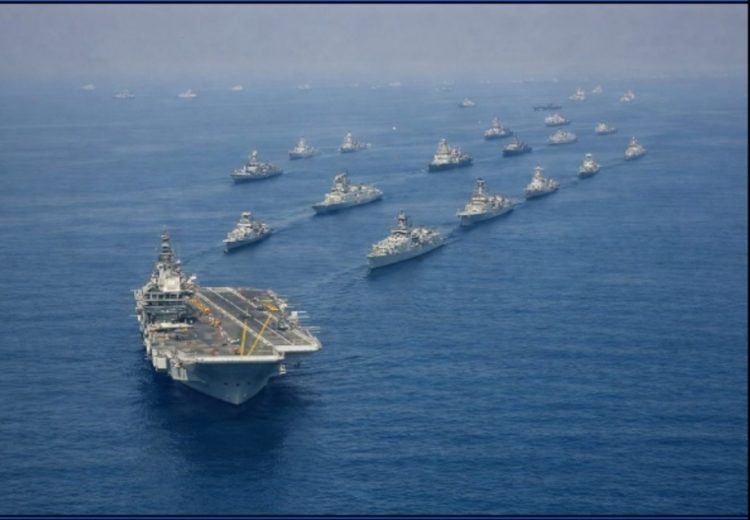
In recent times, global attention has returned to strategic maritime chokepoints such as the Strait of Hormuz, where countries like the USA and other powerful nations
demonstrate their blue-water naval strength by imposing blockades on enemy shipping routes. Whenever we see such news, we naturally wonder about whether the Indian Navy has similar power and capability.
Yes, the Indian Navy does have the power to blockade an enemy country. One historical example was demonstrated during the 1971 Indo-Pakistan War through Operation
Trident and Operation Python. During that time, the Indian Navy effectively blockaded West Pakistan from East Pakistan. No ships could enter the Bay of Bengal due to the fear of INS Vikrant and the strong naval presence.
However, we must remember that those events happened in 1971, and it is now 2026. A lot has changed since then. The modern Indian Navy is significantly more advanced and capable in terms of technology, strategy, and reach. Today, the Indian Navy is considered one of the most powerful navies in the world and is often ranked around the 7th position. It operates a large and modern fleet of approximately 350 ships and submarines in active service.
Today, the Indian Navy is no longer just a regional coastal force—it is widely recognized as a blue-water navy, capable of operating across the Indian Ocean and beyond.
Fleet Strength (Updated Reality)
The Indian Navy currently operates around 130–140 commissioned warships and submarines (not 350 active warships).
The larger number sometimes quoted (300+) includes auxiliary vessels, support craft, and coast guard-type assets, not frontline combat ships.
Aircraft Carriers & Capital Ships
India now operates two aircraft carriers:
INS Vikramaditya – a refurbished Russian carrier
INS Vikrant (IAC-1) – India’s first indigenous aircraft carrier
These platforms give India true carrier strike capability, allowing air operations far from its coastline.
Modern Combat Capability
Missile & Strike Power
Advanced BrahMos supersonic cruise missiles (joint India-Russia system)
Long-range anti-ship and land-attack capabilities
A precision strike doctrine focused on sea denial and sea control
Submarine Arm
Diesel-electric submarines (Scorpène-class)
Nuclear-powered ballistic missile submarine Arihant-class
Stealth and deterrence-based underwater warfare capabilities
Surveillance & Networking
P-8I long-range maritime patrol aircraft
Satellite-supported maritime domain awareness systems
Network-centric warfare integration across fleets
Strategic Role Today
The Indian Navy today is focused on:
Securing the Indian Ocean Region (IOR)
Protecting sea lanes of communication (SLOCs)
Anti-piracy operations near the Horn of Africa
Humanitarian assistance and disaster relief (HADR)
Balancing growing naval presence of China in the Indo-Pacific
The Indian Navy is focusing on becoming a stronger and more modern force in the coming years. It plans to increase its fleet with new aircraft carriers, submarines, and advanced warships to protect the Indian Ocean region. More attention is being given to indigenous production under Atmanirbhar Bharat, reducing dependence on imports.
The Navy is also investing in new technologies like drones, cyber systems, and satellite surveillance. Strengthening maritime security, safeguarding trade routes, and improving coordination with friendly countries are key priorities. Overall, the aim is to ensure security, quick response capability, and a strong presence in the Indo-Pacific region.
Your message has been sent

Future project of Indian Navy
Third aircraft carrier (IAC-2 / INS Vishal) Project-75I advanced submarines
Nuclear submarines expansion (e.g., INS Arihant)
Next-generation destroyers (Project 15B) Advanced frigates (Project 17A)
Naval aviation (new fighter jets & helicopters) Unmanned systems (drones, UUVs)
Once a Legend said: ‘When the Indian Navy goes to war, it changes the world map’
