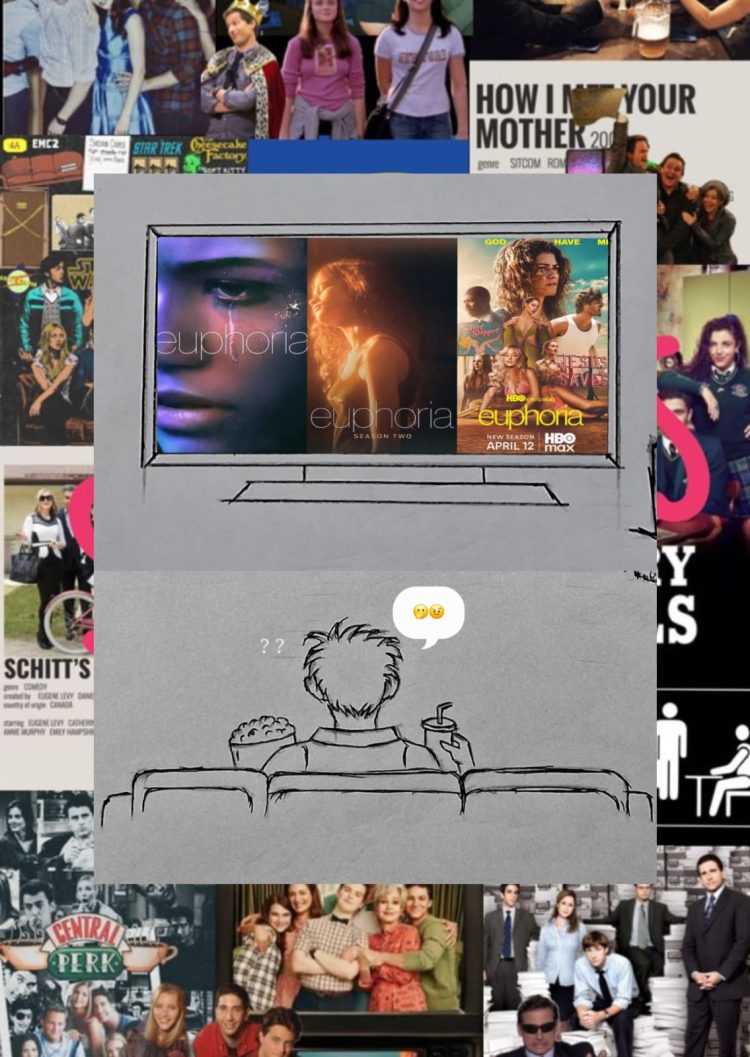
There is something deeply unsettling about watching a scene from Euphoria float across your screen like debris, the kind of content that forces even the most open-minded viewer to pause, sit with the discomfort, and ask: Is this it? Is this what we have become, or more dangerously, what we are being told we are? We are perhaps witnessing the slow, unglamorous death of the sitcom as a cultural institution. Not a sudden collapse, but a quiet erosion–the kind you only notice when you look back at what once was. Think of Friends, of Seinfeld, of Two and a Half Men– shows where characters had the full, complicated weight of personhood. You loved them. You hated them. You were stunned by them. They were flawed in the ways that actual human beings are flawed: inconsistently, sometimes comically. The pillowy lips of a blonde woman sashaying across a sun-drenched set in a fur coat, set to a pop song rising gently in the background, do not carry the same charge. Novelty is not the same as depth, and spectacle is not the same as story.
What made the older generation of television so enduring was its willingness to portray the mess of ordinary life without aestheticising it beyond recognition. Teenage angst, in particular, was once handled as something close to sacred, a transitional state so delicate, so interior, that to dramatise it was an act of artistic courage. The experience of becoming an adult was shown in its nuances: the quiet embarrassments, the stumbling toward identity, the grief of leaving childhood behind. It was imperfect, and that imperfection was the very thing that made it resonate. It was not a performance.
It did not require a soundtrack. Sitcoms have always had a responsibility to reflect the times we live in, and at their best, they did so with warmth and acuity. But somewhere in the last decade, that mirror cracked. What we are handed now is a carefully polished surface that reflects only a sliver of human experience at us, the most extreme, the most marketable, the most sensational and then presents it as a universal truth. Their grand mediocrity creates a dangerous illusion: that to be human is to be perverse, broken, self-destructive, adrift in a haze of dysfunction and desire with no compass and no consequence. This matters because the media does not simply describe culture; it participates in shaping it. The images and narratives we consume become parameters against which we quietly, often unconsciously, measure ourselves and each other. When every character on screen is defined by their damage, we begin to internalise these as norms. And yet not everyone watching comes from the rarefied social class being depicted.
Not everyone’s life resembles the neon-lit excess on screen. The working and middle classes, the vast, unglamorous majority, are largely invisible, their interiority apparently too undramatic to be worthy of serious exploration. There is nothing inherently wrong with examining the cruelties of the upper class or with exploring the darker facets of human psychology. Literature has always done this. But there is something insidious in how current television conflates complexity with degeneracy, as though the only way to create a nuanced character is to build their entire identity around their brokenness. All of these shows seem to pass through the same invisible conveyor belt, different products, different titles, different casts, but all bearing the same residue. A blueprint has been unblocked, and it is being replicated endlessly. The post-pandemic media landscape is, as any cultural researcher would recognise, a peculiar and fertile field of study. What has truly shifted is not simply what is being made, but how it is being deployed. Characters are not written so much as they are engineered, carefully assembled to speak directly to the psychological vulnerabilities of a generation raised on anxiety, alienation, and algorithmic validation. They are mirrors designed to confirm the worst of what we suspect about ourselves, and in doing so, they keep us watching. Consider Oscar Wilde; here was a man for whom his identity was genuinely his life’s greatest struggle, a struggle that cost him dearly, both personal and publicly catastrophic. And yet his works were not reducible to that struggle. They had class. They had wit. They had a breadth and a dignity that came from a well-read, deeply observant mind turned outward onto the world, not merely inward onto itself. His queerness informed his vision without consuming it. That is the distinction I wish today’s writers and directors would sit with: why has sexuality — hetero or otherwise become the sole organising principle of a character’s existence? Why is dynamism treated as an anomaly? Is it so radical to imagine a person who is invested in their work, their friendships, their intellectual life, their hunger to understand the world and who also, incidentally, has a body and a desire? Are we so committed to the theatre of transgression that we have forgotten how to write a human being?
The fear is not that these shows are dark. Darkness has always been the province of great art. The fear is that they are narrow, and that in their narrowness, they are quietly engineering a way to feel nothing beyond a numbing, consuming bodily urgency—to mistake sensation for experience, performance for truth.