
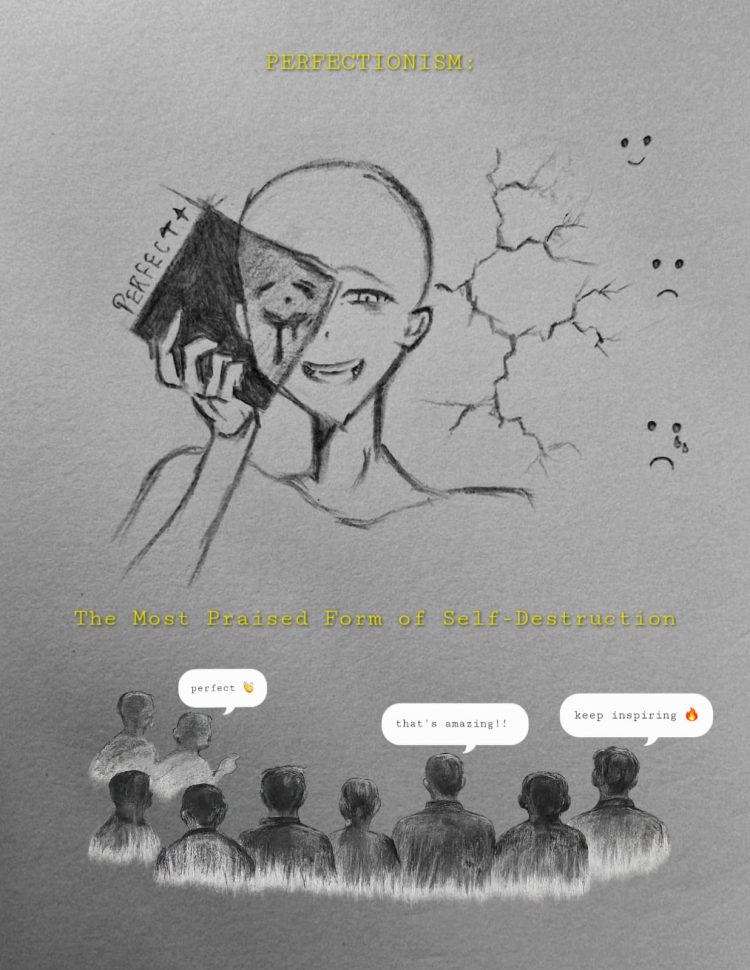
Exhaustion is glorified in our society.
People parade their sleepless nights and their emotionally draining experiences as a sign of extreme ambition. The need to be perfect was once considered obsessive behavior, but today it has been wrongly interpreted as self-discipline, productivity, and “high standards.” It is praised by society based solely on its appearance—beautiful grades; beautiful looks; beautiful social status; beautiful happiness; etc. However, underneath this beauty is a person who is suffocating from the weight of never being “enough.”
Perfectionism could be considered as the one form of self-destructive behavior that is openly accepted and even congratulated.
At first glance, perfectionism may seem harmless. It starts off innocently as the desire to improve yourself or to become better at something. Eventually, your need to better yourself will turn into a compulsive obsession. Instead of studying to learn something new, you do it out of fear of failing. Instead of writing because it brings you pleasure, you write for others’ approval. And instead of letting yourself be yourself, you only put on a show for the acceptance of others. Your worth is determined by what you’ve done, and making mistakes can be a truly horrifying ordeal.
Ironically enough, perfection does not exist. Humans are flawed and will always have flaws. We forget, fail, hesitate, cry, break and rebuild; that’s what being human means. However, society has convinced us that having flaws is unacceptable, being vulnerable is weak and that you must earn rest through suffering.
This is especially true for today’s youth; social media has turned everyday life into a competition. The youth is supposed to be beautiful, gifted, smart, successful, socially engaged, emotionally mature, and financially independent by the age of 25 years. As such, many people are pursuing an illusionary persona rather than working on developing their own personality.
However, one of the most tragic elements of perfectionism is its promotion of a sense of importance for those things that will never bring about any satisfaction in the long run.
A beautiful body deteriorates with age. Fashions come and go. External reinforcement shifts with variations in collective opinions. But true character – compassion, concern, integrity, emotional maturity – has an enduring influence, even when physical traits have lost their significance. Intelligence is not solely measured by one’s ability to memorize information; it is measured by inquiring, wise, and brave responses to our surroundings. A person’s character is demonstrated in both their successes and their failures, particularly in the absence of witnesses.
The willingness to learn is the only asset of greater worth than the false comfort of believing one already knows everything.
An individual who continues to pursue knowledge will always be well-connected internally. They will continuously develop and expand their consciousness, no matter how egotistical they may have been previously. Intelligence is not demonstrated through arrogance; intelligence is exhibited through humility. Intelligence acknowledges that, despite how much is known, there is always more to learn and understand. The world’s greatest thinkers are not defined by their quest to present themselves in a flawless manner, but rather by their willingness to accept what they do not know.
Perfectionism can suppress someone’s desire to learn by making them too afraid of making a mistake and therefore lacking the motivation to try new things. This fear is often compounded by the fear of being seen as a novice, the fear of asking questions and the fear of failure. As a result, when you see someone achieve a high level of skill, they arrived there as a beginner, a writer that wrote bad sentences and a scholar that misunderstood the most basic of concepts. Growth has never occurred as a result of having achieved perfection but has always resulted from consistent effort.
A meaningful existence is not contingent on presenting a perfect image to the world; rather, it is determined by the amount of wisdom, kindness, strength and awareness developed over time.
The world does not need more perfect individuals; It requires more individuals whose primary concern is integrity rather than their outward image; more individuals whose concern is more about nurturing wisdom rather than seeking affirmation; and more individuals whose main concern is more about learning rather than protecting their own egos. An individual with high integrity and open-mindedness adds much more value to society than one who looks like a success.
It’s likely that the true purpose of life is not to attain perfection, but rather to evolve and grow as individuals who accept that we may never truly achieve complete perfection.
At the end of our life, however, we tend to admire those who have been imperfect rather than those who were flawless. We admire those who maintain their humanity throughout their lives in a world consumed with the idea of being perfect.
