
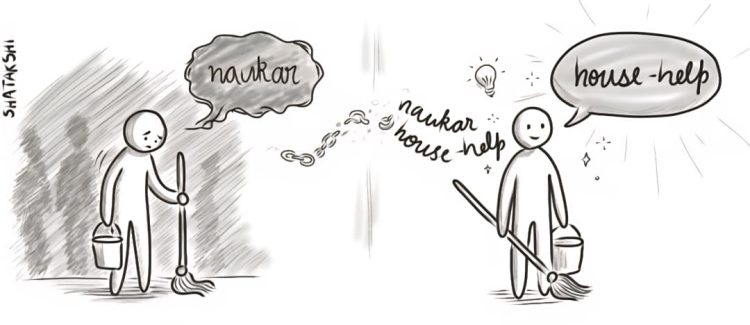
Language has a powerful way of communicating ideas and thoughts. The types of words we use can illustrate not only how we think, but more significantly, what we have accepted as part of the social fabric of our culture. I was reminded of the power of language while sharing lunch with several friends recently, when an unexpected conversation arose between my friend and me. I was enjoying a meal with my friends when our conversation was flowing so well that we were laughing and joking with one another. Sometime during one of these fits of laughter, I casually said “naukar,” and did not even think anything of it. I didn’t mean any harm by it; it was simply a very popular phrase I had heard many people say throughout my life.
As soon as I said it, I was corrected by my friend; she said I could say “house-helper” instead of “naukar.” This was met with much resistance on my part, because I argued to her that “naukar” isn’t a bad word. Technically, I was correct in saying there was nothing wrong with the word “naukar”; the word was never meant to be coined as an insult. However, she went on to explain some of the issues with language and how our use of it shapes our view of society.
As she points out, “It’s not as much the typical or true ‘dictionary’ definition of a term as it is what a term has meant to a culture over time and how a society has treated people (or used that word) for a very long time. To one person, the word may seem completely innocent; however, to another person, that word has been a source of embarrassment or discrimination for their whole life.”
The term “naukar,” which derives from Persian and Urdu references, refers to someone who has been employed as a servant, attendant, or personal worker for another. It has gone from its use in feudal and colonially focused societies to describing a rigid class system and how people have often been treated based on class. Thus, over the years, most people in South Asian culture have associated the term with a message of inferiority/subordination, even when the term was not intended to be used with disrespect.
Due in part to this association, many people today have chosen to use words/phrases such as “house-help,” “domestic worker,” “caretaker,” and “house assistant” instead of “naukar.” These words/phrases place a value on the dignity of the ‘work’ performed, while ‘naukar’ only describes a person by their ‘servant’ role. Those other words also express a more positive view of the ‘work’ being done (i.e., a greater sense of contribution)
An individual who performs any type of household duties (cooking, cleaning, washing dishes, caring for children, and other household-related tasks) should be viewed equally to individuals who do non-household duties, as they too work towards providing valuable service to others and make our lives much easier. In many families, domestic workers quickly become integrated within the daily functions of that family.
Domestic workers generally rise early in the morning, work long hours, and assume responsibilities that many other people often overlook or take for granted. The word house-help removes the “higher” to “lower” focus and puts emphasis on how the house-help has assisted in supporting running the home rather than implying they are below those in the home. This subtle change in language usage may be an initial step to assisting in changing our perception and interaction with one another.
Another thing I realised is how normalised classism is in India. Hierarchies are so commonly accepted, from how people treat domestic workers to how we create a gap between ‘owners’ and ‘servants’. Many people aren’t even aware of how deeply embedded class divisions are in our language. In many countries, particularly more progressive ones, there is an increasing trend toward ‘dignity-first’ language. For example, the terms ‘domestic worker’, ‘caregiver’ and ‘house assistant’ may be used, as they both acknowledge the contribution these workers have made but also do not demean them or put them in a lower socio-economic group. India is still a long way off from being able to unlearn many of our ingrained classist behaviours, while the rest of the world is slowly trying to move toward equality and respect in our daily interactions.
What most struck me during this conversation was not just the correction, but the intent behind it. My friend was not policing my language for the sake of appearing politically correct, but instead asking the question:
‘Why not choose words which are respectful of the human being when we have the option to do so?’
And honestly, I still think about that and the agreement I made then… I still have that in my mind now!
The way we think about things, the way we communicate; the use of language creates how we perceive something and relates to us in many aspects of our lives.
Through generations, words spoken repeatedly over time will shape perceptions of how one person sees other humans, not just how they respect one another, but also how they are treated based on those perceptions.
Using a different term or word to describe a worker (i.e. using the term: “House-Helper” in place of “Naukar”) will not immediately cause all forms of inequality (social, class, work exploitation) to cease to exist; however, it can show an attempt to view others with empathy and equality. Also, this shows us that no matter what profession, every person has dignity and there is no honest work that is labelled as inferior.
That lunchtime exchange provided me with a very insightful lesson about how we can learn about growth through simply interacting and talking to someone else; it doesn’t require grand speeches to change our lives but may come from an ordinary conversation with an individual, challenging something you’ve said all your life and never giving it a second thought.
What I learned that day changed the way I see things, and I hope it will do the same for you.
Thank you, my friend, for sharing this with me!
I guess this is how the world transforms, through numerous conversations, periods of discovery, and gradual changes in vocabulary.
