
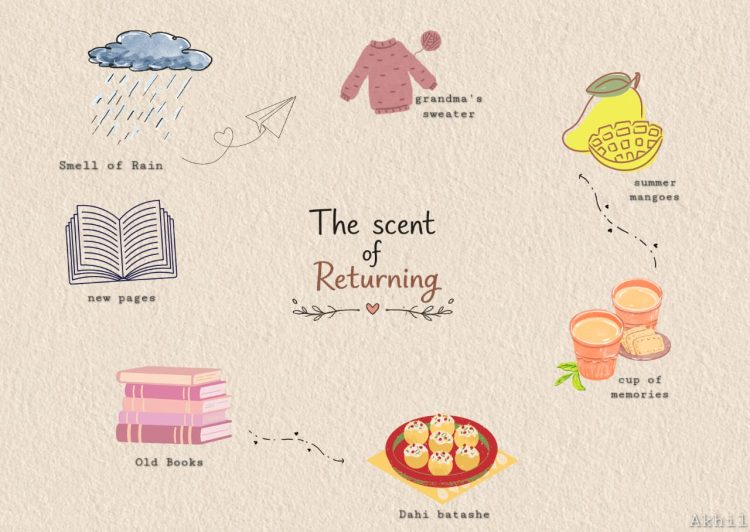
I often find myself revisiting old conversations, replaying vanished summers, searching for familiar songs, and craving familiar tastes. It makes me wonder whether human beings live more in memory than in the present, forever trying to return somewhere.
We spend much of our lives looking back. We replay moments long after they have ended, searching for traces of people, places, and versions of ourselves that no longer exist. Yet memories do not emerge from nowhere. They are built from rituals so ordinary that we rarely notice them while they are happening.
We like to believe that we understand the world through reason. We speak of consciousness, critical thinking, reflection, and awareness. We imagine ourselves as creatures who arrive at meaning through thought alone.
Yet before thought comes sensation.
Before we know what a place means, we know how it smells.
Every place, every person, every season carries an invisible signature of its own, an olfactory identity, a texture, a taste, a particular arrangement of light and sound that quietly settles into the body and waits there.
I spent many childhood summers at my grandmother’s house. I do not remember every conversation that happened there. I cannot reconstruct every afternoon that I had spent there. Yet I remember the smell of that place: the scent of wet mud rising after the rain and spreading through the aangan; mustard seeds crackling in hot oil somewhere in the kitchen; the sweetness of ripe mangoes hanging in the heavy summer air.
Years have passed, but those fragrances remain untouched by time, surviving where language fails.
There are people whose faces I have forgotten but whose presence still linger in stranger forms. I barely remember my best friend from fifth grade. Yet if I were handed one of the parathas her family used to make, I think I would recognize it instantly.
The tongue remembers what the mind abandons.
Perhaps that is why I always smell a new book before reading it.
It is an irrational ritual, but one I follow instinctively. The fragrance of fresh pages feels like a promise, as though an unopened book carries an atmosphere of its own. The smell of old books feels different, older, slower, almost sacred, as though they have absorbed fragments of the decades through which they have travelled.
Sometimes I wonder whether we should judge a book by its smell. Not because it tells us what the book contains, but because it reminds us that every book exists not only in ideas, but also in time.
The scent of old paper feels less like an object and more like a doorway.
My grandmother is gone now.
Yet every winter, when I take out the woollen cardigans she knitted by hand, I encounter her again, as a memory, as a photograph,but mostly as a presence.
The wool still carries something of her, a faint trace, impossible to describe and impossible to mistake.
For a moment, she is there.
Every time I eat dahi batashe, I think of my sister because that was always our order. Every time I see a kiwi fruit, I laugh at the memory of ordering an expensive kiwi mojito, convinced it would be the most sophisticated drink in town, only to discover that it was deeply disappointing.
Objects become stories.
Stories become memories.
Memories become parts of ourselves.
Once, while walking through a friend’s garden, she introduced me to every tree and plant as though she were introducing old friends. We stopped beside each one. We smelled leaves. We tasted fruit. We exchanged stories.
When we reached a guava tree, she told me how she used to climb it as a child. Then, almost playfully, we wrapped our arms around its trunk and hugged it.
I remember feeling an unexpected peace.
The tree had stood there through seasons, storms, childhoods, and departures. It seemed to contain time differently from us, more patiently.
Life is not made meaningful only by achievements, ambitions, or grand revelations.
Sometimes meaning emerges from paying attention.
From noticing the smell of rain before a storm.
The taste of a familiar meal.
The rough bark of an old tree.
The scent lingering in a sweater knitted by someone who is gone.
A quiet walk with a friend.
We spend so much of our lives searching for extraordinary experiences that we overlook the miracle hidden inside ordinary ones.
Perhaps the purpose of living is not merely to pass through the world, but to allow the world to pass through us.
To be marked by it.
To let places, people, seasons, and small rituals leave their traces upon our senses until they become part of who we are.
And maybe beauty is nothing more than this:
To live so attentively, so immersively, and so lovingly that one day even the smell of rain can return an entire universe.
