
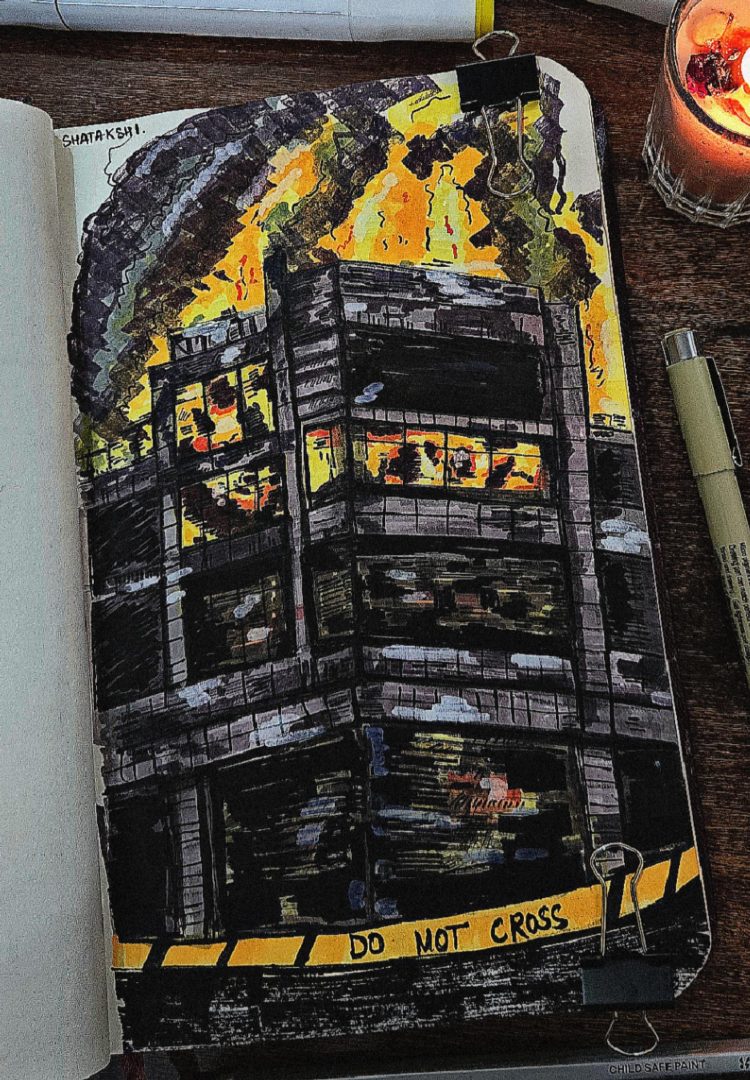
There are some places that become part of your life without you ever entering them.
For me, this was one such building.
Every day on my way to the University of Lucknow, I would pass the commercial complex in Aliganj. It was impossible to miss. On the ground floor was a large pet store— its glass façade lined with colourful toys, treats, leashes, scratching posts and cages. I don’t even own a pet, yet I found myself glancing at it every morning. There was something oddly comforting about seeing it. Amid the rush of rickshaws, lectures and deadlines, it was a small reminder that life could also be gentle.
Then, one afternoon, it disappeared.
Not physically. Structurally, the building still stands. But the place I had unknowingly woven into my daily routine became something else overnight. It became a crime scene. A site of mourning. A place where dreams ended before they had the chance to become lives.
A devastating fire tore through the building, killing at least fifteen people—most of them young students attending an animation training centre housed inside the complex. Survivors described dense smoke filling staircases, trapping people inside. Some reportedly broke windows and jumped to escape. Others never made it out.
The building I smiled at because of a pet store had become the last place many students would ever see.
And perhaps that is what disturbed me the most.
Not simply the fire.
But how ordinary the place had always seemed.
Whenever a tragedy like this occurs in India, we almost instinctively know what comes next.
The condolences.
The compensation.
The promises of strict action.
The announcement of a high-level inquiry.
Questions suddenly emerge.
Did the building possess the necessary fire safety clearances?
Were emergency exits functional?
Were inspections carried out?
Who signed the approvals?
Were safety norms actually followed?
These are necessary questions.
But every time I hear them, one thought keeps returning.
Why are we asking them only after fifteen people have died?
If compliance certificates, fire safety audits and inspections exist to prevent disasters, why do they become subjects of public discussion only after a building turns into a funeral ground?
A safety system that awakens only after lives are lost is not merely inefficient. It defeats the very purpose for which it exists.
Following the Aliganj fire, the Uttar Pradesh government ordered a Special Investigation Team (SIT), suspended several officials, initiated arrests and directed statewide inspections of coaching centres and commercial establishments. Authorities have said the investigation will examine possible safety lapses and determine responsibility.
These actions are important.
But they also expose an uncomfortable pattern.
It often takes catastrophe for institutions to discover urgency.
Across the country, inspections suddenly become rigorous only after disasters. Buildings are sealed. Licences are scrutinised. Emergency exits are checked. Fire extinguishers are tested. Notices are issued.
The same procedures that could have prevented tragedy suddenly become a priority because tragedy has already occurred.
This cycle has become so familiar that it almost feels institutionalised.
We are remarkably efficient at reacting.
We remain far less committed to preventing.
What makes this incident particularly heartbreaking is not merely the number of lives lost.
It is who those lives belonged to.
Young people.
Students.
People who had left their homes believing they were walking into classrooms.
Parents send their children to coaching institutes because they believe education is an investment in the future. Every notebook purchased, every tuition fee paid, every bus ride undertaken carries a silent promise—that the child will return home.
Safety is not something parents consciously negotiate every morning.
It is assumed.
It should never have to be negotiated.
There is another uncomfortable truth hidden beneath this tragedy.
Our cities increasingly depend on commercial buildings that have gradually evolved beyond what they were originally designed for.
A pet store below.
An animation institute above.
Gaming facilities.
Offices.
Libraries.
Training centres.
Different activities stacked floor upon floor inside structures that thousands of people enter every day simply because they exist.
Normalcy creates trust.
If a building has been operating for years, we instinctively assume someone has ensured it is safe.
Most of us never ask to see a fire safety certificate before entering.
Nor should we have to.
That responsibility belongs elsewhere.
Perhaps this is what frustrates so many citizens.
Not that accidents happen.
No society can eliminate every accident.
The frustration emerges when preventable risks repeatedly become visible only after irreversible consequences.
If investigations eventually establish violations, then one question becomes unavoidable:
Why were those violations not identified earlier?
And if investigations conclude that all procedures had indeed been followed, then another question arises:
Why did those procedures fail to protect the people they were designed to protect?
Either way, the public deserves answers.
Not merely punishment.
Answers.
As students, we often speak about examinations, placements and careers.
Rarely do we speak about whether the buildings in which we study are themselves safe.
That silence exists because safety has always been treated as invisible infrastructure.
We only notice it when it disappears.
Much like electricity.
Or oxygen.
Or trust.
This tragedy also forces us to reconsider what governance should mean.
Good governance is not measured by how efficiently compensation reaches grieving families.
It is measured by how few families require compensation in the first place.
It is not measured by how quickly inquiry committees are constituted.
It is measured by how effectively inspection mechanisms function before an inquiry ever becomes necessary.
The true success of regulation is not visible after disaster.
It is visible in disasters that never happen.
As I travelled to university after the fire, I found myself instinctively looking toward that building again.
The pet toys were gone.
The bright storefront was gone.
Instead stood barricades, police personnel, cameras and silence.
The route remained unchanged.
I had changed.
Because now, every commercial building I pass raises questions I never asked before.
Are the exits clear?
Would people escape if something went wrong?
Has anyone actually checked?
Or are we simply waiting for another headline before we begin inspecting again?
Perhaps the most frightening thing about the Aliganj fire is not that one building caught fire.
It is that tomorrow, millions of Indians- including me- will walk into schools, coaching institutes, offices, hospitals and commercial complexes believing that someone, somewhere, has already ensured they are safe.
We trust systems we cannot see.
When that trust is broken, the damage extends far beyond one building.
It begins to erode faith itself.
Because a nation cannot be governed on condolences.
It cannot be regulated through posthumous accountability.
And it certainly cannot continue treating every preventable tragedy as the first warning sign.
Some alarms are meant to ring before the smoke appears.
