
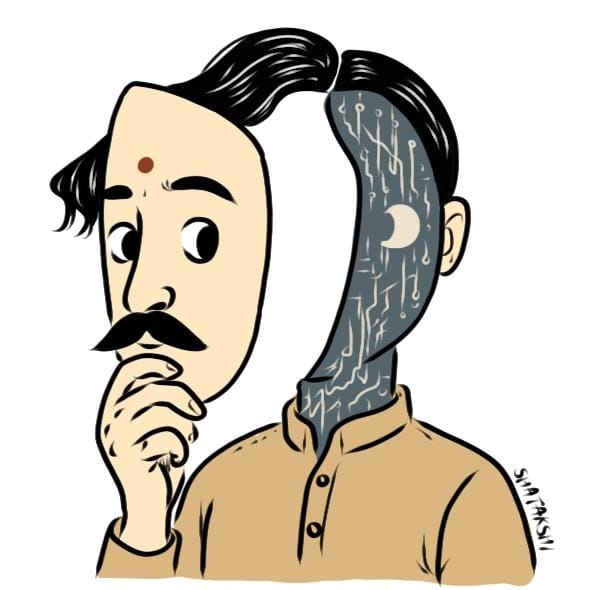
There are certain moments in life when you suddenly realise that technology has gone a little too far.
For me, that moment came when I discovered that my mother had been listening to Osho on YouTube.
Now, there is nothing particularly strange about my mother listening to Osho. She likes spiritual talks, and Osho has been around long enough to have become a familiar name in Indian households. What was strange was that she had been listening to him almost every day for about a week.
One evening, I happened to hear his voice coming from her phone.
Something felt… off.
I listened for a while.
Then I looked at the video.
And there it was.
The title. The thumbnail. The familiar face.
But the voice wasn’t Osho’s.
It was AI.
My mother had unknowingly spent an entire week listening to a machine imitate a dead man’s voice.
I don’t know what disturbed me more: the fact that AI could imitate Osho so convincingly, or the fact that my mother hadn’t noticed.
Actually, I do.
It was the second one.
Because this wasn’t some futuristic experiment happening inside a Silicon Valley laboratory. Nobody had implanted a computer into her brain. She hadn’t knowingly participated in an AI demonstration.
She had simply opened YouTube.
And that, perhaps, is the most important part of this story.
We tend to talk about artificial intelligence as if it is something that is still arriving. We discuss what AI will do, what it might become, how it could transform education, employment, entertainment and politics.
But sometimes I think we are asking the wrong question.
AI has already arrived.
It is sitting in our phones.
It is writing emails. Generating pictures. Editing photographs. Creating music. Translating languages. Recommending videos. Answering questions. Cloning voices. Writing code. Making advertisements.
And increasingly, it is becoming almost indistinguishable from the people and things we already know.
That is where things become interesting.
My mother’s Osho episode was funny. At least, I found it funny.
I told her what had happened and she looked genuinely surprised.
And then came the inevitable question:
“But why would someone make a fake Osho?”
I had no particularly satisfying answer.
Perhaps because it gets views.
Perhaps because people click on familiar faces.
Perhaps because a familiar voice makes synthetic content feel authentic.
Or perhaps because we have entered a strange economic era where producing something that sounds real can be more valuable than producing something that actually is real.
And this is where I think the AI conversation needs to move beyond the usual “AI good” versus “AI bad” debate.
AI itself isn’t necessarily the problem.
The problem is that we are entering an age in which authenticity can no longer be assumed.
For most of human history, seeing was not always believing, but it was at least a reasonable starting point.
A photograph showed something that had probably existed in front of a camera.
A recording usually meant that someone had actually spoken those words.
A person’s voice belonged to that person.
A handwritten letter had, quite literally, passed through someone’s hands.
Now?
I can theoretically hear a politician say something they never said, watch a celebrity appear somewhere they never went, see a photograph of an event that never happened and listen to a dead philosopher give a lecture that was never recorded.
And the terrifying part isn’t that these things can be created.
The terrifying part is that they can be created convincingly.
We have spent centuries developing technologies to preserve human expression.
Now we have technologies capable of manufacturing it.
That distinction matters.
Consider my mother’s situation again.
She wasn’t looking for “AI-generated Osho.”
She was looking for Osho.
And the internet gave her something that looked and sounded sufficiently like Osho for the distinction to disappear.
That is a fundamentally different problem from simply knowing that AI exists.
It means the consumer has to become a detective.
Is this actually the person?
Was this actually said?
Was this photograph actually taken?
Did this interview actually happen?
Is this journalist real?
Is this voice authentic?
Is this quote genuine?
At some point, browsing the internet starts feeling less like browsing and more like forensic investigation.
And honestly, as a college student, I find that both hilarious and slightly terrifying.
We have grown up being told to “check your sources.”
Now we might have to check whether the source itself exists.
The irony is that AI may eventually make authenticity one of the most valuable things on the internet.
For years, the internet rewarded abundance.
More content.
More posts.
More videos.
More articles.
More podcasts.
More everything.
AI has now made abundance almost ridiculously cheap.
One person can produce what would previously have required an entire team.
A photograph can be generated without a camera.
A voice can be produced without a speaker.
A video can be created without the event ever happening.
An article can be drafted without the writer sitting down to write it.
So perhaps the scarce resource of the future won’t be information.
It will be trust.
And trust is a very strange commodity because it cannot simply be generated by pressing a button.
You cannot manufacture years of someone’s life.
You cannot manufacture the fact that they were physically present.
You cannot manufacture the awkwardness of a genuine conversation, the imperfections of a live performance, the peculiarities of someone’s handwriting, or the small mistakes that remind us that there is actually a human being on the other side.
Ironically, the more perfect our synthetic content becomes, the more valuable imperfection may become.
A slightly shaky photograph.
A voice cracking during a speech.
Someone stumbling over a sentence.
A writer making an oddly specific reference that an algorithm wouldn’t know to make.
A musician playing one note imperfectly.
These things used to be flaws.
Perhaps they will become evidence.
Evidence that somebody was actually there.
I don’t think we should respond to this by becoming paranoid about every piece of technology.
That would be absurd.
AI can genuinely make life easier. It can help students learn, assist researchers, help people with disabilities, translate information, accelerate creative work and open possibilities that were previously unimaginable.
The problem begins when convenience replaces judgment.
My mother wasn’t stupid for believing the voice she heard.
The technology simply became good enough to exploit an assumption that humans have made for thousands of years:
A familiar voice probably belongs to the familiar person.
That assumption is becoming obsolete.
And perhaps that is the real cultural shift AI is bringing.
We aren’t merely learning how to use artificial intelligence.
We are learning how to live in a world where artificiality can imitate reality extremely well.
Which means that, ironically, being human may become more valuable precisely because machines are becoming better at imitating us.
I now occasionally hear Osho playing from my mother’s phone and instinctively look at the screen.
“Real Osho?” I ask.
She rolls her eyes.
“Yes.”
“You sure?”
“Yes.”
“Did you check?”
“No.”
And then we both laugh.
But somewhere underneath that joke is a serious question.
A few years from now, will we still be able to laugh about it?
Or will verifying reality simply become another everyday chore?
Maybe the future isn’t going to be a world where humans are replaced by AI.
Maybe it will be a world where humans become increasingly desperate to find things that AI didn’t make.
And if that happens, I suspect the most valuable thing we can offer each other won’t be perfection, efficiency or endless content.
It will be something much older.
Proof that there was a person here.
