
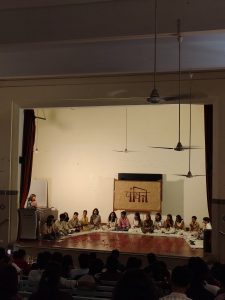
Haldar Hall, Fine Arts Department, became a space for poetry, emotions, and meaningful conversations as Pankti brought together young poets who participated and gave recitations of their poems predominantly in Hindi, Urdu, and English. Around 100 people came to the event at the Haldar Hall of the Fine Arts Department, where different poets conveyed their emotions beautifully and exchanged serious and heartfelt dialogues. The various poets took the audience through many facets of poetry that communicated sentiments that are very difficult to express in words.
The commonality among many people when they were reciting the poem was that they shared the themes of love, desire, and distance. The poets recited pieces in which they conveyed emotions of love using deep and strong words. Poetry that talked about the experiences of poets regarding love was recited, which is otherwise very difficult to put into words. Lines such as “Mera pyaar aaya meri qabr pe mujhe jalane ke liye” drew whistles and applause from the crowd, conveying the intensity of love and the ache of longing in just a few words.
One of the best parts about the Pankti was that poets received resounding acceptance there. House-deserved applause, approval, and excitement arose in the hall as soon as the lines were uttered. Actually, the audience often admired the lines long before they were delivered by the poets. Apart from that, some poets recited famous authors to make the event even more literary. All this contributed to the pleasant and friendly atmosphere in the hall.
At the same time, not only love and suffering were discussed at the Pankti. There were no less important poems about anger, patriotism, and the role of women in society. One of the most powerful lines is the following: “Main Sita nahi ban sakti, main Ahilya nahi ban sakti, main Kalyug ki naari hoon”. The message of the poem is that the ideal standards presented for women are unreal. It says that women do not need to be obedient and endure pain as is expected, nor do they need to be similar to such people just to fit into society.
Simplicity and the transience of things in life were a common thread in poems recounted that day, as echoed in the verse “Mujhe dhan na pasand aaye, mujhe bas shamshan ki pavitra dhool pasand aaye”. Poems about death being a reality and how to purify oneself were read as well, encouraging people not to get attached to worldly possessions.
The introduction of English poetry added another dimension to the program, as was evident from the line “I am running in a wild world.” The combination of languages, Hindi, Urdu, and English, gave Pankti a distinct character and made it clear that poetry is capable of expressing deep emotions irrespective of language.
Another interesting aspect of the event was the equal participation of male and female poets. They all presented their personal views of life and completely different ideas on how to write poetry. All of them had different experiences in life, different thoughts and ways of thinking, which contributed to the variety of the literary event.
The event was closed with an Awadhi poem and its dialect interpretation that impressed the listeners. This was a good ending of the event because attendees had a journey through different languages and emotions. The mention of the dialect of Awadhi made it clear that poetry exists not only in literary languages, but also in dialects, traditions, and native languages.
Pankti’s event gathered almost a hundred poets and poetry enthusiasts together in a setting that revelled in the power of words. The constant applause and enthusiasm demonstrated the connection of the audience with the poetry being recited. Each poem offered a fresh view on life, and every voice added something interesting to the event.
In essence, the event organised by Pankti shows that poetry is not necessarily about using complex and impressive language. It turns out that at times even a single line of poetry expresses more than an entire conversation. The poetry discussed topics such as love and loss, social pressure, death and culture, among others, enabling people to voice their ideas and feelings. The reading of the final lines in Awadhi proved that Pankti was much more than just poetry; the event became a place for expressing people’s thoughts and emotions.
