
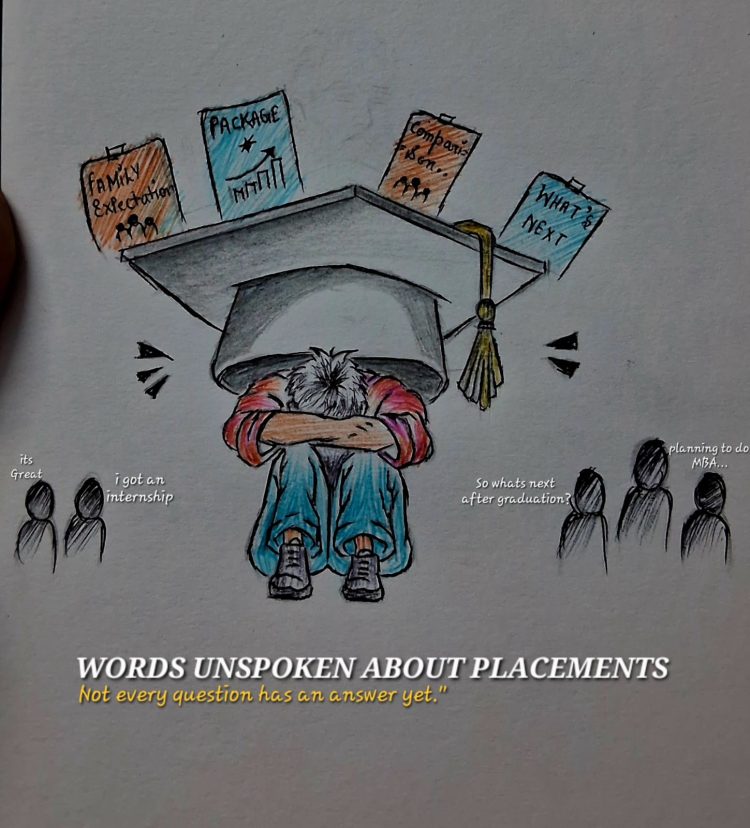
Everyone asks, nobody answers
One question that has eaten at my head since joining university: “Beta, aage ka kya plan hai?” It comes from relatives at weddings, from the neighbour on the stairs, from an uncle who has never asked how my semester went but always wants to know about my “package”. In first year, I used to laugh it off. By final year, I know a lot of us just answer with a vague “dekhte hain” and change the topic.
What nobody tells you is that most of the people around you are clueless too. In the department corridor, it looks like everyone is sorted. One friend is preparing for sarkari naukri, another is doing an internship, while some other has got referrals in a reputed company. Then you sit with the same people in the canteen at 5 pm, and someone says, quietly, “yaar, mujhe bhi samajh nahi aa raha.” The satisfying relief on every face at that table is hard to describe.
The Grim Paradox of Comparison
We all do it, and we don’t admit it. A friend posts about getting an internship, and I react with a heart, and I mean it; I am happy for her. Ten minutes later, I am lying on my bed doing math in my head about how far behind I am. Both feelings are real. The problem is that I am comparing my messy, unposted days with everyone else’s best announcement, which is not a fair match. In fact this is a loop we all are stuck in our daily lives.
“Follow your passion” is not advice for everyone
In seminars, the speakers always say to follow your passion and money will come. I totally get that. But a lot of us belong to backgrounds where the degree is not a random sheet of paper. It is the thing the family has been saving for, sometimes through a loan, sometimes through a mother’s savings she never mentions and sometimes through those tearing shoes of papa. When that is your situation, a risky first job is not an adventure. It is a conversation at home that you dread.
So many of us pick the safer option. Some are happy with it. Some keep a small “what if” with them for years. I don’t think either choice is wrong. I just wish we would stop acting as if everyone is paying the same price for it. And really become conscious that decisions should be made without the emotional cages we are all stuck in.
All of us have different starting lines
Some students enter an interview room with fluent English and a parent or elder sibling who has already worked in a corporate office and can explain how things go. Others, like many of us, practise “Tell me about yourself” in front of a hostel mirror and translate each sentence from Hindi in our heads before saying it. The talent in both groups is equal. The ease is not.
If you have ever gone blank in an interview because of the language and not because you didn’t know the answer, please don’t take that as a measure of your intelligence. You knew the answer. You just had to carry it across a language first. And that journey indeed is a difficult one.
The rejections nobody posts
People post offer letters. They do not post the seventeen applications that got no reply, or the group discussion where you said nothing because three people started talking at once and you waited for a gap that never came. Rejection mostly happens in silence. It looks like checking your email at midnight and telling your mother, “haan, process chal raha hai.” So often people tend to become stressed seeing other people’s glamorous lights but don’t know the dark night that prevailed before.
I have started to think of a “no” as a statement about one seat, one budget and one week, and not about me. It is harder to believe than to write, but on good days I manage it.
When resting feels like falling behind
Take one evening off, and the guilt shows up on time. Somewhere, someone is solving a mock test while you watch reels. So you end up studying with a tired mind and scrolling with a heavy one, and nothing gets done properly. Burnout does not arrive with a warning. For me, it looked like snapping at my friends, reading the same page for forty minutes, and saying “bas thak gayi hoon” for the fifth week in a row. If that sounds familiar, it is a sign to rest, not a sign that you are lazy. And believe me, the stuff you do after that rest will be next level.
One degree doesn’t define you
Underneath all of this is a belief we rarely question: that the course we chose at seventeen decides the rest of our lives, and that one wrong turn closes many doors. But if you look around, people switch fields, start all over again at twenty-six, and build things from scratch with a phone and a stubborn idea. The real path is messier than the brochure shows. Not everyone gets their result in placement season. Some people get it a year later, and nobody cheers for them, and nobody puts up a poster for them, but it still counts.
What has really helped
Nothing big. A friend asking “sach batao, tayyari kaisi chal rahi hai?” and meaning it. A senior who told me about her three failed interviews before she told me about the job she got. A teacher who said, “Come to my room, let’s look at your resume.” And saying “I’m scared” out loud and hearing two other people say “same”.
If the pressure is getting loud this year, try writing down what you are actually good at, not what sounds impressive on a form. Also write what scares you and start doing that thing again and again until it no longer does. Then pick one small thing for this week: one application, one skill, one conversation with someone a year ahead of you. After that, stop comparing for the rest of the day. It helped me more than I expected.
For those who already have an offer, For those who are having the best of both worlds
Congratulations, really. But please don’t make it an enormous deal. When someone asks “kaise hua?”, tell them honestly, including the parts that went the other way. Share your notes and your referral if you can. Someone is sitting where you sat not long ago and fighting the battles you valiantly fought, so be a generic one and help people cross the storms.
Last word
Placement season will end. The results will come in different shapes, some on time and some late, some loud and some quiet. What will stay with us is how we treated each other while we waited. So the next time someone asks, “beta, kya plan hai aage?”, it is fine to say, “abhi soch raha hoon” or “soch rahi hoon”. That is an honest answer, and most of the people asking were once giving it too.
So remain cheerful because it is going to be a journey worth cherishing.
