
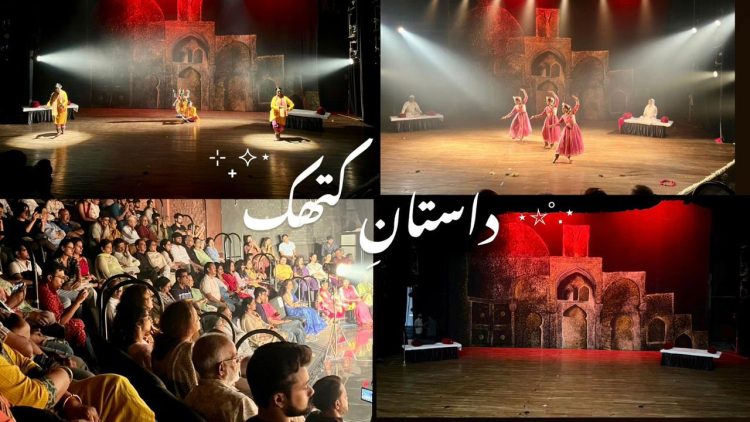
In Lucknow, the sounds that mark a life are ordinary: the cycle bell at dawn, the sputtering of an auto in traffic that refuses to move, the azaan threading through loudspeakers at dusk. For me, the one sound missing for about two decades of being born and raised in this city was the pulse of ghungroos on a wooden stage. Strange, isn’t it, to grow up in Lucknow, the seat of Kathak, and yet never have seen Kathak? That changed on a Sunday evening, when I went to attend Daastan-e-Kathak at the All-India Kaifi Azmi Academy.
The evening came alive with Trilay’s Daastan-e-Kathak, a production that traced the Lucknow gharana’s journey from devotional offerings in temple courtyards to the refined spectacle of Nawabi courts. It was not just a recital but a history lesson set to rhythm. Preeti Tiwari, Simran Kashyap, and Gauri Sharma danced as if their bodies were both archive and argument. The seamless blend of dance, music, and expression highlighted the subtle grace, etiquette, and delicacy that distinguish the Lucknow style.
The recital featured rubaai and vilambit laya compositions, alongside emotive renditions of the Kajri ‘Kankar Mohe Laag Jahiye Na Re’ and the Thumri ‘Kaun Des Gayo Saawariya.’ The musical canvas was adorned by tabla maestro Vikas Mishra, lyricist and singer Prakhar Pandey, eminent sarod player Hriday Emu Desai, harmonium player Dinkar Dwivedi, sitar player Neeraj Mishra, and sarangi virtuoso Zeeshan Abbas. Enhancing the stage further was a magnificent 150-meter backdrop depicting Nawabi architecture, painted by Vivekanand, a Fine Arts student at Lucknow University, along with Sanjeev, Aryan, Aastha, and Suraj from a private college in the city.
Written and directed by Salman Khayal, the production was enriched with dastangoi performed by theatre artists Abhishek Singh and Mini Dixit, who brought narrative depth to the performance. Dignitaries such as artist Anil Rastogi and Kathak guru Akanksha Srivastava were present on this sparkling evening.
Sitting before the stage, one cannot help but realize that Kathak is not simply observed but absorbed. The dancer’s ghungroos unfurled like an overture, each bell marking an intention until the floor itself seemed to reverberate as if complicit in the drama. The tatkār was flawless, precise yet fluid, mathematical in its alignment with the tabla but never mechanical. And then came the chakkars: dizzying, controlled, a kinetic meditation in which centrifugal force gave way to grace. What astonishes most is the abhinaya, those infinitesimal shifts in gaze and gesture that carry the weight of epics. A raised brow could summon a battlefield, a half-smile could dissolve into a monsoon of longing. The performance became less about spectacle and more about transmission: of rasa, of centuries-old storytelling, of an intimacy between performer and audience that transcends language. By the end, one did not applaud so much as exhale, aware of having been entrusted, briefly, with the secret of how rhythm and silence, motion and stillness, can coalesce into art.
But as the dancers spun in perfect circles, I felt myself split in two. On the stage were women telling centuries-old stories with their feet, their wrists, their eyes. In my head was the child I once was, the one who desperately wanted to be a part of something bigger , something that would set me free. And now what better to ‘set one free’ than art ?
That child was silenced, because I grew up in a household where such desires were frivolous at best, dangerous at worst. And so, obediently, I turned the volume down, shut the door on myself, and let that life remain a stranger. But watching the performance, I couldn’t help but feel the ache of what might have been.Kathak is storytelling, but it is also reclamation. Each tihai, each spin, insists on remembering what came before. That night, I felt it remember me. I was no longer a spectator but an orphaned child of this tradition, finally stumbling back home.
The hall, for all its grandeur, and beauty was filled mostly with faces weathered by time , men and women leaning forward with the weight of memory. They watched as though recalling something they had once known, a rhythm that belonged to their own youth. What struck me was not just who was present but who was absent. The absence was louder than the applause: the ones who claim culture online, the curators of taste and irony, were nowhere in sight. Which propelled me into thinking- Art doesn’t only die when its practitioners fade; it dies when its audience disappears. Worse still, when art is approached only as a credential, a way to signal belonging to some invisible “in” table.
Returning that night ,my journey came full circle , my ‘Tamasha moment’ as I called it when narrating it to my friends, when my auto driver corrected my singing. I had been humming absentmindedly, badly, and he laughed before finishing the verse for me in a voice so startlingly clear it almost silenced the traffic. He told me he always wanted to be a singer. That moment , for me , carried more rasa than most concerts. Maybe the audience has not vanished after all. Maybe it has shifted, gone underground, become anonymous in autos, late-night kitchens and university classrooms rushing between one assignment to the next. The tragedy is not that art disappears, but that we no longer recognize it when it brushes against us.
Which is why homecoming feels complicated. To return is not just to reclaim what was denied but to admit what is fragile. Kathak, like me, like us, survives in fragments. It dazzles under lights in academy halls, but it also gasps for breath in a city where its rhythms compete with ringtone jingles. There is beauty here, but also a precariousness , the knowledge that heritage can become performance, and performance can become museum piece.
Which forces you to realize how much of life is performance. Not in the theatrical sense, though the metaphor holds, but in the quiet rehearsals we carry out each day. There are scripts handed down by family, gestures borrowed from colleagues, words chosen to keep the plot moving. We perform so well that, after a while, we forget the role ever had a beginning, or that there might be an end.
This is the vanishing act of modern adulthood, not the glamour of disappearing on your own terms but the slow evaporation of self under the bright lights of responsibility. One day you look up and realize the applause stopped long ago, and you are still moving through the same monologue.
This self-actualization , contrary to popular belief, barely arrives like a revelation,or a sudden clearing of clouds, or a grand unveiling. It comes in fragments. In the uneasy pause when you stop mid-sentence, realizing you no longer believe the words. In the quiet recognition of envy, when you see someone living freely and admit to yourself that you want that too. In the odd tenderness of returning home and realizing you are both a stranger and native at once.It comes in sitting among crowds you could have belonged to, had the world looked kindly at children who made “bad art,” who sang “off beat,” who danced “clumsily” or wrote “poorly,” the way it does at maestros.
To grow up is to be told, over and over, that art is secondary, that stories are luxuries, that one must live “practically.” And yet the hunger for narrative persists. Why else do we binge-watch shows and movies late into the night, or press our headphones tighter when a lyric seems to speak directly to us? Or skip a family dinner to go attend a kathak performance on a Sunday evening , despite the wrath which you know it will bring ? We are, at our core, creatures of story. But in forgetting ourselves, we forget the need for our own story, the one only we can tell.
I do not mean to romanticize authenticity. It is not always beautiful. Sometimes it is exhausting, even terrifying, to strip away the layers and stand bare in your own voice. There is risk in self-actualization: what if you do not like the person you uncover? What if the child you once were looks at you with disappointment? What if no one appreciates the art you make?
But there is risk, too, in silence. In playing out a role to an audience that no longer exists.
And so here I am, slowly, awkwardly, stumbling into something that feels closer to myself. Not the character I have been performing, but the person who once loved the sheer act of story, of living. A homecoming, perhaps. But not to a place. To a voice.
So, when the dancers bent for their final salaam, I felt the contradiction resolve, if only for a moment. Art does not need to be whole to be alive. It needs witnesses, however few. It needs the risk of being heard and misheard, applauded or ignored. It needs the stubbornness of one person still humming in an auto. And it needs, perhaps, one silenced child who chooses to listen again.
