
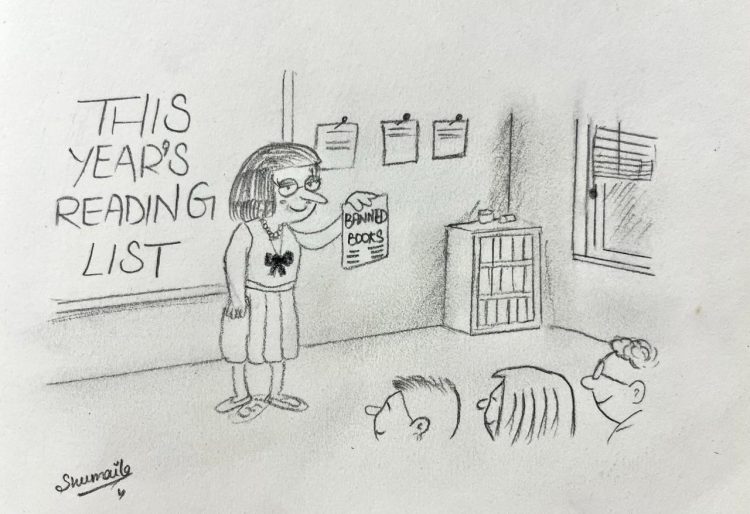
In The New Yorker, Robert Samuels wrote, “I had envisioned book bans as modern morality plays, but the reality was far more complicated.” And it is. ’Cause what exactly are we protecting people from by banning books?
When a government obsessed with optics is still afraid of paperbacks, one is forced to consider that the pen might actually be mightier than a propaganda ad.
And I, for one, have always been intrigued by the forbidden. As a child, I was less interested in fairy tales than in the stories they whispered about but never read aloud. I didn’t want answers; I wanted what they edited out. Because the thing about censorship is, it’s excellent marketing. The quickest way to spike a teenager’s interest? Stamp “Banned” across the cover in red ink. No offence but the fastest route to irrelevance? Include it in the syllabus.
And perhaps that’s the point. Conveniently, a list of banned books doubles as one of the greatest reading lists in the world. It’s a syllabus in reverse, a curriculum of everything the system deems too disruptive, too nuanced, too unwilling to fall in line. A reading list curated by fear, and therefore, one worth reading.
Now, there are many reasons a book might be pulled from circulation. It may question the moral superiority of a ruling class. It may use language too adult for children who already hear worse at the dinner table. It might suggest that war is bad or that some nations are not born perfect. That Dalits and Muslims exist. That women have desires. That queer people are not Western conspiracies. In other words, it might tell a truth too raw.
But let’s not be unfair. The government always has a reason.
“Sentiments were hurt.”
“It misrepresents history.”
“It’s too complex for children.”
“It’s not suitable for a culturally sensitive society.”
Reasonable? On paper, yes.
The actual argument isn’t moral. It’s managerial. If people start asking questions ; about religion, gender, caste, war, or how a country goes from secular democracy to surveillance state , things become harder to govern. A silenced population is an obedient one.
Whatever the reason, once a book is banned, a sort of aura of mystique is created around it that, more times than not, draws readers who want to decide for themselves whether it is in fact unfit for publication. As Art Spiegelman said, “Keep your nose in a book and keep other people’s noses out of which books you choose to stick your nose into.”
So below, smuggled is an inventory of rogue works someone, somewhere, doesn’t want you to read. Books that have been banned, barred, withdrawn, erased, or simply omitted from official memory. And now, dear reader, I hope you read them, not in spite of that fact, but because of it.
Find the Google Drive folder with these titles (except Fekuji Have Dilli Ma) linked below.
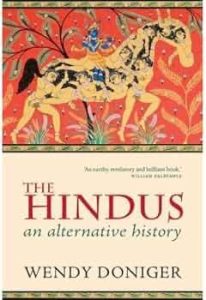
- Wendy Doniger: The Hindus – An Alternative History
In 2014, Penguin India quietly agreed to pulp every remaining copy of The Hindus: An Alternative History, not because the book was found unconstitutional, nor because it incited violence, but because someone somewhere found it “hurtful.” That someone was the Shiksha Bachao Andolan, a self-appointed guardian of Indian culture with a flair for outrage. Led by Dinanath Batra , think Mary Whitehouse meets WhatsApp uncle , the group filed a lawsuit claiming Doniger’s retelling of Hinduism was offensive to Hindus. The publisher folded.
Let’s pause here. Doniger is no TikTok provocateur. She’s a Sanskrit scholar with decades of immersion in texts that most of her critics have never read in translation, let alone the original. Her book does what good scholarship should: it complicates. It tells the story of Hinduism not as a tidy lineage of divine avatars and moral victories, but as a messy, pluralistic sprawl, brimming with eroticism, caste conflict, and counter-traditions that challenge orthodoxy.
But Doniger’s crime wasn’t bad history. It was an alternate history. She wrote a version of the past that didn’t flatter the ruling class’s present. She told readers that Hinduism could be many things at once: subversive and sacred, bawdy and profound, fragmented and eternal. In the Hindutva project of nation-building, this multiplicity is heresy. Uniformity, not nuance, is the new god.
There was no official ban, no parliamentary decree. The book vanished not in fire but in fear.
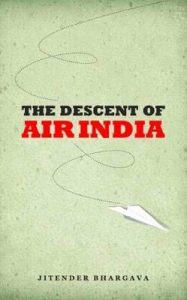
2. Jitendra Bhargava: The Descent of Air India
If The Hindus was pulped for offending gods, The Descent of Air India was pulled for offending ministers. 2014 was not a good year for truth. Jitendra Bhargava’s forensic autopsy of India’s once-proud national airline vanished from shelves almost as quickly as it appeared. The cause? Not bad sales or poor reviews, but a legal notice from Praful Patel, the very man Bhargava’s exposé implicated in the airline’s tailspin.
Bhargava, a former executive director at Air India, writes not with literary flourish but with a bureaucrat’s precision and a whistleblower’s fury. This isn’t gossip. It’s chapter-and-verse documentation of how political meddling, bureaucratic apathy, and corporate complicity grounded a symbol of Indian modernity. And Bhargava names names.
That made him dangerous.
This wasn’t a cultural ban. There were no mobs at book fairs or primetime morality sermons. This was a quieter beast: a lawsuit for defamation, a publisher that blinked, and a book that disappeared. No fire, no outrage. Just one man’s truth against a machinery allergic to accountability.
What makes The Descent of Air India notable isn’t just its content. It’s the genre of its suppression. In a democracy allergic to bad press, dissent is either shouted down or quietly litigated out of existence. The book may no longer have a publisher, but it has something better: a motive, a target, and a reason to be remembered.
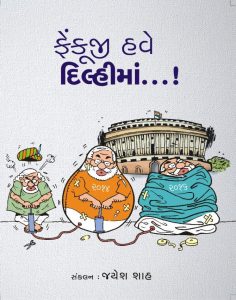
3. J.R. Shah: Fekuji Have Dilli Ma
(Translation: Fekuji is Now in Delhi)
In 2016, a slim satirical volume written in Gujarati did what no serious white paper could: it needled the Prime Minister. Fekuji Have Dilli Ma mocked Modi’s 2014 campaign, its soaring promises, its halo of messianic nationalism, with irreverent political humor. Is it a crime? Making people laugh.
A BJP supporter filed a defamation suit, claiming the book insulted the Prime Minister. What followed wasn’t a formal ban, but the now-familiar tightening of the state’s humorless grip on dissent. Bookstores quietly pulled it. The media didn’t touch it. The author found himself ensnared in legalese, not debate.
This wasn’t a threat to national security. It was a parody. But for regimes that blur the line between government and godhood, satire isn’t comedy. It’s blasphemy.
The irony? Fekuji isn’t some underground manifesto. It’s vernacular sarcasm, the kind of thing a grandmother might mutter over tea. Its suppression says less about its content and more about a political culture that confuses ridicule with rebellion.
What was punished wasn’t falsehood, but tone. And in that lies the greater fear, not that someone will say the wrong thing, but that they’ll say it too cleverly.
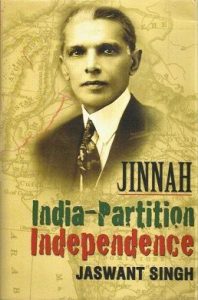
4. Jaswant Singh: Jinnah – India, Partition, Independence
In 2009, the state of Gujarat, forever touchy about its icons, banned Jaswant Singh’s Jinnah, not for exalting Pakistan’s founder, but for daring to complicate the good-versus-evil script of Partition. A founding BJP stalwart, Singh had the temerity to suggest that the blood-soaked division of India wasn’t the handiwork of one villain in a sherwani, but a shared failure ; Patel, Nehru, Jinnah: all culpable, all human.
The blowback was swift and telling. Singh was expelled from his party. His book was banned in Gujarat, Sardar Patel’s home turf, where the iron man must remain untarnished, even if that means flattening the entire history of a subcontinent.
The irony writes itself. The BJP, while trying to canonize Patel, censored one of its own for doing what Patel himself might have respected — telling a difficult truth plainly.
What the book threatened wasn’t unity, but myth. And in the nationalist imagination, myths matter more than facts. Especially the ones that sanctify power.
Even after 2014, the ban was never lifted. Why bother? Historical complexity is an inconvenient guest in a political house built on binary memory. You’re either with Patel or with the enemy. There’s no room for revisionism in a shrine.
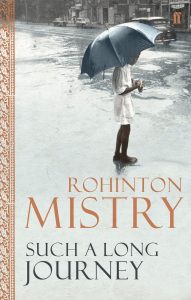
5. Rohinton Mistry: Such a Long Journey
In 2010, Mumbai University quietly yanked “Such a Long Journey” from its English syllabus after Shiv Sena’s student wing raised hell over some allegedly “anti-Marathi” lines and disparaging mentions of Bal Thackeray. The book, a nuanced, mournful portrait of 1970s Bombay, was accused of hurting Marathi sentiments , because it dared to name political thuggery for what it was.
Mistry’s novel doesn’t rant. It remembers. It tells of a city where ordinary citizens are ground down by bureaucracy, corruption, and fear , themes that apparently cut a little too close for comfort. Shiv Sena didn’t just take offense. They took hostages ; of curriculum, of discourse, of the right to read what rattles us.
The university, in a textbook case of intellectual cowardice, caved. No formal ban, no legal writ , just a stealthy erasure. That’s how populist censorship works best: with a quiet nod and a threat in the air.
This wasn’t about protecting students. It was about protecting power. Because if literature dares to remember the violence we’re supposed to forget, well then, literature must go.
Of the five, “Jinnah: India, Partition, Independence” saw its ban formally overturned. Gujarat’s High Court quashed it in 2010, a rare instance of the judiciary standing up for historical nuance. Rohinton Mistry’s “Such a Long Journey” to this day, has not been reinstated , a quiet erasure that continues unacknowledged. “The Descent of Air India” vanished after a lawsuit from Praful Patel. While the book remains technically available via self-publishing, no mainstream publisher has reissued it, and its original edition remains withdrawn. As for “The Hindus: An Alternative History”, Penguin’s 2014 decision to pulp the book was pre-emptive, not state-mandated. And while the text was later published by Speaking Tiger in India, the original controversy still looms over it like a cautionary tale , more a resurrection than an exoneration.
Take Fekuji Have Dilli Ma. The Ahmedabad High Court never banned it ‘cause Shah had every right under Article 19 of the Constitution, which guarantees freedom of speech and expression. No legal order exists. And yet, every copy has vanished. Gone from bookstores, libraries, even digital archives. Coincidence , maybe.This wasn’t about defamation — it was quiet erasure. A coordinated cover-up. Someone ensured the book disappeared, and they did it without leaving a trace. The question isn’t whether it was banned. It’s who made it vanish , and why.
To study how the scissors moved from bookstores to classrooms read my article, “A Brief History of Forgetting”. There, too, the purge is quiet but clinical. Histories have been thinned, syllabi sanitized, designed to rewire how a generation sees the past , and by extension, the present.
But the real question isn’t why the government bans books.
It’s why we let them.
Where is the outrage when a novel vanishes from a syllabus? Where is the petition, the protest, the public hunger to read what was deemed too dangerous?
The truth is, most people didn’t even notice. Or worse — they noticed and shrugged.
And that is the censorship we never talk about.
Not state-sponsored, but self-inflicted.
Apathy. Silence. Fear dressed up as politeness.
That’s the soft power coup: the moment people start believing that what’s missing was never needed in the first place.
Because the thing about censorship is, it never ends with paper. It always wants the mind.
You can find the pdf to the books below-
https://drive.google.com/drive/folders/1E8B9tzIYpSsFOmYBX5fbCCmlKv-zJZD5?usp=sharing