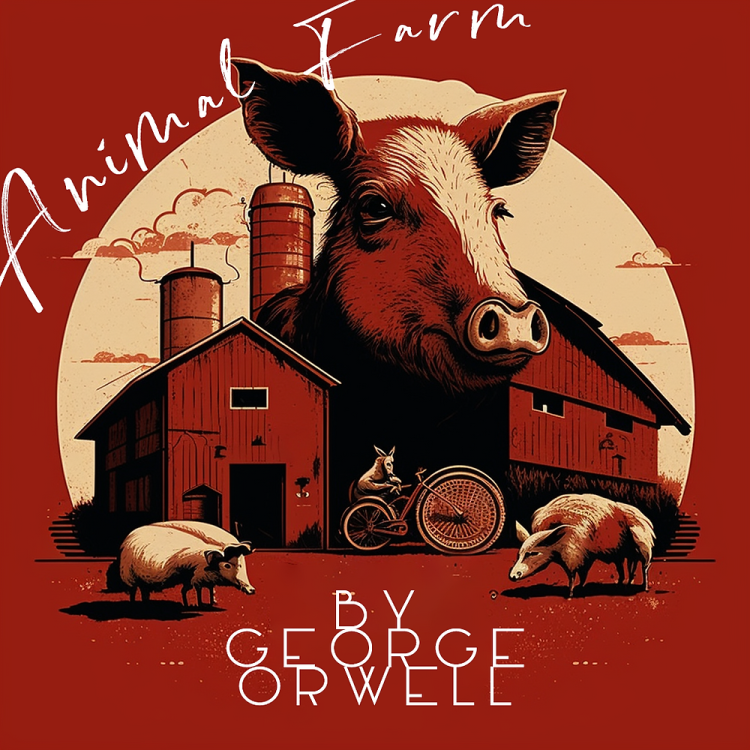
I read George Orwell’s Animal Farm the other day, and felt a sense of hopelessness when I finished the novella. the story is set around a farm called the ‘Manor Farm’, owned by Mr. Jones, a farmer who was once a hardworking man who took care of his animals, but had recently faced economic hardships due to a lawsuit and had fallen victim to alcoholism, thus becoming irresponsible and neglectful towards his animals. A boar by the name of Old Major, the oldest and the wisest of all animals, encourages the feelings of revolution within the rest, and thus follows an uprising of the animals, who successfully drive away the Jones family from their farmhouse. After the humans are driven away, the animals’ life on the farm takes a turn for the better, or does it?
In a game of chess, the pawn is the only character that can move forwards, but not backwards. It was something that came to my notice as a precocious child, that all the rest of the pieces can retract their steps, move backwards, dodge attacks, but not the pawn. never the pawn. it can only move forward in the face of danger, allowed to turn diagonal when it has to attack, a sliver of generosity. The pawn is also the first character that chess players lose. but it isn’t the player who kills the pawn, it is the sheer helplessness of having no option but to march forward.
The expulsion of humans from the farm comes with a momentary sense of peace, and a unanimous decision is made to let the pigs, the smartest animals in the farm, make the decisions for the rest. This included Snowball, who had a convincing as well as demanding voice, and Napoleon, who preferred working between the lines and usually remained reserved. However, these two never saw eye to eye, and bickered over every idea they had. They came up with some core principles of the now ‘Animal Farm’ and them in the wall of their shed, which every animal memorised by heart, even if they couldn’t read or write. They even had a war with the humans once, when Jones tried to reclaim his farm, and the animals emerged victorious in what they called the ‘Battle of Cowshed’.
As time passed, Snowball started focusing more on development of the farm, but Napoleon did not agree with his ideas to build a windmill, and instead of peacefully arguing his point, he expelled him by the help of the dogs he had trained. And thus followed what can only be described as the most gut wrenching betrayal done against the animals of the farm. Napoleon had gained sole leadership over the animal farm and as we all already know, absolute power corrupts absolutely.
The important principles laid down within the very core of the farm were soon contradicted as time began to pass, when the pigs began living in the Jones’ house, wearing their clothes, sleeping in their beds, drinking their wine, killing the animals who dared to disobey Napoleon, and so on. And when the animals thought this to be a betrayal of the principles etched within their hearts and on the wall of their shed, they soon found that the pigs had altered the sentences to benefit their own interests. “No animal shall sleep in a bed.” became “No animal shall sleep in a bed with sheets“; “No animal shall kill any other animal” became “No animal shall kill any other animal without cause“; “No animal shall drink alcohol” became “No animal shall drink alcohol in excess“.
And so it happened that towards the end of the book, the most important principle laid down at the start was contradicted. “All animals are equal” and the other six principles were all removed, and in their stead, the words on the wall read “All animals are equal but some animals are more equal than others“. The old promise of liberation was betrayed, and it was, quite frankly, gut wrenching. Snowball’s reputation was twisted for the pigs’ gain, blaming him for all that went against Napoleon’s commands. Every memory of the animals was altered, to the point where they couldn’t remember if their lives under Jones were better or worse than under Napoleon’s leadership.
The parallels make themselves clear once you realise that, the pigs represent the kings and the queens; the dogs the knights, the bishops and the rooks; and the animals remain the pawns in the grand game of revolutionary chess, where one tyrant ruler is replaced by another, where the pieces move but the game stays the same. When the game ends, a new one begins, the same pieces and the same rules. When Jones is driven out, Napoleon takes his place, and the oppressed become the oppressor, thus continuing the cycle endlessly.
It is said that when you read a book, you pick a character and grow with it throughout the story. such can be said in my case with ‘Boxer’, a character in the novella. Boxer was an enormous horse, who albeit a little stupid, still worked tremendously hard and was respected by every animal on the farm. In the end, he gets sacrificed when he proves to be useful no longer, much like the pawn in a game of chess. It served as an ultimate betrayal to the sentiments of the animals who had been there since the beginning. Boxer’s death impacted me greatly, but it also made me realise that such is the fate of a pawn in the game, who works harder, and not smarter.
In the end, Animal Farm left me with an uncomfortable truth: people often seek power not to uplift others but simply for the sake of possessing it. Napoleon’s rise isn’t driven by vision or principle, instead it is driven by appetite. And once he has power, he clings to it with the same desperation as any tyrant in history. The tragedy isn’t just his corruption; it is the animals’ heartbreaking inability to recognise the manipulation unfolding before their eyes. Their trust, their loyalty, their belief in the revolution, these values become the very chains used to bind them. Watching all this from the outside, I felt that familiar frustration: Why can’t they see it? How are they still falling for this?
But Orwell’s genius lies in turning that frustration back toward us as humans. We like to think of ourselves as different, as the only intelligent species on the planet, capable of logic, reason, and self-awareness. And yet, when faced with the most obvious traps, we behave exactly like the animals on the farm. The promises fed to common people are like bait dangled before fish: glittering, tempting, and always just convincing enough. We swim toward them repeatedly, forgetting the hook beneath the surface. We keep believing in those who speak the loudest, who promise the most, who claim to act “for our good”. Even when history tells us otherwise, even when the lies are transparent, we fall for them over and over again.
Perhaps that is the deepest sense of hopelessness the novel leaves behind, that power corrupts, and absolute power corrupts absolutely, but that corruption survives only because we allow it to. Pawns remain pawns not solely because the kings are powerful, but because they continue to move blindly, faithfully, obediently. Animal Farm asks us to confront the uncomfortable possibility that the game does not change until the pawns finally open their eyes. And until then, the board remains the same, the players remain the same, and the cycle of deception spins on, quiet, predictable, and devastating.
