Ever wondered what really separates school life from college life?
After all, the activities are almost the same.
We attend classes, study for exams, participate in events, laugh with friends and of course daydream through lectures as well, all in a similar manner.
Remember how we all came dressed up for our first day of college expecting something straight out of Karan Johar’s SOTY, but instead got a reality check within the first three months? Despite that, you will still hear people confidently declaring how university life is completely different from all our prior experiences.
So apart from the fact that we are now studying specialized subjects, what truly changes?
This question casually wandered into my mind one afternoon while I was sipping a cup of chai at the Kishori Canteen of our University.
There is something interesting about a college canteen. It is never just a place for tea and snacks. My third grade teacher would probably call it a fish market, but I prefer referring to it as an unmoderated session of the United Nations with delegates from different departments. Everyone is talking at once in groups, nobody is entirely listening, and yet somehow the conversations keep flowing.
That afternoon, I was lost in one such thought. My zoning out, however, was quickly interrupted by the gentle nudge of my friend sitting beside me.
“Are you even listening?” she asked.
Without waiting for my reply, she continued enthusiastically with her story about how she celebrated Holi in her village.
According to her, the celebrations begin not with colour, but with tradition. First, the villagers offer gulaal to a sacred tree in their locality. Only after this ritual do the children gather to play Holi, sometimes not even with colours but with mud.
Messy? Yes.
Unusual? Definitely.
Fun? Absolutely.
And the celebrations are not limited to a single day. In her village, Holi unfolds over three entire days of laughter, chaos, rituals, and togetherness.
As I listened to her describing this vivid celebration, I realised something.
This was so different from the way I had celebrated Holi all my life.
And suddenly it struck me.
This. This right here was the answer to the question that had been bothering me.
Now before you assume that I am merely writing poetic nonsense for the sake of submitting an article on deadline, I promise that is not the case (at least not yet).
Let me explain what I mean.
I am talking about these subtle yet beautiful differences.
This exposure.
This opening of an entirely new horizon of stories.
There is a reason schools make us wear uniforms. That was not just for those irritating daily assembly checks. Of course, officially it is to maintain discipline and equality. But symbolically, uniforms remind us of our similarities.
Think about it for a moment.
In school, most of our friends live nearby. We often share similar social environments, family structures, cultural practices, and even festivals. There might be slight differences here and there, but overall the world we inhabit is relatively familiar.
(Give me a minute, I just got a sudden flash of nostalgia from those crowded van rides and lunch breaks where everyone fought over those stone-turned Maggi noodles.)
Well.
College, however, gently breaks that bubble. Suddenly the classroom becomes a crossroads of countless different worlds.
Students arrive from different cities, different states, and sometimes even different countries. Hostellers bring with them not just suitcases but accents, traditions, food habits, childhood stories, and memories from places we may never have visited.
And all of these worlds meet in the same classroom.
I see these different worlds colliding every day.
The girl who grew up in a bustling metro discussing assignments with someone from a quiet village.
A student ancestrally from the mountains explaining maple tree leaves to someone who has never seen them.
Friends exchanging homemade sweets during festivals they had never celebrated before. (Special thanks to my friend from Jharkhand who made me taste those delicious thekuas.) And if you are lucky enough, you will find friends that are international students too.
Our conversations quietly become cultural exchanges.
Sometimes these differences appear in the most amusing ways. One person cannot tolerate spicy food while another believes food without chillies is practically a crime. Someone considers 7 a.m. unbearably early, while someone else proudly claims they have already been awake since 4 a.m. doing yoga.
One person celebrates festivals with elaborate rituals, while another celebrates with nothing more than loud music and friends. Somebody who is highly accomplished in university (typical Dekisugi vibes) while others who are just there for the sake of it.
And somewhere between these differences, friendships form. Different and beautiful. The sense of oneness that our constitution talks about in the formal language of unity and diversity- The very essence of it.
It brings me to another fascinating part of university life– Language.
A single conversation on campus can travel through Hindi, English, Awadhi, Bhojpuri, and occasionally a dramatic hand gesture when vocabulary fails. Trust me, I found it beautifully hilarious to see a classmate passionately complaining about our broken classroom furniture in Bengali. So to all my wonderfully trilingual friends whom I occasionally request to speak in their regional languages purely out of curiosity, thank you for tolerating my enthusiasm.
Because every unfamiliar word carries with it a glimpse of another world.
In many ways, a university campus is not just an academic institution. It is a living museum of human stories. (One museum quietly rests inside the Tagore Library, while another living one unfolds just outside in the PMP Park.)
Every student carries a unique narrative of their hometown, their childhood festivals, their struggles, and their dreams.
And when these stories intersect, something beautiful happens.
We begin to realise that the world is far bigger, more colourful, and far more diverse than we had imagined during our neatly uniformed school days.
Perhaps that is the real education universities provide.
Not just knowledge from textbooks, but an understanding of people and real life. (I get you, Rancho from 3 Idiots. I really do.)
Maybe the foundation of that change begins in places like this, where students from different backgrounds sit together, share food, exchange stories, debate ideas, and slowly learn to understand each other.
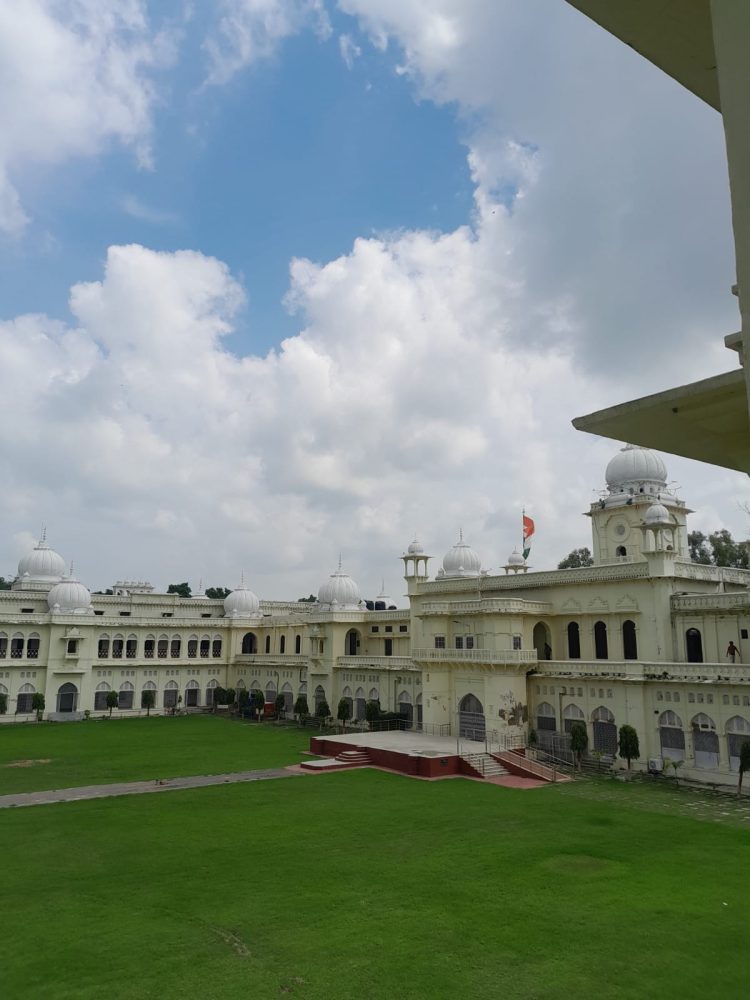
Looking around the campus of the University of Lucknow, one realises that it is not merely a place of lectures and examinations.
It is a meeting ground of cultures.
A crossroads of languages.
A gathering of countless small stories that together form a much larger narrative.
And perhaps that is the greatest difference between school and college.
School teaches us what to learn. But college teaches us how to learn.
And sometimes, all it takes to discover that lesson is a simple cup of chai in a crowded canteen, while listening to someone else’s story…