
Last week, I accompanied my youngest cousin to meet a career counsellor. The conversation unfolded much as I expected it would: subjects, entrance examinations, employability, prospects, leading with the familiar vocabulary of a world preoccupied with outcomes. She was thoughtful and impeccably professional, and I assumed the meeting would remain comfortably within the boundaries of education and employment.
Then, almost in passing, she said something that seemed to suspend the entire conversation, at least for me.
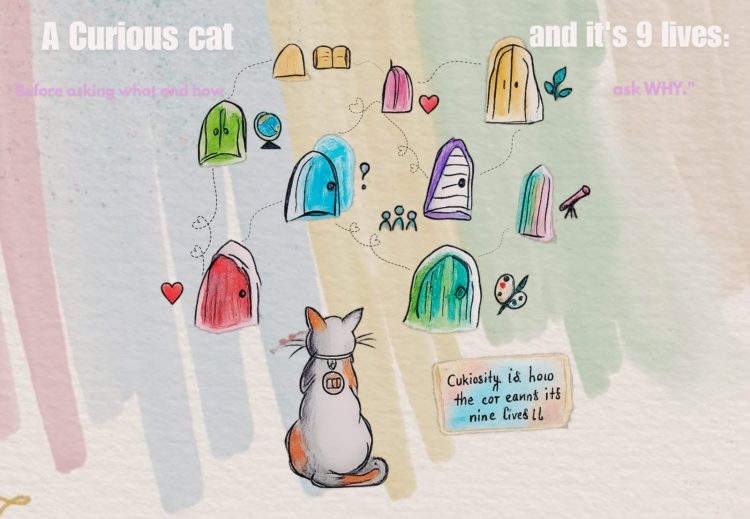
“Before asking what and how,” she said, “please ask yourself why.”
It is the sort of sentence one could easily mistake for motivational rhetoric, the kind that appears on posters and notebook covers. But it lingered with me.
We spend astonishing amounts of our lives asking what we should become and how we should get there. We devise strategies, revise trends, collect qualifications, compare timelines, and chase identities. Far less often do we pause to ask why we desire the things we do, why we believe what we believe, or why we are so eager to arrive at certainty.
When do we ask ourselves why?
I have always admired people who preserve the heart of a child, the rare capacity to remain astonished by the world long after adulthood begins to reward certainty over curiosity. I am someone who arrives late at conclusions, and sometimes never at all. I move through the world with caution rather than conviction, or at least I try to, reluctant to imprison people, places, or ideas within the narrow boundaries of my first impressions. Whenever possible, I choose to give the benefit of the doubt.
And to me, compassion and curiosity are not separate virtues. Curiosity is what allows compassion to exist. It asks us to suspend judgement long enough for another person, another place, or another way of seeing the world to reveal itself.
Certainty asks, What is this? Curiosity asks, What else could this be?
We rarely think of curiosity as a moral virtue. We treat it as an intellectual habit, useful for scientists, scholars, and children; rather, to me, it is one of the deepest forms of humility.
I was reminded of this only recently.
A friend’s younger sister travelled alone to Ayodhya for an examination. She wears a hijab, and given the social and political atmosphere of our times, her family’s anxieties were understandable. They worried about whether strangers would be welcoming, whether she would be safe, whether she would be treated with dignity.
Before she left, I remember telling her, “Be hopeful. Be brave. Let reality surprise you more than your fears startle you.”
And reality did.
She found warmth where she had expected distance. Strangers offered her help instead of hesitation. When she was running late for her examination, an elderly man insisted on helping her reach the examination centre on time, asking for nothing in return except that she arrive safely.
When she returned, she said something that has stayed with me ever since.
“I love nothing more than when my preconceived notions and biases break apart. It feels like dusting dirt from my clothes.”
She wasn’t celebrating being right.
She was celebrating being corrected.
I have rarely heard a more beautiful description of intellectual humility.
Most of us experience being wrong as a wound to the ego. But curiosity transforms correction into liberation. Every mistaken certainty abandoned is another layer of dust shaken from the self.
There is a quiet radiance about people whose greatest possession is their enthusiasm to learn, one I hopefully can earn and grow within myself.
They say curiosity killed the cat.
I prefer to think curiosity is how the cat earned its nine lives.
Every genuine question risks an old certainty, an old identity, an old life, and when we begin to question it all, it returns us to a renewed world. There is the quiet joy of being corrected, discovering that we were wrong, discovering, again and again, that reality is richer than our imagination had allowed, and that the world is always far more wonderful than the stories we tell ourselves about it.
