
When the government wants you to do work but doesn’t provide enough facilities, when the pressure is so high that it forces you to take your life, then, I don’t think it’s just a duty. It is overly intensive labor disguised as duty. There comes a point a system becomes so heavy, so suffocating, that those inside it can no longer breathe.
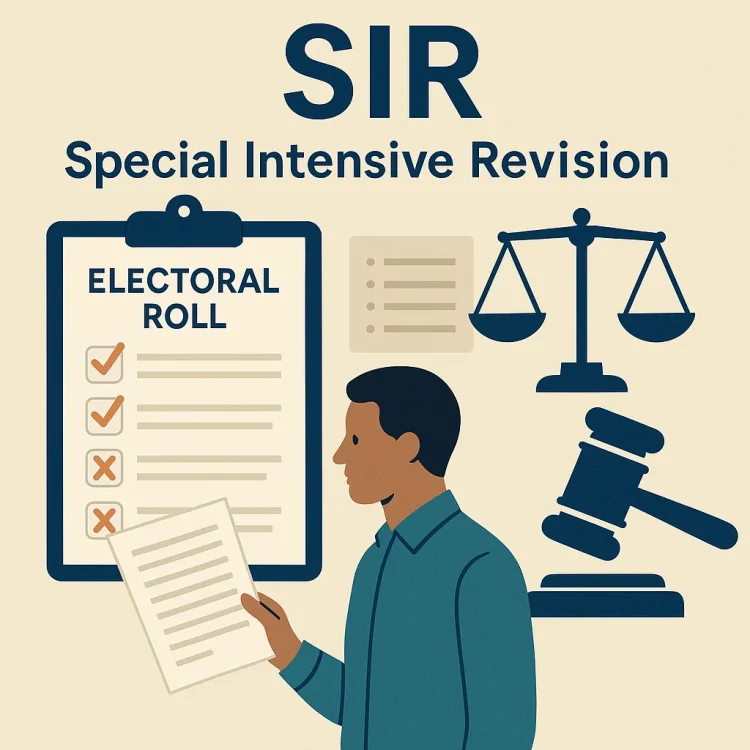
What’s happening right now with the Special Intensive Revision process or ‘SIR’. is exactly that. A form of pressure that should never exist in a democracy, yet it is unfolding right in front of us.
What is happening in SIR is something that should never happen, but it is happening, here in India. And it is not free of malice, it’s coming with a cost – human lives.
The nation is shaken by the death of a booth-level officer (BLO) in Moradabad, who took his own life after making a heartbreaking video saying, “Sir, I want to live.”
It’s not a cry for help rather it is a mirror image of the ground reality. When the work of democracy reaches this point where a person begs for their life because of “duty” then we must ask: Is this duty at all? Or is it something else entirely?
Because the truth is simple yet uncomfortable.
This is not what duty looks like. Duty brings pride. But it’s exploitation in the same form.
The Impossible Task: The SIR process, on paper, aims to clean electoral rolls. We don’t disagree with the need for accuracy, transparency, or integrity in electoral lists. These are essential pillars of democracy.
But it’s not the “what”. It is the “how”that’s being problematic.
The route chosen is the hardest possible route. One that demands an enormous amount of manual work in an extremely short period. One that involves visiting houses, verifying documents, uploading details, generating reports, all while managing regular duties, limited resources, and near-zero support.
And this raises a very real question: Even if the SIR is happening, why do we need to go towards such a tough route rather than the easy one? Why take such a route that even the learned find absurd?
And if the educated find it difficult, where will the illiterate go? How will they do it all? And in such less time too? How will they gather documents they never possessed? How will they understand forms written in language they cannot read? How will they navigate online portals when they barely know how to operate a smartphone?
Let’s not forget the illiteracy rate in India.
A democratic process that leaves behind the most vulnerable is already failing in spirit and execution.
The Fear: And in the midst of all this, a quite chilling fact gives weight to the fear. For those who stand on the margins of society, the poor, the landless, migrant laborers, women without documents, the elderly with fading papers, such conversations and implications create terror. They line up not because they trust the system, but because they are afraid of it.
And where will they go – to detention centers, or to camps?
The Breaking System: The stories emerging from SIR show the fall of a democracy. BLOs thinking of suicide as an escape. Officers suffering from heart attacks. Citizens confused, terrified, and running from office to office, with papers in hand, unsure if what they filled is even correct or not. Administrators overwhelmed by impossible deadlines. And helplessness spreading like a flu.
The question isn’t about the intention. It is about whether the method is humane. Whether the process respects the dignity of those who run it. Whether ordinary people can realistically comply. Whether India can achieve transparency without breaking its own citizens in the process.
If something like just a recheck of electoral lists can lead to fear, stress and suicide creating chaos everywhere then we shouldn’t reboot the system but our methods.
The aim should be fairness, not suffering. Verification, not harassment. Inclusion, not distress.
A society under democracy must ensure that no one has to say “Sir, I want to live” because of pressure.
The SIR crisis is a warning. A reminder that when duty starts resembling forced labor, when pressure pushes people beyond their limits, when processes disregard the ground reality, the entire democratic foundation begins to shake.
India and its citizens deserves better. And the people who serve it deserve dignity not duty disguised as labor with impossible deadlines and fear.