
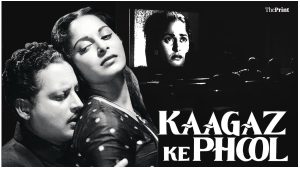
When we speak of the golden age of Indian cinema, this is what I imagine – A time when films were not merely commercial products but works of art, created by artists who treated cinema like their own children. Kaagaz Ke Phool stands as one of the purest examples of that era. What Guru Dutt achieved through this film goes beyond imagination, and the fact that it became a reason for his professional downfall and eventually his tragic end remains one of the most painful ironies in Indian cinematic history.
Kaagaz Ke Phool is not merely a romantic tale or a story of personal downfall. Rather, it is a confrontation with reality itself, a reality presented almost poetically through its visual language, wide frames, silent spaces, and haunting beams of light. These lights do not symbolize honesty or greatness; instead, they illuminate loneliness. They expose the emotional isolation that the characters are forced to endure.
From my perspective, this is not a film about love, nor simply about the irrationality of society or family drama. In fact, there is no true villain in the film. What it explores is human nature. A nature capable of tenderness, understanding, and cruelty at the same time. And because of this, the tragedy emerges from ordinary human behavior rather than true evil intentions.
Many mistake it as a film about the downfall of an artist but according to me, it is about a society that depends on art while simultaneously rejecting the artist. It reveals the, sometimes painful, contrast between what society needs and what it desires. With its failure at the box office, Indian cinema lost, for decades, a reflective, poetic, and deeply human form of storytelling that dared to question its own existence. Understanding its commercial failure is not difficult. Audiences entered theatres expecting romance, social drama, or emotional reassurance. Instead, they encountered an unsettlingly realistic portrait of life, a world that uses individuals and discards them once their purpose is fulfilled. The characters feel incomplete, unresolved, and unfinished, which disappointed viewers accustomed to clear emotional closure. Yet that incompleteness is precisely the film’s truth. Its point? life does not conclude with happy or tragic endings. It simply moves on.
The film acted like a slap on the face, not because it was harsh, but because it was brutally honest. Audiences of that time were unprepared to accept such realism in a medium they associated primarily with entertainment. In rejecting the film, they unknowingly rejected a mirror and a beacon of self-reflection not just for themselves but for society as a whole.
Somehow, despite being a tragedy, I felt a sense of peaceful ness at the ending, and I cannot fully explain why. Maybe it is because I chose to interpret it that way, or perhaps because he dies not as a celebrated figure but simply as a director whom the world treats normally. Neither glorifying him nor completely mourning him. He simply no longer mattered to them. And perhaps there could not have been a more beautiful ending than this.
In the end, I would say that Kaagaz Ke Phool is a film that shows us what Indian cinema once was. Today, Kaagaz Ke Phool survives not just in the form of film but also as a stark reminder of a path Indian cinema might have taken. A path where art and introspection stood equal to entertainment. Its failure did not simply end a filmmaker’s creative journey, I believe that it postponed an entire cinematic possibility for generations