The streets of Delhi have spent the better part of recent weeks doing something that streets are historically rather good at: making noise. Be it the famous, or rather, infamous CJP protest; or the currently ongoing protest at Hindu College. Let’s rewind a bit though.
The CJP movement began as an online reaction to a controversy surrounding remarks attributed to the Chief Justice of India and quickly developed into a wider youth-led protest movement. Demonstrations, solidarity marches and public gatherings followed in Delhi and elsewhere. The movement subsequently entered another phase, with proceedings concerning cases against protesters reaching the courts. What followed was not merely another political controversy, but another reminder of how quickly an issue can move from a few voices online to the streets and eventually into the institutional machinery of the state.
And somewhere alongside all of this was another, quieter phenomenon.
The silence of India’s celebrities.
Actors. Singers. Public personalities. People whose faces occupy billboards, whose voices reach millions, whose Instagram posts can generate more attention in an hour than an ordinary citizen could hope to generate in a lifetime.
Some people criticised them for not speaking.
The response, where it came, was familiar:
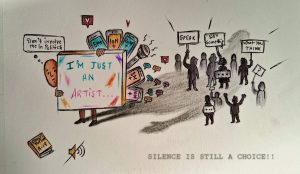
“I am an artist. Don’t involve me in politics.”
It sounds reasonable.
Perhaps it even is.
But it raises an uncomfortable question: Can an artist actually choose to be apolitical once their art has made them influential?
Let us begin with the most important distinction: nobody has a legal duty to comment on a protest.
India’s Constitution guarantees citizens the freedom of speech and expression under Article 19(1)(a), subject to the reasonable restrictions specified in Article 19(2). The freedom is broad, but it does not create a corresponding obligation to express an opinion on every public controversy.
In fact, Indian constitutional jurisprudence has recognised something even more interesting: the right to remain silent.
In Bijoe Emmanuel v. State of Kerala, the Supreme Court protected schoolchildren who respectfully stood during the national anthem but did not sing it because of their religious convictions. Decades later, in Kaushal Kishor v. State of Uttar Pradesh, the Supreme Court discussed the right to silence as the converse of speech and recognised it within the broader understanding of Article 19(1)(a).
So legally, the answer is relatively straightforward.
An actor does not have to condemn a government.
A singer does not have to endorse a protest.
A sportsperson does not have to post about a political controversy.
Silence is not, by itself, unlawful.
But law is not the only way in which we understand responsibility.
And that is where the question becomes considerably more complicated.
There is something strange about the phrase, “I am just an artist.”
We rarely regard artists as apolitical when their art itself says something political.
A film about caste is political.
A song about war is political.
A painting about displacement is political.
A play about authoritarianism is political.
Even choosing which stories deserve to be told can involve political assumptions.
Yet when an artist is personally asked to speak about politics, the same person can suddenly retreat behind the label of artist.
Perhaps that distinction is legitimate. An artist’s work can engage with society without requiring the artist to become an activist. Creativity does not automatically create a political obligation.
But celebrity introduces another variable: scale.
An ordinary citizen may post an opinion and reach fifty people.
A celebrity may post the same opinion and reach five million.
That difference does not make the celebrity legally more obligated to speak. But it does change the social consequences of speech.
India’s own regulatory framework already recognises that influence can create additional responsibilities in other contexts. Advertising guidelines recognise celebrities and influencers as people whose credibility and reach can affect the opinions or decisions of their audiences, and therefore impose disclosure and due-diligence expectations in commercial endorsements.
The principle is revealing.
We already accept that influence matters when the subject is selling a product.
Why should the question become irrelevant when the subject is public life?
That does not mean celebrities should be forced to take political positions. It means that perhaps we should stop pretending that their influence disappears simply because the subject has changed.
Modern celebrity is no longer merely fame.
It is infrastructure.
An actor with tens of millions of followers possesses something remarkably similar to a media organisation: an established audience, distribution, recognition and the ability to determine what enters the attention of millions of people.
The difference is that the celebrity’s audience often trusts them for reasons that have nothing to do with politics.
They may have spent twenty years watching an actor on screen. They may have grown up listening to a singer. They may follow a sportsperson every day.
That familiarity creates something traditional political communication often struggles to manufacture: intimacy.
Political actors have understood this for years. The contemporary influencer economy has increasingly intersected with political communication, with political actors using creators and influencers to reach audiences outside conventional media. Researchers and media-law commentators have consequently raised questions about disclosure, transparency and the distinction between organic opinion and political promotion.
The celebrity therefore occupies an unusual position. They are not elected. Neither are they journalists nor activists. Yet they can influence public opinion on a scale comparable to institutions that traditionally perform those functions. This influence is simply a by-product of success, carrying no additional civic expectation.
In the United States, political expression is among the forms of speech receiving the strongest protection under the First Amendment. Political advocacy and ideological expression sit at the core of American free-speech jurisprudence.
But American celebrity culture has also produced the opposite phenomenon: celebrities openly campaigning, endorsing candidates, attending rallies and using their platforms to mobilise voters.
That does not mean every celebrity participates. Nor does it establish that celebrities should participate.
In fact, American law creates another complication that is often missed in popular discussions of free speech: constitutional free-speech protection generally constrains the government, not private employers. Entertainment companies can impose workplace consequences for political expression in circumstances where the First Amendment itself would not prevent them.
Britain takes a somewhat different legal route. Article 10 of the European Convention on Human Rights protects freedom of expression, including artistic expression, while Article 11 protects peaceful assembly. Both rights can nevertheless be subject to lawful restrictions.
Across these systems, then, one principle remains remarkably consistent:
The state cannot simply decide what an artist must believe.
But that is different from asking what society should reasonably expect from someone whose influence extends far beyond their art.
There is an irony here.
Celebrities frequently benefit from being perceived as more than their professional work.
Their personal lives become content. Their opinions become headlines. Their relationships become public discussion. Their endorsements become commercial assets. Their political associations can influence how brands and audiences perceive them.
Fame is therefore rarely treated as something confined to the screen.
But when a political crisis arrives, the argument can suddenly become:
“I am only an artist.”
Perhaps we should take that statement seriously.
Perhaps we should allow an artist to remain an artist.
But then perhaps we should also be consistent enough to accept that the public is equally free to ask why someone who has repeatedly used their enormous platform to discuss lifestyle, fashion, fitness, relationships, films, brands and everything else chooses silence when the subject becomes politically uncomfortable.
The public cannot demand speech as a legal entitlement.
But it can certainly form an opinion about silence.
That distinction matters.
There is another side to this debate that deserves equal attention.
A celebrity may remain silent because they genuinely believe that their political opinion is irrelevant.
Another may fear that their statement will reduce a complicated issue to a slogan.
Another may not know enough about the issue.
Another may believe that speaking without adequate knowledge would be irresponsible.
And another may fear professional retaliation, online abuse, boycotts or threats.
Silence can therefore mean many things.
Likewise, speaking does not automatically make someone courageous or principled. A celebrity can speak because they genuinely care. They can speak because their public-relations team advised them to. They can speak because everyone else is speaking. They can speak because controversy generates engagement.
The existence of a statement tells us that someone spoke.
It does not, by itself, tell us why.
This is why the demand that every celebrity must publicly declare a political position can itself become dangerous. A democratic society should not replace one form of conformity with another.
The right to dissent includes the right not to perform dissent.
So, can an artist say no to being political?
Yes.
Legally, an artist can say no.
An artist does not surrender their freedom of conscience merely because millions of people admire their work. Article 19 protects expression, and the constitutional understanding of that freedom has also recognised silence.
But perhaps the more interesting question is not whether an artist can refuse politics.
It is whether an artist can indefinitely claim to exist outside politics while simultaneously existing inside a society shaped by politics- and while possessing an extraordinary ability to influence how millions of people perceive that society.
Maybe celebrity does not create a legal duty to speak.
Maybe it creates something much less tangible: a responsibility that cannot be legislated, only negotiated between the individual and the audience. And perhaps that is precisely where democracy becomes uncomfortable. We should neither force artists to speak, nor should we punish them merely for remaining silent.
But neither should we demand that society treat their silence as politically meaningless.
Because when someone has a million people listening, silence is still a choice- even if it is a perfectly legal one.
