
For most students, theatre lives in a textbook: a Shakespeare play to annotate, a Chekhov one-act to summarise before an exam. Literature was written to be performed, though, and a play only finishes its work when an audience is in the room. The room, it is said, has been dimming for a while. Theatre, as some people believe, belongs to another era, something people once gathered for and have long since stopped chasing. It is an easy belief to hold, until the lights actually go down. On October 25th, the Kaifi Azmi auditorium proved otherwise. The reception overflowed, every seat was taken, and a hall full of strangers sat in the dark waiting for The Matinee Theatre’s The Bear. The love for art and literature was never gone. It was waiting for a room, a stage and an audience willing to show up.
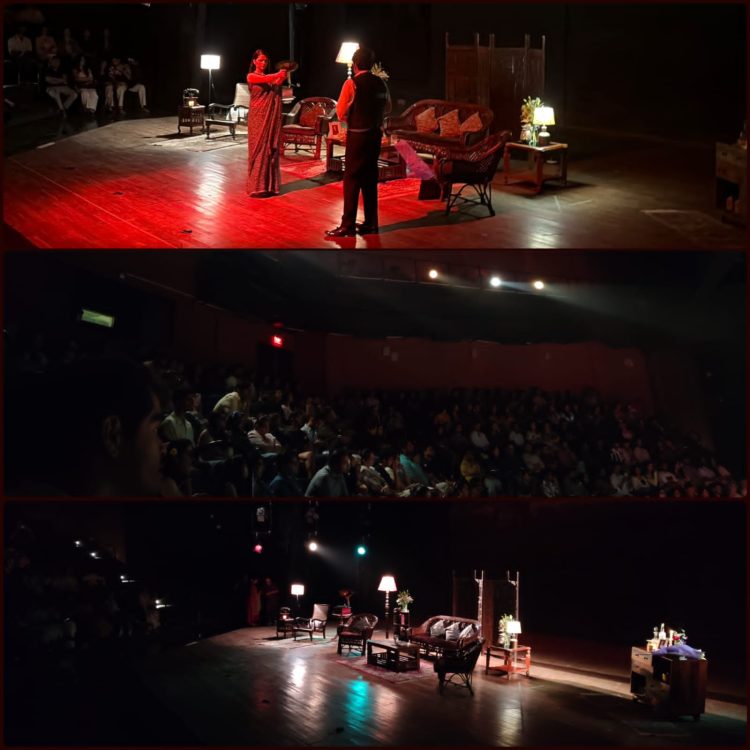
Before a single line was spoken, the stage had already started telling the story. The living room was designed with intent: wooden furniture, a couch and table drawing the eye to the centre, a drawer tucked at the far right, and candles burning on the desk, their faint smoke catching the light. Green and pink washed the left side while warm yellow held the middle, giving the room a lived-in softness. It looked like a home that someone had recently stopped living in properly, and that was enough to raise a question in the hall: who belongs here, and what is about to walk through the door? Anticipation had already built outside. The set turned it into curiosity.
The Bear is a Russian play, written for a Russian stage, and the first question was whether it could survive the journey to Lucknow. Rather than reproduce the play in an unfamiliar setting, Matinee Theatres gave it a world its audience could recognise. The characters carried Indian names, the debt was counted in lakhs of rupees, and the widow mourned in a saree, so the story arrived in a world the audience already knew. Chekhov’s comedy runs on pride, money and manners, and all three travel easily once the setting is familiar. The adaptation kept the absurdity that defines the original and added its own elements, keeping the play from feeling like a museum piece.
The story opens in grief. A woman in a blue saree, played by Shubha Pandey, lights a candle, pours a drink and straightens a photo frame before turning to the audience. Everyone expects her to move on, she says, and that is easy to say when the pain is not theirs. Knocks interrupt her reading. “I’m not seeing anyone today,” she shouts twice, until a man in a white shirt and black vest, played by Aman Shah, walks in anyway. He has come for five lakh rupees her late husband owed him, and he settles into a chair, refusing to leave until it arrives. What follows is a war of words: money surfaces in every conversation, he rants that women “complicate everything”, and she grows more furious at his presence and advances. Then he challenges her to a duel, and she does not back down. Her late husband’s pistols come out, and the room holds its breath. How it ends is best left to the stage.
Then the tension breaks. The hall expects a showdown, but the play takes an unexpected turn. An ending nobody in the room saw coming has the audience on its feet, followed by a wave of applause. It is precisely the sort of ending best experienced rather than explained.
When the lights came up, the applause did not stop. It rolled through the sold-out hall in waves, loud and sustained, from an audience that had stayed with every beat. The cheering was not only for the two leads. One by one, each member behind the production was called forward: those who designed the set, ran the lights and sound, and handled everything backstage, and the applause that met them came from the team standing together as much as from the seats. The Matinee Theatre’s company took its bow as a unit, and it was clear that the evening belonged to all of them.
That applause was earned long before the curtain rose. Mr Aman Shah of The Matinee Theatre remembers the beginning as a gap: Lucknow had little theatre for younger audiences, only “very old school” fare. So he pitched a theatre club to co-actor Shubhra, and rehearsals began the next day. Within weeks the play was ready, and The Bear, by his count, is now the company’s fifth sold-out show. But the hall that filled so fully had to be made ready first. Before the audience arrived, he said, it was “banjar zameen,” and he and his team handled the cleaning, washrooms, lights, air conditioners, decor and stalls. The day before the show, he was on the fifth floor getting the curtain pump right. To him, the reason is simple: somebody had to do it. Someone had to step forward for theatre in Lucknow, and he chose to be that person. Even now, a fifth sold-out house does not feel like an arrival. What the company has cracked so far, he said, is “not even a per cent.” In a time of screens and phones, he believes people are hungry for something real, and that hunger is what inspired him to begin. Mr Shah also gave an insight into what is next for The Matinee, with Amrita & Imroz in the works and the Matinee Theatre Open House, a gathering for anyone drawn to literature, poetry, acting and direction. The idea is not to teach what is right or wrong, but to sit together and work through each person’s creative blocks, as a community event. Beyond that, he dreams of a theatre culture in Kanpur, Agra, Banaras and Prayagraj, because theatre “shouldn’t be just a Bombay fancy thing.”
Perhaps, in one way or another, everything begins as banjar zameen. An empty auditorium, an idea for a society, the first few pages of a publication, a gathering of people who aren’t quite sure what they are building yet. The difference between these beginnings and the things we eventually come to recognise is rarely instantaneous. It takes work, disagreements, failed attempts, people willing to show up again and, sometimes, people willing to take over when those who began it have moved on. The next stage in Lucknow may not be built by someone more experienced, better resourced or better placed, but by whoever decides the work is theirs to do. The only question left is who will start it. Perhaps the next act belongs to the one who doesn’t wait for the curtain to rise.

