
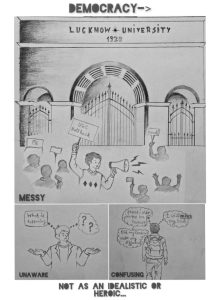
People often say universities shape democracy. At first, that sounds like something written in a brochure. But if you look closely at everyday life in a university, the idea starts making sense not in a grand way, but in small, ordinary moments.
Lucknow University is not perfect. It is crowded, slow, and often confusing. Yet, in these very conditions, students begin to learn what it means to live with difference, disagreement, and authority.
At LU, students come from very different backgrounds. Some are from Lucknow itself, others from small towns or villages across Uttar Pradesh. Many are first-generation college students. Others come with better exposure and resources. These differences are visible in classrooms, hostels, and even in the way people speak.
Living and studying together forces students to adjust. You hear opinions you don’t agree with. You sit next to people whose lives are nothing like yours. Over time, you learn to listen, argue, and sometimes stay silent. This is not taught in any syllabus, but it is one of the first lessons in democratic living.
In some classes students are encouraged to question what they read. Not always confidently, not always freely but enough to make you think. You begin to realise that textbooks are not neutral and that policies affect people differently.
This habit of questioning does not come instantly. Many students arrive from school systems that reward memorising over thinking. University slowly unsettles that comfort. You start asking why certain decisions are taken and who benefits from them. That shift, however small, matters.
When protests happened whether over UGC rules, exam patterns, delays, or administrative decisions they were not dramatic moments of unity. They were messy.
Some students shouted slogans. Some stood quietly. Some left early because they had class or buses to catch. Others watched from a distance, unsure whether participating would make any difference. Many didn’t even agree on what exactly they were protesting.
But something still happened in those moments. Students saw how authority responds slowly, selectively, sometimes not at all. They learned that protests are tiring, outcomes uncertain, and unity fragile. This was political education without idealism.
These protests are not always successful. Sometimes they are ignored. Sometimes they end without clear outcomes. But they teach students something important: that disagreement exists, that authority can be questioned, and that collective action is messy and difficult.
Standing in a protest, listening to slogans, arguing about demands, or even deciding not to participate all of this becomes part of learning how democracy actually works, beyond theory.
Most political learning at Lucknow University does not happen during organised movements. It happens during irritation.
When exam results are delayed and no one explains why.
When notices contradict each other.
When rules are enforced strictly on some students and loosely on others.
Over time, students begin to connect their frustration with larger ideas accountability, transparency, power. You start noticing patterns: who gets heard, who doesn’t, and why.
This is where democratic thinking quietly forms not through speeches, but through repeated experience of being affected by decisions.
Not all politics happens in protests. A lot of it happens in conversations outside classrooms, near tea stalls. Students talk about exams, jobs, reservation, fees, government policies, and everyday frustrations. These discussions are often half-formed, emotional, and contradictory.
But they matter. They shape how students understand society. Democracy is not only practiced through organised movements; it also grows through these small, informal exchanges.
Politics also shows up in conversations about reservation, employment, government exams, and cut-offs. students argue about caste, merit, privilege, and opportunity often imperfectly, sometimes uncomfortably.
People repeat things they’ve heard at home or online. Others challenge them. No one leaves these conversations fully convinced, but almost everyone leaves more aware. Democracy here is not politeit is awkward and unresolved.
Lucknow University, like many public universities, often struggles to match democratic ideals. Decisions feel distant. Communication is weak. Students are rarely included in conversations that directly affect them. Delays and uncertainty are common. Authorities do not easily respond.
These experiences can be frustrating, but they also expose students to the reality that institutions do not always listen. For many, this becomes a lesson in itself about power, limits, and patience.
Lucknow University does not shape democratic values through grand speeches or perfect systems. It does so through confusion, conflict, conversation, and everyday negotiation. Students do not leave with a complete understanding of democracy, but they leave having lived parts of it.
In that sense, the university teaches democracy not as an ideal, but as a difficult, unfinished practice something you argue with, struggle through, and slowly learn to engage with.