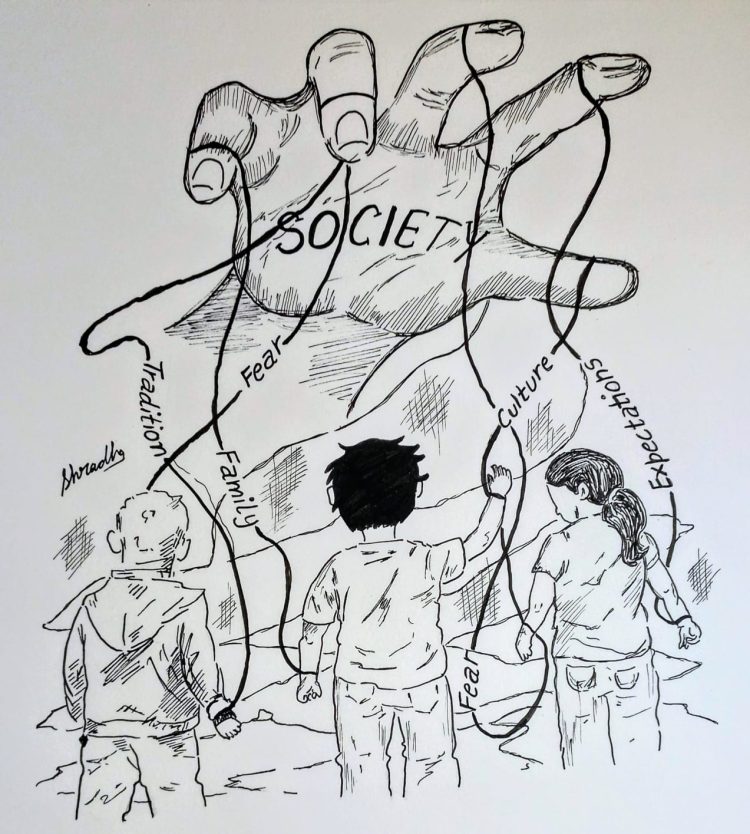
Society, especially in India, unknowingly plays a very key role in shaping our thoughts- how we think and how we make decisions. We try to evolve from it and make our decisions with the help of our own conscience, but that evolution is also unintentionally shaped by the will of society.
Let me present an example. A few days ago there was a solar eclipse, and I, as a student, did not care much about it earlier. But as it came closer and my family talked about it and the precautions we should take throughout the day, a fear slowly grew in my mind out of nowhere. I followed most of the rituals out of fear, which had not been present in me before. That fear was created by the discussions that took place in my family about its precautions and outcomes.
I would not have followed this if I had been in Lucknow, away from my family and my social environment, and I may not follow it in the future either. But that day society changed my view for a short period of time. It shaped my thinking from a scientific outlook toward culture and rituals. I am not saying it was bad that I followed these rituals, but the role society and family play in our decision-making, without any direct intervention, is very big.
Even if we want to challenge norms that we do not like, we have to go through the social process to make any visible change. It does not happen simply by criticizing them or boycotting them; change happens through the planting of new norms suited for today’s world, which themselves may become outdated tomorrow, just like the ones we are boycotting today. So even if we think we have changed and do not follow rules made by society, we are still part of it unknowingly. We do not choose to be part of it or abandon it completely; it is society that chooses us.
There are instances when we think that we have overcome society and that it no longer affects our decision-making and free will, but those instances are also outcomes of the social structure that we followed in order to bypass social norms. We may think society is bad or evil and that it manipulates our thoughts from the very core to favor its values, but most of the time it is not society actively affecting us; rather, we are the ones who get affected by society without any direct intervention from it.
Even when we move beyond one societal structure, we often move toward another that feels freer to us, but which may itself become outdated in the future. So we cannot really ignore society in our lives. What we can do is minimize its direct effect and try to deal with it in a conversational way while making our decisions on the ground of broader possibilities, maintaining a balance between our individual life and society. This may be the most practical way to remain part of society without being completely shaped by it.
We can also completely bypass society, but bypassing it means leaving everything behind that is part of it, because those parts will always mirror us in front of society. If we choose to become our own master, then we cannot afford to remain affected by family or culture in the same way. This path may be difficult, but it can create a pendulum effect where society begins to follow us. In such a situation, we become masters of ourselves as well as creators of new culture, new traditions, and a new society, which may again become outdated in the future, but in its time remains new and rebellious.