
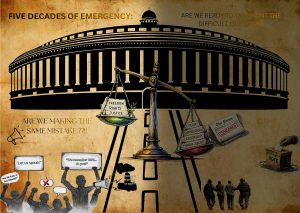
Court No. 24 reminds us that constitutional crises do not always begin with a proclamation. Sometimes, they begin when ordinary legal rules acquire extraordinary political consequences. It was in this very courtroom that the legal preface to the Emergency was written. On 12 June 1975, Justice Jagmohanlal Sinha set aside Prime Minister Indira Gandhi’s election after finding her guilty of electoral malpractice under the Representation of the People Act. It was the first time a sitting Prime Minister had to appear before a court as a witness. What followed over the next few weeks was an extraordinary chain of events: press censorship, the arrest of opposition leaders, suspension of fundamental rights, curbing of dissent, and widespread violations of civil liberties.
Recently, NCERT included a section on the Emergency in its Class IX textbook. This is a welcome step. Students must be taught not only the virtues of democracy but also the challenges that democracy has faced. Rather than revisiting the factual chronology of the Emergency, which remains well documented, this column seeks to confront some of the questions it continues to raise even today.
A journalist who extensively covered the Emergency once remarked, “India today is no longer the shining example of democracy that the framers of our Constitution envisaged.” Many may dismiss this as rhetoric, but several contemporary developments compel us to engage with such concerns. For instance, the police action against NewsClick and the arrest of its editor generated significant legal and public debate before judicial intervention. For many observers, such incidents revived broader discussions about press freedom and the limits of state power.
Media: The Fourth Pillar
India’s media has consistently ranked in the lower half of the World Press Freedom Index. Critics have pointed to instances where sections of the media have misreported sensitive issues, including falsely identifying an Indian student questioning the CBSE as Pakistani and initially describing a Kashmiri civilian killed during Operation Sindoor as a terrorist. Such incidents have raised concerns about journalistic standards and accountability.
Many also argue that sections of the media devote less attention to pressing public issues than to narratives that favour the ruling establishment. It often generates more sound than light.
The comparison with 1975 is instructive. During the Emergency, the press was subjected to formal censorship. On the night of 25 June, electricity to newspaper presses was reportedly cut to prevent publication. Yet not every publication remained silent. The Indian Express famously resisted censorship, even publishing a blank editorial as a symbolic act of dissent. Today, critics argue that formal censorship has, in many cases, been replaced by self-censorship and editorial conformity.
Elections and Democratic Competition
Democracy remains meaningful only so long as those in power face a genuine possibility of electoral defeat. Political scientists describe this as institutionalized uncertainty. Political analyst Yogendra Yadav, along with several international democracy indices, has described India as an “electoral autocracy,” a characterization that remains contested but nevertheless reflects ongoing debates about the health of democratic institutions.
History reminds us that even the Emergency could not permanently suppress democratic choice. When elections were eventually held in 1977, Indira Gandhi suffered a historic defeat. Senior journalist Coomi Kapoor recalls that outside the Indian Express office, where election results were displayed on a public board, crowds celebrated upon learning that Mrs. Gandhi was trailing from her own constituency. Slogans echoed through the streets: “Mummy meri car gayi, beta meri sarkar gayi,” with “Mummy” referring to Indira Gandhi and “beta” to Sanjay Gandhi, whose influence during the Emergency was widely discussed.
Democratic Institutions Under Scrutiny
Equally concerning are the debates surrounding institutions meant to safeguard democracy. Questions regarding the weakening of habeas corpus protections, reports highlighting declining public trust in the Election Commission, stringent bail provisions, concerns over prolonged incarceration of undertrials, and the perception that legal processes themselves can become punitive have all become part of contemporary public discourse. Similarly, allegations of political manoeuvring to secure legislative majorities continue to fuel debate about institutional integrity.
Whether one agrees with all these concerns or not, they point towards an important reality: democratic institutions derive their legitimacy not merely from constitutional provisions but from sustained public trust.
India’s democratic tradition is deeply rooted in discussion, debate, and dissent, dating back to the sabha and samiti of the Vedic period. In such a society, truth cannot—and should not—be suppressed. The Emergency remains a reminder of the consequences of concentrating excessive power and curbing democratic freedoms. As the country marks five decades since that defining chapter, its excesses should serve not merely as a historical memory but as a constitutional warning.
Returning to where this discussion began, students should not only learn about the Emergency as an event of the past but also engage critically with the democratic challenges of the present. Such awareness enables each generation to appreciate both the value and the fragility of constitutional freedoms.
To conclude, democracy ultimately rests on one enduring principle: it is the only form of government in which the power of the people can ultimately surpass the power of those who govern them.
