
Dear reader,
It has been a while since we caught up. And because I’ve promised myself to stop oversharing, I’ll simply say this: I was busy, and writing had to wait. Now, as I nurse my way out of a stubborn writer’s block, I thought I’d share a story from my life, one that doesn’t require invention; the story of Lucknow’s Annual Book Fair and me.
Every city has its rituals. In Lucknow, mine was this fair. My father began taking me there when I was small enough to hold his finger like a compass, dressed in little frocks, my hair tied in two pigtails, a bag slung across my shoulder that became, over time, something of a personality trait. Inside it, as a habit, were a few books and my little pocket dictionary. If you cannot tell, I really miss those old dictionary days, the thrill of flipping it open in public, and for a fleeting moment feeling like I possessed the kind of brilliance the world could not touch.
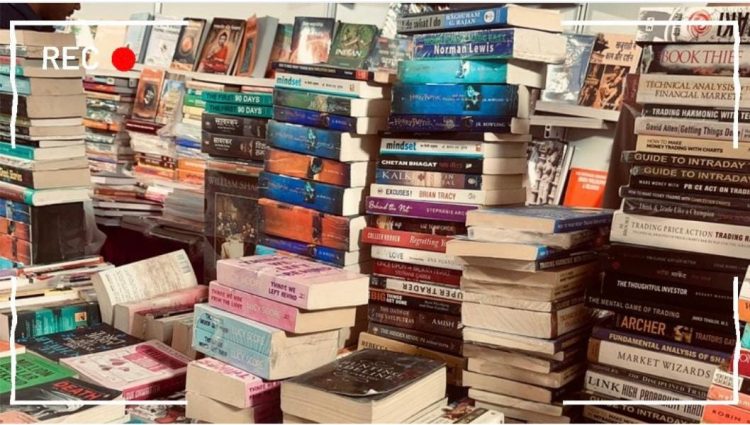
Back then the fair was hardly a “fair” at all: just scattered heaps of paperbacks piled on rickety tables, their covers curling in the dust. In those early years, it was mostly students and educators, exam guides piled high on tables, everyone stocking up on what they needed. But slowly, year by year, it grew, spreading its arms wider, bringing in publishers from across the country, and stretching its genres from textbooks to fiction, poetry, history, mythology, children’s books, self-help, and anything and everything you could imagine.
Despite its rusty old days, to my seven-year-old self it was nothing less than a carnival. It had a smell I could never quite name; it was not just a mix of notes, but a feeling. Back then, it smelled like possibility. Right now, it smells like childhood. Maybe one day, when I leave this city behind, it will return to me as the smell of home. And that is the thing about memories: they keep shifting shape and with it our perception. Each time we return to them, the frame tilts. The place itself does not change, but how we see it does. Through that shifting frame, I want to take you back to a book fair that, for me, has always been more than an event. It became a quiet map of growing up.
Year after year, the fair learned to dress itself. Tables became tidy stalls; volunteers became vendors with barcode scanners. The chaos folded into an order that wanted to be taken seriously. And yet, even as it modernized, the rite remained the same. You still had to elbow your way in, follow the tug of some invisible magnet toward a spine, make a choice that felt at once trivial and decisive. It was as if the fair were learning to walk alongside me, stretching itself into something more organized, more polished. But the heart of it never changed: the dizzying feeling of possibility, the suspicion that at any moment I might stumble across a book that would change me forever.
And I did change. My choices in books shifted as seasons do. As a child, I clutched fairy tales and comics, or anything with pictures basically. In my teens, I discovered novels that questioned authority and tradition, books that demanded that people take me seriously. Now, in my twenties, I seek out books that help me make sense of the world, that answer the questions I can not yet articulate, and, yes, I sometimes return to the books I could not access as a child, trying to make sense of the contradictions both around me and within me. But perhaps that is why I return to the fair so faithfully. It embodies a kind of constancy, a reminder that even as the stalls rearrange themselves and my tastes change, the act of searching remains the same: the hunt for words that might explain me to myself.To return to the same fair each year was to watch not only the city grow, but also my own reflection in the spines I carried home.
I believe return is an underrated verb. Contemporary ambition often valorizes novelty, the new city, the new degree, the new love. But return is the scaffold on which many lives are built. You realize growth is not always about breaking new ground; sometimes it is about retracing your steps and noticing the difference in the footprints you leave behind. The fair taught me that , when you revisit a familiar place with new eyes, you revise your past. You realize that you did not simply leave the old you behind; you carried it into your new life, and now it is a companion rather than a relic. The child who clutched fairy tales is not erased by the adult who seeks philosophy. She is the reservoir from which certain kinds of wonder still rise, the traces visible if you are willing to look.
And the metaphors are the fair’s natural language. The stalls are synapses, sellers the restless neurons firing conversations into your head: “Madam, two for one, classics!” The spines are streets on a map that reorients depending on your mood; sometimes the route leads to consolation, sometimes to provocation. Books are tickets, yes, but also periscopes. They let you look out and look around. When the world is too loud, a book becomes a subtle device for seeing what is otherwise obscured: the quietly complicit, the gently heroic, the devastatingly foolish.
And the world has felt too much, more often than I would like to admit. I have stumbled in ways I did not anticipate. There are a few things the fair has taught me, lessons that sneak out of the aisles and into everyday life.
First, patience. You can’t rush a good find. Sometimes the book you’re looking for is three stalls away, sometimes it’s not there at all. And that’s okay. Life works the same way ; you don’t always get what you want on the first try, but if you keep walking, keep searching, you usually stumble onto something worth keeping.
Second, curiosity beats certainty. At the fair, I’ve picked up books I never thought I’d care for or to simply make fun of them later, only to find they had the exact sentence I didn’t know I needed. It reminds me to leave space for surprise in life too ; to wander into conversations, ideas, or even mistakes that end up reshaping me.
And joy… joy is not something you wait for. You have to go to it. You bend down, brush the dust off a cover, whisper the first line to yourself just to hear how it sounds in your voice. It’s like stealing a dialogue from the universe , and reminding yourself it was always in the little things.
And letting go. Letting go is shelf space. You can’t keep every book forever. You rearrange, you let some go, you make space for the new. That’s how you move forward, not by erasing the old chapters, but by making sure the next ones have somewhere to land.
And yes, the fair is a place that teaches you to forgive yourself. I have brought home books because I thought they would fix me, as if a single paragraph could rearrange my bones. They did not. What books did, and what the fair kept teaching me, was how to keep trying. They taught me that repair is iterative, made up of small returns: a reread, a return visit to a stall, a conversation with a vendor who knows the inventory of sorrow and joy as intimately as anyone.
The fair has taught me to treat my life like a library: arrange the volumes, keep the ones that matter on the shelf within reach, and every so often, take down a familiar book and read it again, not to prove anything, but to remember who you were when you first believed a story could change you.
Over time the fair also outgrew its own definition. It stopped being just a place to buy books and became more of a festival, with musical events on stage, children painting and listening to stories in a corner, food stalls adding their own temptations. This year they even tried a kathak performance, proof that stories will find any way to spill beyond the page. It feels less like shopping now and more like the city gathering to celebrate itself through words.
Nostalgia, in this sense, is not merely an ache. It is a diagnostic, a way of testing what we have kept intact and what we have let go. The fair pushes you to interrogate the reverence you feel. Is your attachment to an old book a refusal to change, or a refusal to abandon something that still matters? I have tried to guard books from becoming tokens, props for an online persona, and failed often enough to learn nuance. Sometimes a picture of a book is just that, a picture. But other times that same book cracked open in a sunlit stall becomes a revelation, a hinge on which your day, or your life, swings. They let me borrow another life for a while, and in the borrowing, they teach me something about my own.
When I think of my father leading me through the aisles, I realize that these visits were not just about books. They were about inheritance, not of wealth or property, but of curiosity. To be taken to a book fair as a child is to be told, without words, this is how you might feed your mind. This is where you can go when the world feels too much.
My father does not walk beside me at the fair anymore. Perhaps it is because I have grown, able to find my own way through the aisles, and perhaps because he has grown too, older, slower, no longer able to linger for hours as I hunt for that one perfect paperback, or carry the weight of my ever-growing book bags. I understand this now, and in that understanding lies the quiet, tender evolution of our relationship, for better or for worse. We speak less than we once did, partly from uncertainty, partly from the unspoken negotiations of our lives, each of us unsure which parts of the other remain relevant.
And yet, whenever I return to the fair, I drift back to the seven-year-old version of myself clutching his hand, small and certain in a world that felt boundless but safe. I see him then, patient, steady, a compass through the dizzying possibility of the aisles, a gentle presence I never had to question. In those memories, the fair is more than books. It is light spilling over dusty tables, the faint smell of paper, the thrill of possibility, the mandatory ice-cream after, and the quiet sense that anything might happen if you only reached far enough. Time folds in on itself there, carrying both the ache of absence and the warmth of presence, leaving me with the knowledge that some connections, like the spines of beloved books, endure even when the hands that once held them no longer can.
Each year the fair grows, and I grow with it: new tastes, new doubts, new abilities to forgive; me and the people around me. The stalls change, the spines wither, but the magnet that drew a small girl to a crooked table continues to tug at me. Returning, I have learned, is not a surrender to the past. It is an act of preservation, an insistence that the self is built not only in breaks and newness, but in the faithful repetition of the places that taught us how to be. Every year when I walk those aisles, I see a younger version of myself in the corner of my eye, tugging at my father’s sleeve, holding a book with trembling hands. She looks at me as if to say, We made it here again.
And we did. Together, we keep growing.
And turns out I still need to work on my oversharing habit.
