
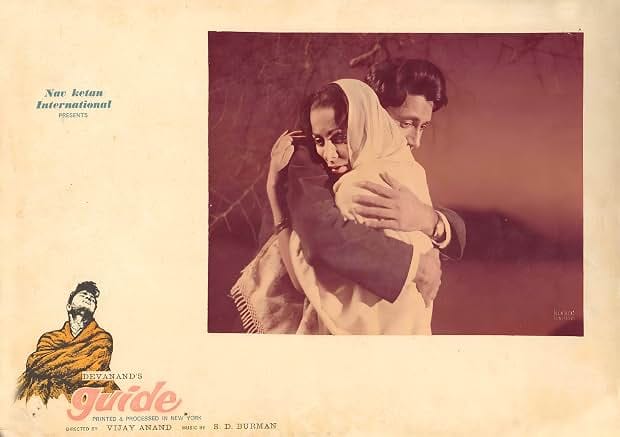
Upon following my rather over-optimistic goal of watching more and better cinema, I landed on Vijay Anand’s Bollywood cult classic, Guide (1965). I was reeling.
Having spent a weekend relishing the acts and whims of an utterly charming Dev Anand, I hardly expected to walk away with something spiritual, let alone mind-awakening, from the film. But Guide left me returning to it a second time, now armed with my own theories, questions, and tracings of the art.
Adapted from R. K. Narayan’s classic novel of the same name, the film apparently came with its share of disagreements between the author and the makers of the adaptation. Naturally, I ordered the novel almost immediately. If the film had left me with so many questions about its characters, I wanted to know what remained of them on the page.
This is an attempt to put together my observations of the film and the truths I found in Narayan’s novel. I am not here to fret over whether the book was better than the movie, or vice versa. I enjoy both in their own significance, and I would rather look at what each version allows its characters to become.
The privilege of being human
One of the things I miss in much of mainstream Indian cinema is the freedom of a character to be contradictory without having to justify that contradiction to the audience.
Our popular stories, more often than not, are built around familiar arrangements. Romance, family, sacrifice, the hero’s search for purpose, the eventual triumph of goodness, or some dramatic reconciliation between duty and desire. There is nothing inherently wrong with these stories. But somewhere along the way, characters can begin to feel like instruments of the story rather than people who exist beyond it. Their flaws are introduced to be corrected, their suffering is given a purpose, and their transformations are expected to arrive with some recognisable moral conclusion.
Guide, to me, is far more interesting because it does not seem particularly interested in making its characters behave.
Raju is charming, resourceful, and, for much of the story, rather easy to like. Rosie is a woman whose passion for dance cannot be contained by the life she has been assigned. Marco is an intellectual, absorbed in his research, whose indifference towards his wife becomes almost unbearable. Yet none of these descriptions is enough to account for who they eventually become. They are unpredictable but realistic, their identities never quite rigid, but shifting with their circumstances, desires, and contradictions. Their virtues begin to resemble their vices.
There is no classic transformation of the hero, villain, or other characters into neatly defined versions of themselves.
Guide exceeds the familiar story of a man finding his purpose. Its concerns are not merely about discovering what one is meant to do with life. They are about discovering what one is capable of doing with it, and what remains of a person when the image they have built of themselves begins to fall apart.
Nobody is entirely innocent
The novel offers an interesting starting point for understanding this complexity. Narrated through Raju’s perspective, it draws us into his life while gradually revealing the people who shape it. Rosie is not simply the woman who enters Raju’s life and inspires his transformation. She is an unhappy married woman with an immense passion for dance, caught between a life that suffocates her and an art that gives her a reason to exist beyond it.
Marco, meanwhile, is more than a convenient antagonist. His neglect of Rosie is difficult to forgive, but Narayan gives him a life and convictions beyond his relationship with her. He is devoted to his research, so absorbed in his own world that he seems almost incapable of recognising the emotional world of the person beside him. His flaws are not necessarily dramatic. They are, in some ways, more ordinary than that: the assumption that one’s own pursuits can justify the neglect of another human being.
Then comes Raju, charming, smart, and passionate, but not without his less admirable sides.
What I particularly enjoyed in the novel was the way it complicates our initial judgements. Marco, for instance, remains true to his word about including Raju’s name in his research book. It is a small but revealing detail. A man capable of emotional cruelty can still possess a sense of professional integrity. His failure as a husband does not automatically make him a dishonest man in every other aspect of his life.
I found this fascinating because it refuses the convenient division between good people and bad people. We are often willing to accept a character’s complexity only as long as it does not interfere with the moral position we have already assigned them. But what do we do with someone who hurts us and is still capable of doing the right thing? Or someone who loves us and still manages to betray us?
The three characters in Guide are connected by much more than love and resentment. They are connected by their own limitations, by the things they want from life, and by the damage they cause while trying to get them.
Raju eventually becomes corrupt, turning into a version of the very man from whom he had promised to rescue Rosie. Rosie, having left Marco and built a life with Raju, begins to see him differently as their relationship changes. Marco, too, attempts to win her back. None of them remains quite the person we first encountered.
There is something tragic in this, but also something recognisably human. We do not always become what we set out to be. Sometimes, in trying to escape one kind of life, we reproduce its very conditions elsewhere. Sometimes the person we despise becomes a reflection of the person we are slowly becoming.
And sometimes the person who once seemed to understand us best turns out to have understood us only as long as we served a particular purpose in their life.
Rosie, the artist, and the freedom to dance
There is something particularly fresh about Rosie’s relationship with dance, especially when viewed from where we stand today.
Rosie does not seem to chase the name, power, or fascination that comes with becoming a celebrated dancer. At least, that is not what makes her desire for dance so compelling to me. She wants to dance. She wants the freedom to embody an art that has lived within her for so long, an art she has been denied the space to pursue. The recognition comes eventually, but it does not feel like the original source of her longing.
I find this distinction rather beautiful. There is a difference between wanting the world to know that you are an artist and wanting the freedom to live as one. The former is concerned with the image one builds in the world; the latter, with the relationship one builds with the art itself. Rosie, at least initially, seems far more invested in the latter.
I particularly love the scene in which she dances to the rhythm of a cobra. There is something about that moment that makes me see Rosie as an artist, rather than simply someone who wants the world to know that she is one. Her dance seems to emerge from a place that precedes the audience, the reputation, and the applause. It is almost instinctive. She responds to a rhythm, inhabits it, and finds herself in the movement. The scene is not merely about demonstrating her talent. It lets us glimpse what dance means to her before it becomes a profession, an identity, or a means of making a living.
There is a certain freedom in that kind of expression, one that is difficult to explain without taking something away from it.
As Rosie becomes an established performer, her relationship with dance begins to change. What was once an expression of freedom becomes increasingly entangled with discipline, repetition, professional demands, and the machinery of success. The art that once offered her an escape from a suffocating life begins to acquire its own structures and expectations. The passion remains, but it is no longer untouched by the conditions of the world in which it must survive.
I wonder whether some of the hollowness she experiences can be understood through this change. When something we love becomes our profession, it must also become our responsibility. It acquires schedules, demands, and the expectation that we will keep producing, keep performing, keep being the person the world has come to admire. The very thing that once made us feel free can begin to feel like another arrangement we must submit ourselves to.
This is not to suggest that professional success necessarily kills passion, or that recognition somehow corrupts the purity of art. It is more that the relationship between an artist and her craft is not immune to the conditions under which that craft is practised. Loving something and having to make a life out of it are two different experiences, and the distance between them can be difficult to negotiate.
I find Rosie particularly compelling in today’s world because she does not fit neatly into the familiar image of the successful, self-sufficient woman whose liberation is measured through recognition, status, and professional achievement. There is nothing wrong with wanting those things, of course. But Rosie’s desire seems to begin somewhere else. She wants a life in which she can dance, in which her body and her art belong to her, and in which she is not condemned to the narrow identity her marriage has assigned her.
R. K. Narayan’s treatment of her becomes especially rewarding in the book, where Rosie is not simply an inspiring woman who breaks free from an unhappy marriage and proves herself through her career. She is a woman with her own appetite for life, her own vulnerabilities, and her own complicated relationship with love, ambition, and independence.
I wish we spoke about Rosie with greater depth. She deserves to be considered much more than the woman who escapes the constraints imposed on her. She deserves to be known as an artist trying to negotiate the freedoms she has won. What happens after you finally get to do the thing you have wanted to do all your life? What happens when the pursuit that once gave you a sense of freedom becomes the very thing around which your life must now be organised?
These questions make Rosie feel much more alive to me than a straightforward story of female empowerment would have done.
The strange business of transcendence.
The most compelling part of Guide is Raju’s eventual transformation.
I am usually suspicious of stories about finding one’s purpose. Too often, they arrive with the assumption that a person has some hidden, authentic self waiting to be discovered, and that once this self is found, everything will begin to make sense. There is something reassuring about that idea, certainly. It is also a little too convenient.
Raju’s journey is much messier.
He begins as a guide in the most literal sense, a man who knows how to lead others through places and situations. His charm, his instinct for people, and his ability to make himself useful become the foundations of his identity. But as the story progresses, the distinction between who Raju is and who other people believe him to be becomes increasingly difficult to maintain.
Eventually, he finds himself occupying the role of a spiritual guide, a position that rests on an identity he has not exactly earned through moral virtue. His transformation is entangled with deception, circumstance, and the expectations of others. He does not arrive at sainthood by following a carefully laid path towards enlightenment. He stumbles into a role that demands something of him that his earlier life never did.
I do not think Raju’s transcendence can be understood simply as a spiritual awakening, at least not in the superficial, self-help sense of the phrase. It is not a matter of discovering a higher purpose and suddenly becoming a better person. It is something more uncomfortable: the gradual recognition that one’s humanity cannot be reduced to one’s worst act, one’s most successful performance, or even one’s own understanding of oneself.
Raju has spent much of his life navigating the world through his ability to influence it. He knows how to charm, persuade, entertain, and manoeuvre. But there comes a point when those familiar abilities are no longer enough. The role he occupies asks him to confront a responsibility that cannot be managed in the same way as everything else he has done.
Can responsibility emerge from irresponsibility? Can sincerity grow out of performance? Can a man who has spent his life playing roles eventually become answerable to something beyond the role itself?
I do not think Guide offers an easy answer. And I am glad it doesn’t.
A story that refuses to sit still
What I admire about both the film and the novel is their resistance to predictability. Their characters are not simply good or bad, redeemed or condemned, liberated or trapped. They are allowed to change in ways that complicate our understanding of them, and the story is richer for it.
I think this could be the kind of movie you find yourself returning to again and again. Sometimes, you will see yourself in Rosie’s suffocation, sometimes in Marco’s unbearable nature, and sometimes in Raju’s gift of the gab. You will recognise Raju’s corruption, and then the transformation that comes through honest introspection. You will want to embody Marco’s intellectual order and Rosie’s artistic chaos.
I will leave you with a reflection from Raju:
“Nothing in this world can be hidden or suppressed. All such attempts are like holding an umbrella to conceal the sun.”
Truth will find its way to you. But how afraid can one be of one’s own liberation, when that is the only offering truth has ever made?
