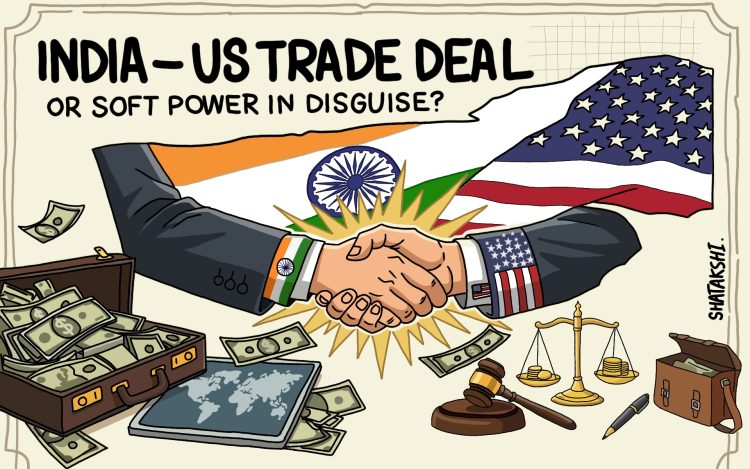
“When one leader’s deal has to be faced by an entire nation, it isn’t a deal- it is soft power in disguise.”
The India-US trade deal between Donald Trump and Prime Minister Narendra Modi is considered a milestone- a bridge between two major economies, a step toward stability in a fractured global market.
But this trade looks gold only on paper, while the real conversations lead in a different direction.
The trade deal isn’t only the talk of imports and exports. The partnership between India and the United States aims to ease tariffs, expand market access, and align supply chains in sectors ranging from manufacturing to technology and agriculture. But instead it gave the USA the power to decide on what’s good and what’s bad for our country.
Every major trade pact carries two parallel narratives.
One speaks of opportunity.
The other fears adjustment shocks.
Reduced tariffs may boost exports but also make imports cheaper, potentially threatening local production.
Regulatory alignment simplifies international business but may force domestic industries to upgrade or risk being left behind.
Digital trade provisions promise innovation and cross-border data flows. But it raises major questions- who controls the platforms? Whose rules will be followed? And who will earn the maximum profit?
Opposition leaders like Rahul Gandhi warn that trade frameworks must consider domestic consequences, particularly for farmers, small manufacturers, and emerging industries facing global competition without preparation.
The deal opens pathways to India and global markets but raises concerns about its impact. Will small textile industries survive? Will local products lose their edge? Will Indian technology rely on external systems? Will data be controlled domestically or by others?
These trade agreements are presented as economic necessities, but the structure designed makes them either a tool of growth or influence. Sometimes it can also be used to deploy their own power as they rewire how countries engage with globalization itself.
For India, the stakes are particularly high. And the loss is still evident.
It is defining how it wants to participate in the next phase of global commerce- as a protected developing market, or as a deeply integrated economic power willing to compete head-on.
Or in simple terms how will India move ahead in global matters.
Whereas, For the United States, the pact strengthens a strategic partnership in Asia, diversifies supply chains, and builds economic alignment with a rapidly growing nation. Making billions within a year.
And that is why skepticism around such agreements persists- not because cooperation is undesirable, but because imbalance can hide behind the language of partnership.
Some see this pact as India stepping confidently onto the global stage.
Others worry it risks allowing external priorities to shape domestic choices- from production patterns to digital ecosystems.
The challenge is not whether to trade.
The challenge is ensuring that participation is negotiated with clarity, transparency, and readiness at home.
A trade pact succeeds when it not only benefits the diplomats but the real world, the real numbers and the charts, and most importantly those which can’t make up to that number. To be visible in employment, resilience and innovation.
The real test of this India- US agreement will be seen in years.
Will the factories still run? Will the local market still thrive? Will the increased traffic protect domestic industries and make the ground cheaper for the locals or will it skyrocket the prices and disrupt supply chains?