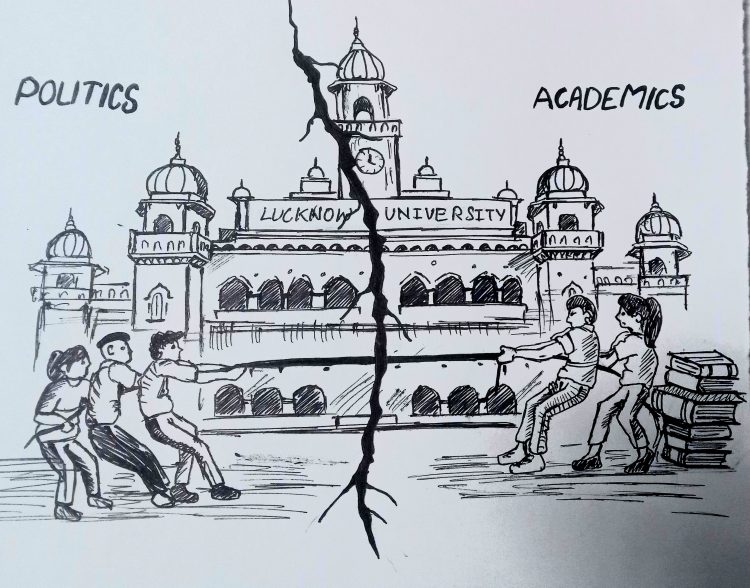
Lucknow University (LU), one of North India’s oldest academic institutions, has recently found itself at the centre of intense political debate. Over the past few months, the campus has witnessed protests, ideological clashes, and allegations of growing influence from political organisations. From demonstrations against visits by leaders associated with the Rashtriya Swayamsevak Sangh (RSS) to religious and ideological disputes among student groups, the university appears increasingly intertwined with the broader political climate of the country.
The question many students and observers are now asking is: Is Lucknow University gradually turning into a political central hub rather than just an academic space?
A Campus Caught in Political Crosscurrents
On 18th February 2026, the visit of RSS chief Mohan Bhagwat to the university sparked protests by several student organisations. Activists from the National Students’ Union of India (NSUI) demonstrated on campus, raising slogans against the RSS and accusing the administration of allowing ideological influence within the institution. Some protesters were detained as tensions escalated and security was tightened across the campus.
For supporters of the visit, the programme was simply an academic interaction with scholars. For critics, however, it symbolised what they see as an increasing institutional space being given to organisations aligned with the ruling political ideology.
This divide reflects a larger debate about whether universities should remain neutral spaces for academic discussion or platforms for political engagement.
Allegations of Growing RSS Presence
The RSS has historically been associated with student politics through its student wing, the Akhil Bharatiya Vidyarthi Parishad (ABVP). Recent campus events have intensified scrutiny over its presence at Lucknow University.
One controversy emerged when the campus hosted an RSS-related scholars’ dialogue programme at Malviya Hall. Security arrangements for the event reportedly led to campus gates being blocked for several hours, leaving many students unable to access academic departments or administrative offices. Critics argued that academic functioning should not be disrupted for ideological events.
For supporters, such events fall under the umbrella of intellectual exchange. Yet for others, they reflect a deeper institutional alignment with certain ideological organisations.
The Lal Baradari Controversy and Religious Tensions
Another major episode that fueled political tensions on campus involved the historic Lal Baradari complex within the university premises. The administration sealed the structure, citing safety concerns, which also restricted access to a small mosque located there.
Students from organisations such as the Samajwadi Chhatra Sabha, NSUI and AISA staged protests, alleging that the move prevented Muslim students from offering prayers during Ramadan. Demonstrators organised sit-ins, even formed a human chain to ensure prayers could continue peacefully outside the barricaded structure.
Soon after, another group of students affiliated with ABVP reportedly gathered near the site, chanting the Hanuman Chalisa and demanding “purification” of the location, further escalating tensions.
The university administration later issued show-cause notices to several students and asked others to furnish bonds to maintain law and order.
The episode highlighted how religious identity, student politics and administrative decisions can quickly intersect on university campuses.
The Larger Question: Universities and Political Influence
Universities have historically been spaces where political awareness and debate flourish. From independence-era movements to contemporary policy debates, student activism has played a crucial role in shaping India’s democratic discourse.
However, critics argue that when political organisations begin to dominate campus spaces, academic priorities risk taking a back seat. Supporters, on the other hand, believe that universities should remain open arenas where different ideologies can interact and compete.
Lucknow University’s recent controversies reflect this national tension between academic autonomy and political engagement.
Lucknow University today stands at an important crossroads. While student politics has always been a part of university life, the frequency of ideological conflicts, protests, and organisational involvement suggests a campus increasingly influenced by broader political narratives.
Whether this transformation represents a healthy democratic engagement or an erosion of academic neutrality remains a matter of perspective. What is clear, however, is that the university is no longer just a space for classrooms and research — it has also become a stage where politics, identity, and student voices intersect in powerful ways.