
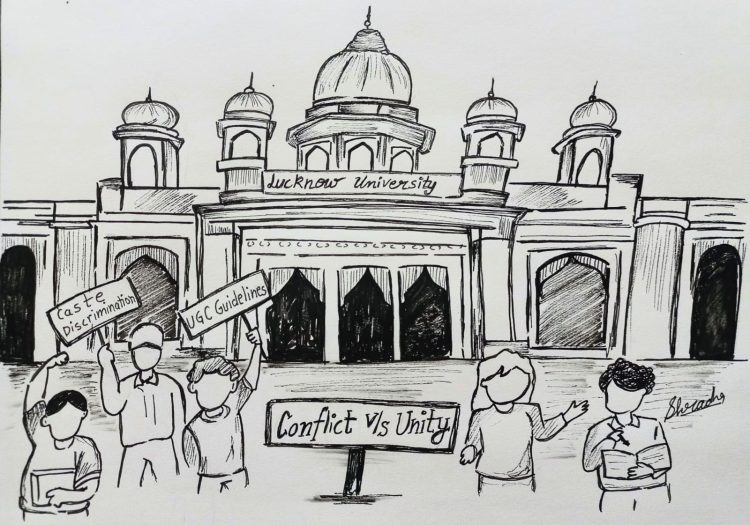
‘LU me padhte ho, neta mat ban jana’- this line might sound like casual slang, but while writing this column, I am pretty much sure that almost every second student on this campus must have come across it at some point. For the past four to five years, there was a sense of calm, but since last month, the political ground has once again ignited.
Two major incidents brought the campus into national headlines. The first was the protest against the UGC (University Grants Commission) Guidelines 2026, which were aimed at curbing caste-based discrimination within campuses. However, a perception arose that they would promote hostility among students and disharmonize the student community, as a result of which protests erupted, joined by students across communities. The protests received extensive media coverage, including a report published on the front page of The Hindu, an English daily. To my mind, this move might not be purely political, as if students feel resentful about directions issued by any regulating authority, they are free to register their dissent. Nevertheless, a few political commentators were skeptical about the alleged involvement of the ruling dispensation behind these mobilisations. Subsequently, a series of protests were reported in various educational institutions and public spaces alike. Whatever be the case, the Hon’ble Supreme Court eventually ordered a stay on these guidelines.
The second incident was more localised and purely a campus matter. Most students of LU must have noticed an old red structure within the campus, which became the centre of controversy between authorities and a section of students, consequently sparking outrage. At the onset of the Ramzan month, the university administration, citing the dilapidated condition of that structure, blocked entry and stopped some people from offering Namaz inside it. This refusal was enough to send waves of unrest across the campus. It triggered strong reactions, and protests began to emerge against the administration. Two days later, on Tuesday, students from other groups organised the recitation of the ‘Hanuman Chalisa’. As the situation escalated, the police had to intervene and took strong action, including the use of force, to bring the situation under control. For several days thereafter, that chauraha seemed like a ‘mini chhavani’, with a heavy police presence. Although the situation was eventually controlled, the incident again received significant media coverage.
Having briefly understood both incidents, we should now examine what actually triggered such outrage. Firstly, regarding the UGC guidelines- these were not entirely new. They were a revision of the UGC (Promotion of Equity in Higher Educational Institutions) Regulations, 2012, and were issued following directions from the Supreme Court, not solely at the discretion of the UGC. This is a widely misunderstood fact. Secondly, these guidelines were perceived by some as being anti-general in nature. Much of the skepticism stemmed from the composition of the committee that was supposed to examine complaints. The book Caste Discrimination and Exclusion in Indian Universities: A Critical Reflection by N. Sukumar (a political scientist from the University of Delhi) examines caste-based discrimination faced by Scheduled Caste students in India’s higher educational institutions. One of its key findings suggests that out of 600 students surveyed across various institutions, 77% reported facing discrimination at some point. Interestingly, when the matter reached the Supreme Court, the same bench which had earlier directed the UGC to issue such guidelines ordered a stay. This situation can perhaps be described as “throwing the baby out with the bathwater.” Students from the general community started to feel alienated, and hence nuances turned into nuisance.
Coming to the second situation, which was largely avoidable and ideally should have been handled better, especially within an educational institution- blindly relying on long-standing practices is rarely wise. On the other hand, if the authorities had taken the concerned people into confidence by issuing prior notice and engaging in dialogue, it might not have escalated to such an extent.
The elephant in the room is this: was there an attempt to make the university a political laboratory? The answer may vary depending on perspective. Regardless of this, the student community must remain cautious about such intrusions and refrain from getting excessively indulged in non-academic discussions within academic spaces.
Undoubtedly, Article 25 of the Indian Constitution guarantees freedom of religion, but the same Constitution also casts a duty on citizens to promote harmony and the spirit of brotherhood, transcending religious diversities, under Article 51A(e). In a nutshell, the purpose of writing this article is not merely to recount recent incidents but to remind the student community of its broader responsibilities and make them aware of underlying concerns. Ultimately, the reputation of any institution is shaped by the conduct of its students, and protecting it should remain a top priority.
JAI HIND.