
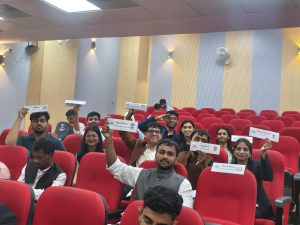
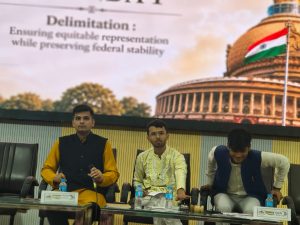
The All India State Summit (AISS) 2026 concluded on 27 July after an engaging parliamentary session that witnessed extensive debate on the future of India’s federal structure. The highlight of the closing day was the successful adoption of a draft resolution, which secured the support of the House after extensive deliberation.
The resolution was authored and presented by Preksha Vashishth, representing a Union Territory without a legislature, with delegates from Tamil Nadu, Rajasthan, and Manipur serving as co-authors. The draft also received the backing of 11 signatory states and Union Territories, reflecting broad inter-state consensus on key federal issues.
The resolution focused on three major reforms aimed at strengthening cooperative federalism. Its first article proposed reducing the Centre’s voting share in the GST Council from 33% to 20%, arguing that greater decision-making power should rest with the states.
The second article recommended extending the freeze on the delimitation of parliamentary constituencies from the existing 15-year period to 25 years, if necessary, to prevent demographic imbalances from disproportionately affecting certain states.
The third article called for the creation of a Joint Union-State Standing Committee on Delimitation and Fiscal Federalism, tasked with reviewing the implementation of these reforms annually until the next national census.
Delegates described the debate as one of the most substantive discussions of the summit, with participants presenting constitutional, economic, and administrative perspectives before the House voted in favour of the resolution.
Behind the success of the event were the members of the Executive Board:
- Arindam Chaturvedi
- Vibhav Shukla
- Sudeep Gupta
Throughout the proceedings, several constitutional interpretations from the Chair enriched the discussions and strengthened the intellectual discourse of the House.
Agenda I: Delimitation
Delegates from several southern states, along with representatives from the North-Eastern region, voiced strong reservations regarding the proposal. A common concern raised across these states was that population alone should not become the sole criterion for determining parliamentary representation.
Speakers argued that governance is influenced by several factors, including geography, development indicators, administrative challenges, and the successful implementation of public welfare policies.
The discussion concluded with an address by the representative of the Home Minister, who proposed an alternative reform aimed at reducing disparities in representation. The proposal suggested assigning different voting weightage to parliamentary seats as a means of balancing representation despite significant differences in constituency sizes.
Delegates questioned the constitutional practicality of such a proposal, asking on what objective basis different voting values would be assigned. Several members argued that unequal voting strength among elected representatives could resemble a veto-like mechanism and risk undermining the democratic principle of political equality.
The debate transitioned into an extensive Question Hour, during which delegates questioned both the Home Minister and members of the Cabinet regarding the constitutional, administrative, and electoral implications of the proposal.
Among the notable interventions was a Point of Information (POI) raised by the delegate representing Bihar, who argued that granting different voting weights could conflict with the democratic principle that every elected representative should exercise an equal vote within the legislature.
During the discussion, the representative of the Home Minister also clarified an earlier reference after inadvertently confusing the Preamble with Article 1 of the Constitution.
Agenda II: Fiscal Federalism
Following the conclusion of the first agenda, the House proceeded to Agenda II: Fiscal Federalism, shifting its focus from political representation to the financial relationship between the Union and the states.
Each participating state and Union Territory delivered a General Speakers’ List (GSL) speech of approximately one and a half minutes, outlining its position on fiscal autonomy and resource distribution.
Among the most discussed interventions were those made by delegates representing Uttarakhand, Manipur, Uttar Pradesh, Tripura, Karnataka, and Sikkim.
Their speeches highlighted the varying developmental needs of different regions and questioned whether a uniform fiscal approach could adequately address India’s geographical diversity. Delegates argued that hill states, border states, and geographically challenging regions often face significantly higher infrastructure and service delivery costs than states located in the plains.
The representative of the Finance Minister responded in the concluding address, defending the existing framework while acknowledging the importance of continued dialogue between the Union and the states. The address emphasised the need to balance fiscal discipline with equitable development.
A second Question Hour followed, during which delegates sought clarification on revenue-sharing mechanisms, GST Council decision-making, and the long-term sustainability of fiscal federalism. Questions from the Chair also addressed alternatives to tax devolution based solely on population and measures for the betterment of Manipur following ethnic clashes.
The exchange enabled ministers and delegates alike to engage in detailed constitutional and economic discussions on these technical issues.
Press Conference
One of the most engaging additions to the summit was the dedicated Press Conference, where student journalists representing The Hindu, The Indian Express, and BBC News questioned members of the Cabinet on policy decisions, constitutional interpretations, and the government’s responses during the debates.
The interaction extended beyond prepared speeches, compelling ministers to defend their positions in real time and respond to critical scrutiny. This added another layer of realism to the parliamentary simulation, highlighting the important role of an independent press in strengthening democratic accountability.
Conclusion
The House subsequently voted on the draft resolution, which was adopted following extensive debate, discussion, and deliberation, marking the formal conclusion of the summit.
Proceedings throughout the summit were conducted with a high degree of parliamentary decorum, discipline, and mutual respect. Delegates actively participated in debates, questioning sessions, and caucuses while adhering to established parliamentary procedure.
There were, however, a few moments of heightened political expression. During the unmoderated caucus, delegates from Uttarakhand and Jharkhand staged symbolic protests while advocating their respective positions. Although these moments briefly disrupted proceedings, they remained within the broader framework of parliamentary engagement.
Special mentions were awarded to the delegates representing Gujarat, the Home Minister, the Prime Minister, the Finance Minister, Rajasthan, Odisha, Karnataka, Bihar, both Union Territories, and Uttar Pradesh.
The summit concluded on a high note, reinforcing the importance of informed dialogue, constitutional values, and cooperative policymaking among India’s future leaders. It stood as a testament to academic rigour and meaningful constitutional engagement, providing participants with an immersive experience in parliamentary procedure, democratic debate, and public policymaking.
