
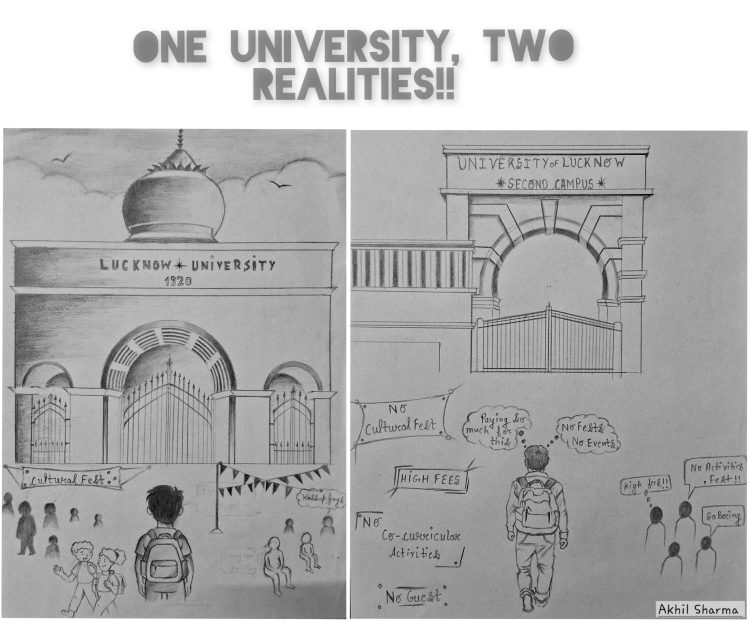
LUCKNOW University – For every student who secures admission to the University of Lucknow, the dream is painted in the crimson hue of its century-old bricks and the bustling, intellectual chaos of the Main Campus. It is a dream of walking through the majestic arches of Canning College and feeling the weight of a legacy that has shaped the state’s history. However, for a significant portion of the student body, this dream hits a sobering wall of reality the moment they are directed 12 kilometers away toward the Second Campus in Jankipuram. What follows is not a transition into a modern educational hub, but a descent into an “under-construction” existence that begs a serious question: Why is the university’s secondary identity being treated as a mere stepchild?
The disparity is not just aesthetic; it is structural and, quite frankly, exploitative. In a move that reeks of administrative irony, the management has placed most of its “self-financed,” high-fee courses—such as Engineering and Management—at the Second Campus. Students are essentially paying a premium price for a sub-par experience. While the Main Campus vibrates with the organic energy of diverse departments and a calendar brimming with fests, guest lectures, and student activities, the Second Campus is a cultural desert. Throughout the year, while the “Old” campus celebrates the vibrancy of student life, Jankipuram remains eerily quiet, ignored by the very management that pockets its higher tuition fees.
The 12-kilometer divide becomes even more insulting when it comes to basic administrative dignity. Despite being labeled a “New Campus,” the facility is so woefully incomplete that students must frequently trek back to the Old Campus for even the most basic documentation and bureaucratic hurdles. Why, in an era of digital transformation and “modern” expansion, is the management unable to provide a self-sufficient administrative block at Jankipuram? It is an ordeal that forces students to waste time and resources, proving that the university views the Second Campus not as a partner, but as a distant, neglected satellite.
One cannot help but wonder if the authorities realize that a university is more than just classrooms. Where is the landscaping? Where is the life? Students arriving with high expectations find an environment that is too open, too quiet, and painfully lacking in the soul that defines the LU brand. The infrastructure might be functional, but it is devoid of character. The “New Campus” moniker suggests progress, yet the reality remains a series of isolated blocks surrounded by an unkempt landscape that fails to meet even the basic standards of its older sibling.
This “exposure gap” is a betrayal of the students’ future. On the Main Campus, a student is at the nerve center of the city’s intellectual life. In Jankipuram, the experience is siloed, and opportunities for networking or co-curricular growth are non-existent. Why are the prestigious cultural fests and placement drives concentrated almost exclusively at the Old Campus? Decentralizing the university’s cultural and professional life is the only way to prove that the Second Campus is a priority.
Lucknow University is a single entity, and it is time the management started acting like it. The students of the New Campus have paid more than their fair share for the LU legacy; it is now up to the university to deliver an experience that matches the price tag. Anything less is a betrayal of the “Light and Learning” promised by the university’s motto. Until Jankipuram receives the administrative independence, the events, and the development it was promised, it remains a testament to management’s failure—a place where students come seeking a legend but find themselves stuck in a high-priced construction site.
