
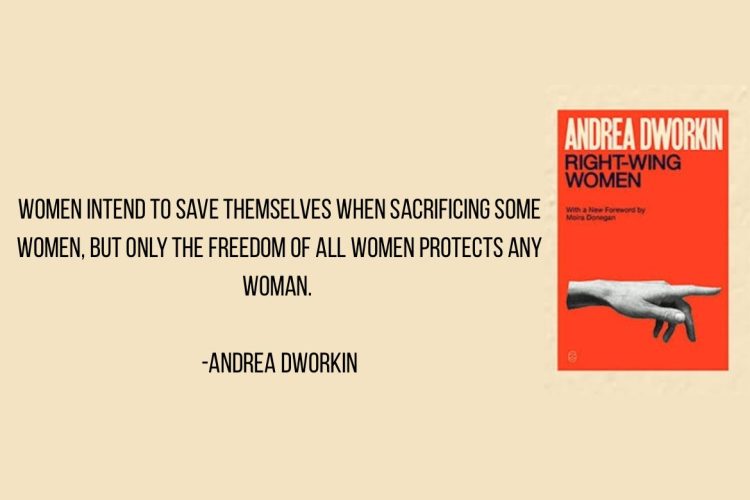
In the spring of 1983, Andrea Dworkin released a book that unsettled even her staunchest admirers. Right-Wing Women wasn’t a call to arms but an x-ray, a forensic, unflinching study of a kind of political allegiance that confounds both liberals and radicals: the woman who kisses the hand that chains her, who curtsies before the system that cages her, and calls it home.
Which brings us to a new kind of rhetorical headache: what do we do with women who want to redefine feminism as something that doesn’t challenge power, but gently complements it? Or worse, protects it?
This is the riddle we continue to skirt around: can a woman campaign against the very apparatus that gave her voice, and still be called a feminist? Or, to borrow the Indian idiom, does wearing bangles disqualify one from breaking them?
At first glance, it seems like a contradiction. How can women, especially in a country where patriarchy runs so deep, so forcefully advocate for ideologies that seek to restrict their rights?
But as Dworkin made clear in her study, these women are not confused. They are calculating. “Right-wing women do not want to be free,” she wrote. “They want to be safe.”
It’s not hypocrisy. It’s a curated contradiction. And contradictions, in the modern age, are among the most marketable ideologies of all.
To choose your chains is not to shatter them. The global feminist movement, already cracked and commercialized, now has to reckon with its most uncomfortable chapter yet: the women who don’t want in.
As Dworkin might whisper to us now from the margins of our liberal fatigue: just because a woman is holding the sword doesn’t mean it isn’t still war.
And here lies the conundrum that ought to rattle us: if a woman rises by pulling the ladder up behind her, if she cloaks majoritarianism in the language of dignity, is she still part of the movement?
Fascism in a Feminist Shawl
Can feminism, a movement built on liberation, accommodate women who freely choose authoritarianism?
Feminism, if one cares to look at the historical record, was not born from nostalgia or nationalist sermons. It began and evolved as a distinctly leftist project, nurtured in the salons of Enlightenment Europe, sharpened by anti-colonial revolutions, and radicalized in labor unions and civil rights marches. It spoke the language of justice, equity, and liberation — not for a single tribe, but across class, race, and geography.
And yet, unlike its right-wing antagonists, feminism never demanded homogeneity as the price of belonging. It has made space, sometimes painfully, for contradiction, dissent, and complexity. Precisely the things modern conservatism cannot bear.
The Left, as ever, stammers. It does not know whether to mock her, mourn her, or invite her to a panel discussion. Meanwhile, the Right holds her up as proof that their ideology empowers women better, because it doesn’t force them to shave their heads or read Judith Butler.
The Fortress of Femininity
In India, feminism has always been a difficult conversation. It must whisper in multiple languages, speak across caste lines, balance gods and constitution, and account for both sari pleats and scars. But the Right offers women something the Left often cannot: simplicity. A neat, nostalgic return to “real womanhood,” rooted in dharma, duty, and domestication.
Savarna women at the helm of right-wing discourse often frame themselves as protectors of Indian womanhood, without ever naming which women they speak for. The ideal Indian woman is always upper-caste, heteronormative, domesticated, and fertile.
Smriti Irani, a former soap opera queen turned Union Minister, has capitalized on this framework. Her brand of nationalist womanhood fuses tradition with visibility, a woman who speaks Hindi on English stages, quotes scriptures, and fiercely guards cultural purity. Her feminism is about dignity, not defiance.
But it is a selective dignity. It flows upward, never outward.
For others, like the women foot soldiers of the Durga Vahini (the women’s wing of the VHP), this role is even more militarized. They train in lathi drills, chant slogans against “love jihad,” and are taught that their wombs are political territory. Their enemy is not patriarchy. It is the Muslim man, the Western influence, the woman who refuses to marry or cook or reproduce.
In the name of protecting women, they become instruments of the state.
The Right has long dismissed feminism as a Western contagion ; alien to Indian values, corrosive to family structures, and fundamentally incompatible with the duties of a “good” woman Meanwhile, Dalit feminists like Ruth Manorama and Gogu Shyamala have long pointed out that, for most women, tradition has never been safe. It has been a landscape of caste-marked labor, sanctioned violence, and inherited silence. Feminism, for them, is not a Western imposition. It is self-defense. It is a way to stay alive in a country where tradition often kills.
From Paris to Prayagraj
India is not an anomaly. Across the globe, the far Right is increasingly female-faced. In France, Marine Le Pen gives xenophobia a motherly veneer. In Italy, Giorgia Meloni wraps fascism in family values. In the U.S., Marjorie Taylor Greene and Lauren Boebert weaponize femininity, lipstick, pearls, and all.
What unites them is not shared ideology but shared strategy. They do not wish to dismantle patriarchy. They wish to inherit it.
As Dworkin warned, power in the hands of the disempowered can be used to validate the system that crushed them.
And so we arrive at the sleight of hand. If feminism is diluted to simply mean “a woman in charge,” then even a woman who erodes civil liberties, strips reproductive rights, or fuels communal hatred can wear the label.
Can a Far-Right Woman Be a Feminist?
If feminism means individual empowerment, then perhaps yes. She climbs. She commands. She is seen.
But if feminism means collective liberation, the dismantling of hierarchies based on gender, caste, religion, sexuality, then no. Because her rise is built on the backs of others. Her empowerment depends on exclusion. Her politics demands obedience, not freedom.
Representation is not revolution. Visibility is not vindication. And not every woman in power is a victory.
The real question is not whether right-wing women can be feminists.
It is whether feminism can survive if it forgets whom it was meant to fight for.
Today’s right-wing feminism is individualistic, Instagrammable, culturally curated. It tells the story of the woman who succeeded within the system, and now insists that her success is proof that the system worked.
She says, It’s my choice. And she’s right.
That’s the hardest part. It is her choice.
Feminism does not , and should not , demand uniformity. But the question is: what happens when your “choice” just so happens to align perfectly with centuries of enforced obedience?
Is it feminism if it only serves women who conform?
Is it feminism if it empowers women by disempowering others — Muslim women, queer people, Dalits, dissenters?
Is it feminism if it’s only palatable when it’s palatable to patriarchy?
These are uncomfortable questions. But any feminism that avoids discomfort isn’t feminism. It’s branding.
So what do we say to the woman who insists she is a feminist because she knows her place and demands respect for it?
We nod. We listen. And then we ask:
What about women who don’t feel safe in that tradition?
What about women who don’t want to be anyone’s goddess, daughter, or deity?
What about women who choose freedom over protection?
And what about the women who do not fit into the majoritarian mold ; who are queer, Muslim, Dalit, childless, defiant, inconvenient?
That’s where feminism begins.In the refusal. In the voice that doesn’t echo yours.
And that’s exactly where saffron feminism, smiling and sanitized, refuses to go.
