
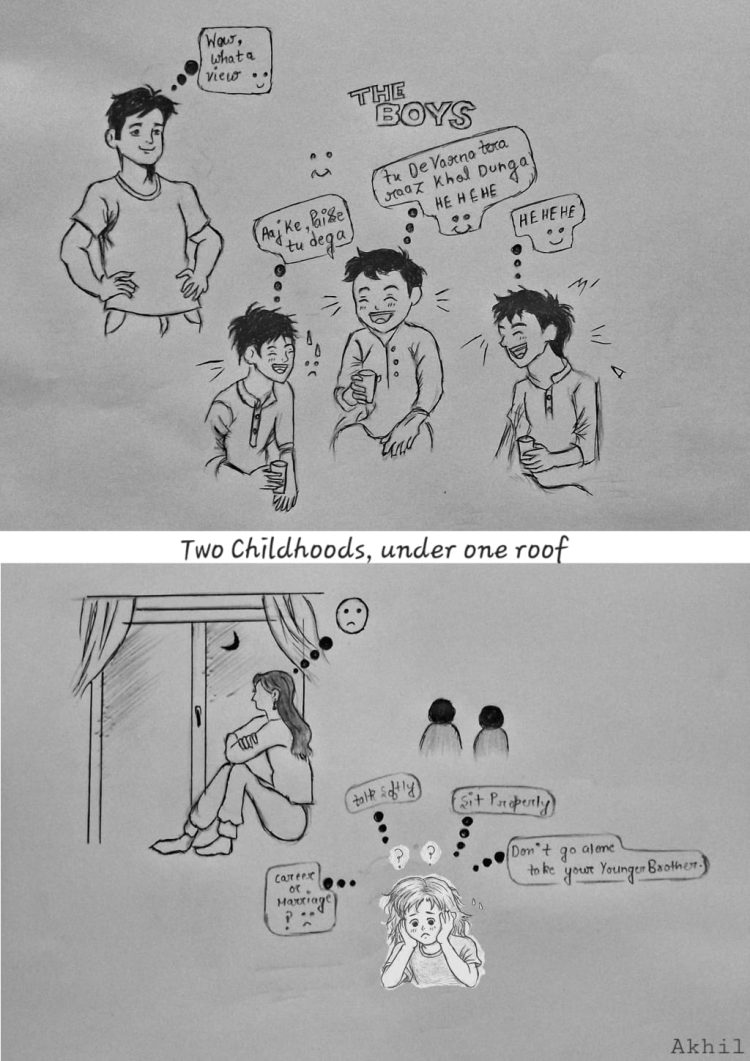
If both are raised under the same roof, why do they grow up in different worlds?
In many homes, the difference in how daughters and sons are raised is not always loud or obvious. It is quiet, woven into everyday habits, casual instructions, and unspoken expectations. It shows up in small moments, so ordinary that they are rarely questioned, yet powerful enough to shape entire lives.
A girl stepping out to the market is often told, “Take your younger brother along.” On the surface, it may sound like care. But beneath it lies a message she absorbs early: you are not enough on your own. Her safety is not seen as a right but as a responsibility that must be managed,often by a male presence, even if he is younger. The boy, in turn, grows up believing that his presence carries authority and protection, even when he has done nothing to earn it.
As they grow older, the differences deepen. A son is encouraged to explore, to fail, to try again. His mistakes are seen as part of growth. “He’ll learn,” people say. Risk-taking is framed as bravery, independence and even leadership. But for a daughter, the margin for error is painfully thin. She is told to be careful, to think twice, to not make mistakes,because one wrong step could define her whole being. She doesn’t get the luxury of trial and error; she is expected to get it right in the first shot.
Perhaps the most overwhelming difference lies in how their futures are imagined. For a son, life is seen as a long road of possibilities—career, ambition, independence. Marriage, if discussed, is just one part of his journey. For a daughter, however, marriage is often treated not as a chapter, but as the entire story. Her education, her behaviour, her skills,everything is quietly shaped toward that one event. It becomes less about who she is, and more about how well she will “fit” into another family.
This is where the idea of “paraya dhan” comes in.The belief that a daughter is someone who ultimately belongs elsewhere. While a son is raised as the “pillar” of the family, expected to support and carry forward the household, a daughter is raised with a sense of temporary belonging. She learns, often without being told directly, that this is not fully her home.
Then come the rules,so many rules. What she should wear. How loudly she should laugh. How much she should speak. Even how she should smile. “Sit properly.” “Talk softly.” “Don’t be too outspoken.” These are not just instructions; they are constant reminders to shrink herself. To be acceptable. To be “good.”
A son, on the other hand, is told to be bold. To speak up. To be confident, even dominant. His voice is encouraged, while hers is moderated. He is allowed to take up space; she is taught to make herself smaller.
Time, too, becomes unequal. A curfew exists for her, not always for him. The same street that is “unsafe” for a daughter at night somehow becomes manageable for a son. The responsibility of safety shifts unfairly onto her,limiting her freedom instead of addressing the larger issue. Why is he never told to come home early or on time? If you set time restrictions for your daughter to keep her safe, why don’t you set the same boundaries for your son to ensure he doesn’t make others unsafe?
And then there is softness. A girl is expected to be gentle, patient, and understanding at all times. Anger is discouraged. Assertiveness is mistaken for arrogance. ‘Your in-laws are not going to entertain your tantrums.’She is shaped into someone who adjusts, compromises, and absorbs. Meanwhile, a boy’s assertiveness is praised. His anger is excused and is even seen as a sign of boldness. His independence is admired
Over time, these differences don’t just create separate experiences,they create separate identities. The boy grows up believing he must lead, protect, and succeed. The girl grows up believing she must adapt, please, and endure.Then comes a stage when she begins to accept the fact that she needs a male member beside her to be safe. She no longer questions these sentences and accepts them as a harsh reality of this world.
Beneath all this conditioning lies a quieter truth: both are limited by these expectations. The boy is burdened with pressure; the girl is burdened with restriction. And both are denied the freedom to simply be themselves.
Change begins by noticing these patterns,not as traditions to be protected, but as habits to be questioned. Because raising a child should not be about fitting them into roles shaped by the past. It should be about giving them the space to grow, equally, freely, and fully human.
And maybe the real question is this: if we continue raising daughters to doubt themselves and sons to assume the world is theirs, what kind of world are we choosing to build?
The change doesn’t begin in big speeches or policies. It begins in these moments,in what we say, what we allow, and what we challenge. So the next time you witness it, don’t just let it pass. Question it. Because equality isn’t something children will learn someday,it’s something they are watching us practice every single day.