
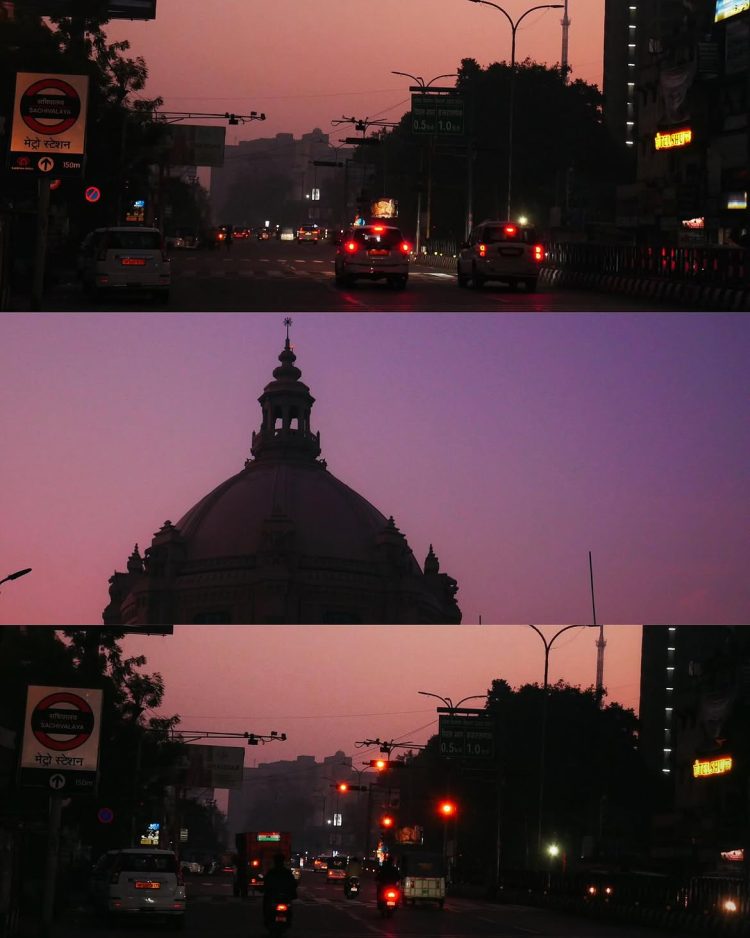
Take a deep breath. Feel the October air.
No, I am not talking about the AQI. Let us not ruin the mood this early.
I mean that October air. You can sense it, can’t you? Something in the evenings feels different. The sunlight has mellowed down, the rain has finally stopped behaving like it has a personal grudge against humanity, and somewhere between one ordinary afternoon and another, you realise that the year has entered its most subtly happening phase.
October has always excited me. Growing up, a significant part of that excitement came from the fact that my half-yearly examinations would finally be over, which, at that age, was reason enough to believe that life was beautiful again. But even beyond the academic liberation, October simply felt different.
(Not to mention that the University exam scheme has apparently ditched us)
It is still a month that refuses to sit still.
Summer is packing its bags, winter is standing outside the door but hasn’t quite entered yet, and October is somewhere in between, confused, chaotic and constantly changing. (Rather relatable, if you ask me.)
The afternoons still carry remnants of summer heat, but the evenings have started whispering about winter. Suddenly, stepping outside after sunset feels pleasant again. The markets become brighter. The streets become louder. Your mother has started mentally planning the Diwali cleaning operation(while you are actively pretending not to notice). Somewhere, someone is practising Garba steps with considerably more confidence than coordination. Navratri songs are ruling the wind everywhere. Dussehra melas begin popping up. And every conversation somehow turns into,
October in Lucknow has its own personality. The evenings begin to soften, Hazratganj seems just a little more inviting, markets begin glowing under strings of lights, and there is an unmistakable sense that something is approaching. Soon enough, winter will bring its own Lucknow rituals, the foggy mornings, the desperate search for sunlight, the weddings, the food and, of course, some gajar ka halwa and makhan malai(No, I’m not a fan of palak and methi, so they don’t find an honourable mention here.) Nevertheless, this month gives us the trailer before the full film arrives.
And perhaps that is what I love most about it. October is anticipation.
It reminds me that transitions do not necessarily have to be dramatic. Sometimes change arrives quietly, through cooler winds, earlier sunsets, different foods appearing in markets and a shawl that your mother insists you carry even though you are “absolutely not cold.”(Alright, enough trying to be Aristotle)
Although I must admit, there is one betrayal involved. The days start getting shorter while I somehow keep getting lazier. Nature is reducing daylight hours and apparently expecting me to remain productive. Very ambitious of her.
But October comes with another promise too: festivals.
And festivals are loud creatures.
But then, almost as quickly as they arrive, the festivals leave.
That part has always fascinated me.
We talk endlessly about festivals arriving. We write about their history, their rituals, their food, their significance. Every schoolchild has, at some unfortunate point, written the legendary essay beginning with something along the lines of “Diwali is the festival of lights and it is celebrated with great joy and enthusiasm.”(Our teachers were probably fed up long before AI-written essays came along.)
But trust me, this article is not that essay.
I am more interested in what happens the morning after.
What happens to the diyas we carefully bought from the roadside vendor? Yesterday, they were glowing along balconies and staircases. A few days later, they sit quietly in some corner of the house, their edges blackened, their purpose apparently fulfilled.
What happens to the rangoli that took two hours, four YouTube references and approximately seventeen sibling disagreements to create? Slowly, the colours begin to blur out. A footprint appears in one corner. Then another. Eventually, it disappears altogether.
(That is, of course, assuming it survived long enough to be photographed before being stepped on by a neighbourhood uncle who was “just coming to give mithai.”)
The flowers begin to dry.
The fairy lights come down.
The expensive outfit you spent weeks choosing returns to the cupboard, possibly never to see daylight again until someone announces a cousin’s wedding.
(How do I tell my mom I can’t wear a lehenga when she keeps saying, “Kapde leti ho dobara kabhi pehenti nahi”?)
The mithai boxes become progressively emptier, except for that one mysterious sweet nobody in the family likes but everyone politely refuses to throw away.
And the house becomes quiet again.
Perhaps that quietness is the strangest thing festivals leave behind.
For days, there were people coming and going. Doors opening. Someone calling from another room. Plates being passed around. Music playing. Children running through spaces they had specifically been told not to run through. Mothers insisting that everybody eat more. That unofficial lightman of the house(In my case, my father) checking whether the lights outside were working. His unofficial assistant (my brother) constantly saying- “Are yeh wali kharab hai! Yeh nahi jal rahi” and stuff. Grandparents telling stories you have heard before but somehow don’t mind hearing again.
And then one morning, there is simply… silence.
Suddenly, it is over. The laughter fades, the house feels strangely quiet, and the days that felt so full leave behind a silence we never quite know what to do with. For a little while, we had forgotten our separate worries and simply felt alive together. And when it ends, you cannot help but wonder how something so beautiful could disappear so quickly.
Even the things we wait for so eagerly eventually pass, just like time itself, leaving us longing for the moments we once wished would never end. And perhaps that is the saddest part, knowing that while we were living them, we never knew how much we would miss them.
The calendar moves forward with remarkable indifference.
But our camera galleries don’t.
They are suddenly full of photographs. Some carefully posed, some blurred, some taken because “one more, this one wasn’t good,” and some completely ridiculous photographs that will somehow become your favourites five years later.
(Let’s try to worry less about those instagram worthy aesthetic photos. Because trust me you are gonna love the goofy ones more in the future)
And perhaps this is where festivals become something more than dates on calendars.
They become archives.
A photograph from one Diwali is not merely a photograph of Diwali. Look at it years later and you will notice everything else. How young everyone looked. The house before it was renovated. The dress you were obsessed with. The person who no longer lives nearby. The cousin who was still small enough to be carried. The grandparents sitting in their usual corner. The version of you who existed then.
Suddenly, you are not looking at a festival anymore.
You are looking at time.
Maybe that is why festivals become more precious as we grow older.
As children, we measure them in holidays, sweets, new clothes and how late we are allowed to stay awake. Growing up quietly changes the mathematics. We begin measuring them in who managed to come home this year. Who couldn’t. How long everyone could stay. Whether all the chairs around the table were occupied.
Somewhere along the way, “Diwali kab aa rahi hai?” becomes “Iss baar Diwali pe ghar aa paoge?”
And that is a rather strange part of growing up.
The rituals stay almost the same, but the people performing them keep changing.
The hands making the rangoli grow older. Children become the people putting up the lights. Someone learns the recipe that somebody else always used to make. Someone takes over the responsibility of buying the diyas. Traditions quietly change hands without any formal announcement.
Maybe this is how culture actually survives.
The festival ends.
The ritual stays.
And perhaps that is what festivals truly leave behind.
Not the decorations. Not the sweets. Not even the photographs.
They leave little pieces of themselves inside us.
Years from now, October may look completely different. Perhaps we will live in different cities. The people we currently meet every day may be scattered across places we cannot imagine yet. The house may change. The celebrations may become bigger, smaller or simply different. Some traditions will survive stubbornly. Some will quietly disappear. New ones will find their way in.
And I sometimes wonder whether October will still feel like October then.
Will the first pleasant evening still make me think that festivals are near? Will fairy lights in a market still make something inside me inexplicably happy? Will I still wait for the familiar food, familiar songs and familiar chaos? Will I someday open an old photograph and realise that what I once considered an ordinary festival was actually a moment I would spend years missing?
After all, festivals were never meant to stay forever.
Maybe what they leave behind is the part we were meant to keep.
And I can’t help but wonder,
Years from now, will October still excite us in the same way?
Or will it slowly fade beneath the weight of responsibilities and the burdens of growing up?
Will you still pause, take a deep breath, years from now,
And feel
the October air?
