
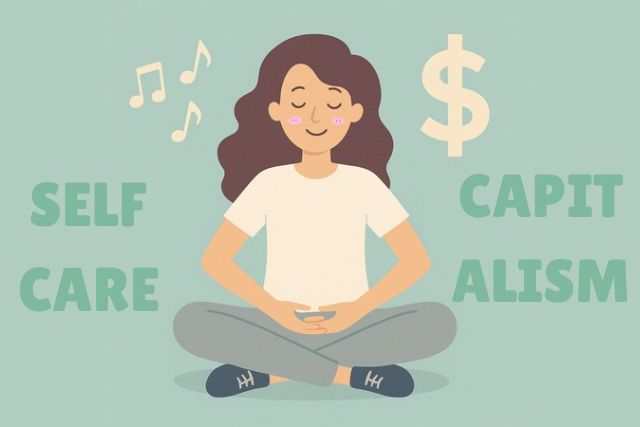
I lit a candle that smells like neoliberalism, poured myself a mug of herbal delusion, and tried deep breathing through the existential dread of unpaid internships and overpriced therapy. They told me self-care would save me. Turns out, all it saved was capitalism’s conscience.
This is your gentle reminder – the kind that sounds like a war drum – that you can’t meditate your way out of a system built to exhaust you. You can’t face-mask away the fact that rent has outpaced reality. You can’t lavender-oil your way past burnout when the burnout is the point.
The Origins of the Self-Care Industrial Complex
Let’s rewind. When Audre Lorde wrote “Caring for myself is not self-indulgence, it is self-preservation, and that is an act of political warfare,” she was speaking as a Black, queer, chronically ill poet in a society that denied her rest, dignity, and survival. Her notion of self-care was radical – a tool for resistance in a world trying to erase her.
Fast forward to 2025: that quote is now plastered on tote bags sold for ₹1,999 by corporations that underpay their women workers in Bangladesh where 80% of garment workers earn below a living wage. The radical has been repackaged as retail.
We’re encouraged to light candles while the world burns.
Even Exhaustion Isn’t Equal
Caste, patriarchy, and racism decide who gets to rest and who is worked to the bone. These systems don’t just oppress – they structure who carries the heaviest burdens of burnout. For example, in India, Dalit and Adivasi women are disproportionately represented in the most precarious, underpaid, and exploitative forms of labor, from sanitation work to garment factories — roles where rest isn’t a right but a risk. Globally, Black and Indigenous women, migrant workers, and queer communities face similar patterns, working longer hours in harsher conditions with fewer protections.
A corporate executive sipping turmeric lattes at a wellness retreat isn’t practicing the same “self-care” as a Dalit woman navigating caste and gender violence, or a gig worker juggling multiple jobs to survive. Rest looks different when you’re safe, when your survival isn’t at stake.
This is why the politics of care must remain intersectional. The idea that we can solve burnout through lifestyle choices alone erases how capitalism, casteism, racism, and patriarchy combine to keep rest out of reach for the most marginalized. Real self-care isn’t a luxury product; it’s the fight for a world where dignity, rest, and healing aren’t commodities, but rights.
The Business of Your Burnout
Capitalism has a genius for turning your pain into profit. It sells you exhaustion and then markets supplements to cure it. The gig economy – where over 7.7 million Indians now work, often without labor protections – destabilizes your attention span with algorithmic dopamine hits, and then tells you to unplug at a ₹3,000 digital detox retreat.
This isn’t self-care. It’s sedation. A glossy pause button on a system that’s eating us alive.
Meanwhile, billionaires do yoga on yachts. Wellness influencers sell $80 “charged” moon water while gig workers fall asleep on night buses. Therapy is locked behind a paywall – in India, only 0.75 psychiatrists are available per 100,000 people, with costs that put private therapy out of reach for most. Rest is a luxury. And everything that once meant healing – community, art, time – has been redesigned to turn a profit.
Burnout Is Not a Personal Failure
What’s sinister is how late-stage capitalism reframes structural issues as personal shortcomings.
-Struggling to keep up? Try a productivity planner.
-Can’t afford rent? Maybe you should budget better.
-Anxious and disconnected? You just need more “me time.”
This language makes burnout feel like a failure of character, not the consequence of exploitative systems. But here’s the truth: no one can “optimize” their way out of precarity. No matter how many vision boards you create, you can’t manifest your way into affordable housing or labor protections.
A 2024 BCG study found 48% of workers worldwide report burnout symptoms, with rates spiking to 62% in India and 61% in Japan, where overwork culture remains deadly (BCG, 2024). In the U.S., burnout costs the economy $300 billion annually, while in Europe, countries like Poland report burnout levels as high as 70% (World Metrics, 2024; Statista, 2023).
The Right to Rest.
Of course, rest is essential. Of course, taking care of yourself matters. But self-care, as it’s been co-opted, often becomes another burden – another should. And it’s always uneven.
Let’s be clear: You deserve care. You deserve slow mornings, nourished bodies, and lives not dictated by deadlines. But let’s not confuse survival hacks with liberation. The face mask won’t protect you from burnout. The scented candle won’t unionize your workplace. The five-step skincare routine won’t dismantle a system that profits from your insecurity.
We don’t need more bath bombs. We need better labor laws. We don’t need more “quiet quitting” think pieces. We need to loudly demand structural change.
So go ahead – drink that tea. Nap unapologetically. Journal like your future depends on it (because it does). But don’t stop there. Recognize the trap. Rest is not an end; it’s a weapon. Self-care should refill you for resistance, not numb you into compliance.
Because the truth is: you’re not burnt out because you’re weak. You’re burnt out because this system is designed to burn you out. And no amount of serums, smoothies, or Instagram affirmations will save us from that.
We will have to save ourselves – together.
