
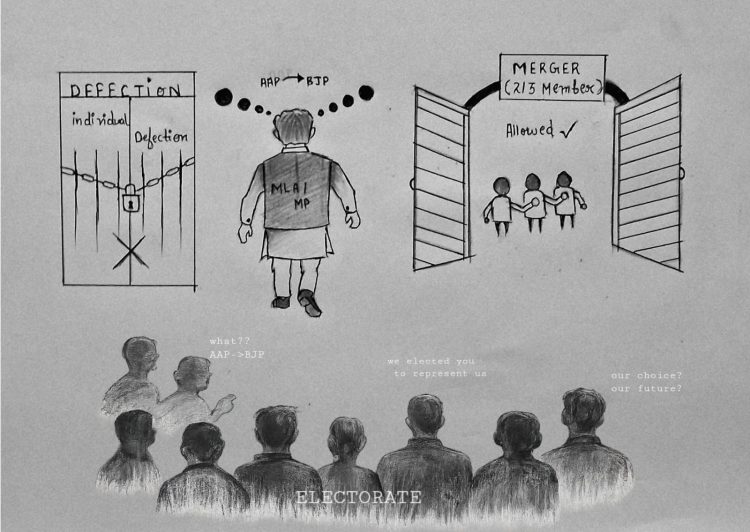
The recent defection of Raghav Chadha, an AAP MLA, from AAP to BJP has once again brought into focus the anti-defection law included in Tenth Schedule of the Indian Constitution. The anti-defection law and its interpretation give rise to several pertinent issues that need to be analyzed and answered. Defection is not the main concern; rather the law and its applicability need to be interpreted.
Enacted through the 52nd Amendment Act, 1985 in the prime ministership of late Rajiv Gandhi, the Tenth Schedule bars MPs and MLAs from resigning from their respective parties or disobeying the party whip. However, the Schedule also contains a provision which is highly controversial and gives birth to numerous debates. In case 2/3rd members of a party choose to become members of some other political party, then such an event is termed as a “merger” and hence cannot be deemed as defection.
The need for such a law was due to the political turmoil that was prevalent during the decades of 1960s and 1970s, which were described as the era of “Aaya Ram, Gaya Ram”. The term came from Gaya Lal, an Haryana legislator, who changed his party allegiance several times during the same day in 1967. He represented the trend of political opportunism that was rife in the period under discussion, wherein politicians kept on changing their political allegiances for petty gains.
Though the law is vital in certain ways, some doubts persist regarding its effectiveness and justice. Though it creates a stable government and eliminates instances of political opportunism, it does so at the expense of the freedom enjoyed by politicians by tying them down to whatever decision is taken by the respective political parties on any controversial issue. Another drawback of the law relates to the biasedness of the Speaker who decides the matter of disqualification.
Another aspect that becomes evident from the case of Chadha is that the law itself has another loophole; that defection is a crime committed by an individual and not a party, but defections by a group can be legalized under the merger clause. Thus, a loophole exists which allows for defections to occur on a large scale without the law being breached technically. In effect, what was being prevented has been legalized and structured.
This scenario, when viewed against the background of the constitution, poses many problems, especially since it concerns the balancing of the party discipline and representative democracy. In India’s parliamentary system of governance, parties are indispensable, but representatives themselves have been charged with the duty of independent decision making based on the opinions of their electorate. The defection law, however, tips this scale towards party discipline, thus depriving representatives of their legislative role.
Moreover, the recurrence of such massive changes in the political scenario indicates that the problem is both legal and ethical as well as structural. Even in cases where defection takes place within the purview of the legal provisions of the Tenth Schedule, there could still be a violation of democratic spirit. This has led to calls for various kinds of amendments in the anti-defection law in India. For example, the ambit of the whip should be restricted only to confidence motions. The authority for taking decisions must be vested in an independent arbiter rather than the Speaker. The merger clause, too, should be re-examined.
To sum up, the effectiveness of the Tenth Schedule is undeniable; it has been successful in minimizing the instability of the period of “Aaya Ram, Gaya Ram”. However, at the same time, defections have not completely stopped, but they have only changed their form.
