
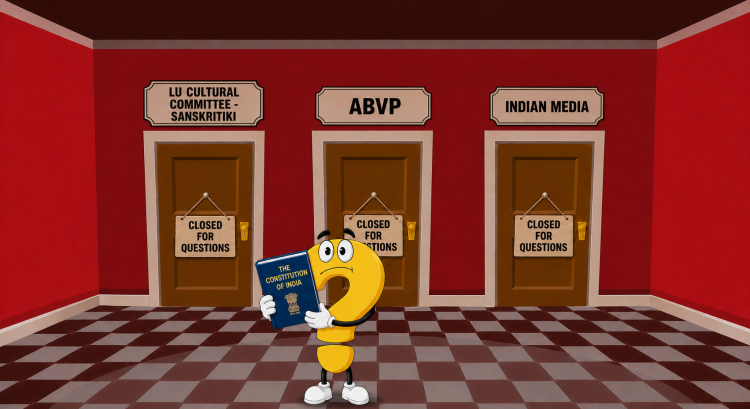
On any ordinary day, Jantar Mantar is a curious monument to time. The eighteenth-century instruments, built to measure the heavens, remind visitors that a nation once looked upward, to the stars, to possibility, to reason itself.
For nearly three centuries, they have watched empires rise, governments fall, and flags change.
In recent days, they have acquired a new object of study.
Not the heavens.
The republic.
The crowds that gathered beneath their shadow did not arrive to contemplate astronomy. They were students, aspirants, young professionals, and ordinary citizens drawn together by examination scandals, administrative failures, and the growing sense that accountability in modern India is often easier to demand than to obtain.
Soon enough, so did the familiar language of order, security, disruption, and inconvenience, the vocabulary through which governments throughout history have translated public dissent into an administrative problem.
The distance between those two positions tells the story of contemporary India.
But large political questions often enter history disguised as small ones.

And power, history repeatedly reminds us, possesses an unfortunate tendency to mistake compliance for legitimacy.
One would imagine that independent India, born from protest, would remember this better than most. Nations, however, possess a remarkable ability to forget.

1. Constitution
Most Indians encounter the Constitution twice in their lives.
First, as schoolchildren memorizing Articles, Amendments, Fundamental Rights, and Directive Principles for examinations.
And later, as adults, when institutions begin behaving in ways that force us to remember why those Articles were written in the first place.
Perhaps we are living through one of those moments now.
India’s founders understood something that modern governments periodically forget. Democracy is not merely a mechanism for choosing rulers. It is a mechanism for limiting them.
The Constitution was drafted by men and women who had spent decades watching an empire govern through hierarchy, bureaucracy, censorship, and coercion. They understood that power possesses an almost biological tendency to accumulate. Left unchecked, authority rarely disperses itself voluntarily. It concentrates. It expands. It seeks permanence.
The constitutional project was therefore not simply an exercise in nation-building. It was an exercise in restraint.
The question before the Constituent Assembly was not merely who should govern India.
It was how to prevent anyone from governing it too completely.
The answer was dispersion.
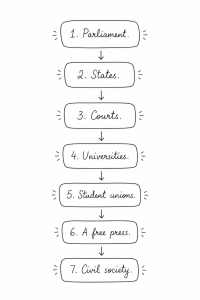
Each institution was intended to function as a counterweight to another. Each was designed to possess enough independence to question, challenge, and occasionally frustrate the others.
The genius of the Constitution was not that it trusted any single institution. It trusted many institutions enough to distrust one another. That distinction matters.
Democracy, at its healthiest, is organized skepticism. It assumes that power requires scrutiny. That authority requires oversight. That governments, however popular, should occasionally be asked uncomfortable questions.
Authoritarianism begins with a different assumption. It mistakes criticism for disloyalty. It treats skepticism as obstruction. It prefers certainty to inquiry.
One asks questions. The other already knows the answers.
The health of a republic, therefore, is measured not by how loudly it celebrates itself but by how comfortably it tolerates criticism, particularly when that criticism is inconvenient.
Which brings us, somewhat unexpectedly, to a university cultural committee
2. Sanskritiki
As students across the country debated constitutional rights, police brutality, accountability, and the meaning of citizenship, students at Lucknow University were presented with an essay competition on topics including ‘India’s rise as the world’s fourth-largest economy’, ‘two outstanding achievements of the state government’, and ‘two outstanding achievements of the Government of India’. This was not only poorly timed but also factually incorrect, for India is the 6th largest economy in the world.
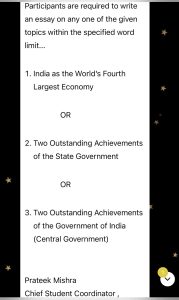
There is, of course, nothing inherently wrong with discussing achievements. A democracy should celebrate its successes. The problem arises when celebration becomes the only approved form of engagement.
Universities are meant to be places where difficult conversations are encouraged, where students are invited to interrogate power rather than merely applaud it. Yet at a moment when thousands of students across the country were discussing democracy, dissent, policing, constitutional rights, and the limits of state authority, Lucknow University’s cultural imagination appeared to extend only as far as government achievements.
The timing was difficult to ignore.
When asked about the absence of topics engaging with the political and constitutional questions dominating public discourse, organizers, including Cultural Committee Head Anchal Srivastava and Chief Student Coordinator Prateek Mishra, whose role as “Chief Student Coordinator” ostensibly places him at the intersection of students and administration, offered no explanation by publication time.
Their silence was difficult to ignore. Particularly because neither individual is generally known for being at a loss for words.
Both Anchal Srivastava and Prateek Mishra have rarely appeared reluctant to participate in public discourse. Yet when confronted with a simple question, why a university should not engage with the defining political conversation of the moment, words suddenly became scarce.
The competition itself was reportedly coordinated by Ruqaiya Ismail and Sofia Bano. When questions were raised regarding the framing of the topics and factual inaccuracy clarification proved difficult to obtain. Sofia Bano, when approached, reportedly declined to offer a response.

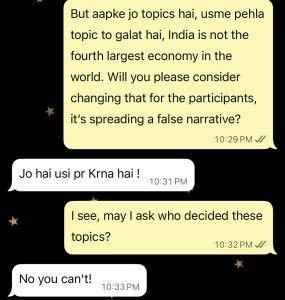
Perhaps that silence deserves its own essay competition.
One is forced to wonder what exactly the custodians of a university’s cultural life believe culture to be. If culture consists merely of celebrating achievements approved from above, then it is not culture at all.
It is public relations.
The most revealing aspect of the episode is not the competition itself. It is the absence of accountability surrounding it. The disappointing part is not that student organizers chose these themes. They are entirely free to do so. The more troubling question is why those entrusted with organizing public intellectual spaces appear so reluctant to publicly defend the choices they make.
Leadership, particularly within a university, is not merely the privilege of making decisions. It is the responsibility of explaining them.
The moment student leaders begin treating accountability as optional, they begin mirroring the very institutional culture that universities are supposed to teach students to question.
And that, perhaps, is the deepest irony of the entire episode.
Universities cannot teach democratic citizenship while simultaneously discouraging democratic scrutiny. The two are inseparable. The most effective systems of conformity rarely depend upon censorship. They depend upon incentives.
Nobody needs to ban uncomfortable conversations if institutions simply stop creating room for them. Nobody needs to suppress dissent if the only discussions deemed worthy of official recognition are celebratory ones.
The result is a peculiar culture in which everyone remains technically free to speak while simultaneously understanding which subjects are welcome, which subjects are inconvenient, and which subjects are best discussed somewhere else.
And perhaps that is the most troubling lesson of all.
The crisis of the modern university is not that students are forbidden from asking questions. It is that institutions increasingly encourage them to ask safer ones.
Or, more precisely, to ask questions whose answers are already known.
3. ABVP
Student organizations often tell us that they are the voice of students.
The claim sounds noble enough.
The real test, however, is not whether one speaks.
It is what one chooses to speak about.
ABVP, perhaps the most visible student organization in the country and certainly one of the most active on university campuses, has rarely been accused of indifference. Fee hikes, administrative decisions, hostel disputes, campus regulations, examination grievances and most importantly college romances, there is usually an ABVP banner, statement, delegation, memorandum, or protest somewhere nearby.
Which made the events surrounding Jantar Mantar all the more curious.
At a moment when students across the country were debating police action, constitutional rights, democratic accountability, and the relationship between citizens and the state, sections of the organization appeared occupied elsewhere. Among the activities promoted during this period was the Janam Shatabdi Varsha commemoration of Prof. Yashwantrao “Priya” Kelkar, one of the ideological architects of the student movement from which ABVP draws much of its intellectual lineage.
There is, of course, nothing wrong with commemorating historical figures. History deserves remembrance.
The question is one of timing. Or, more precisely, priorities.
What does a student organization choose to foreground when students are being detained, injured, and dispersed on the streets?
What does it consider urgent? What does it consider secondary?
The answers institutions provide in moments of calm tell us very little. The answers they provide in moments of crisis tell us everything.
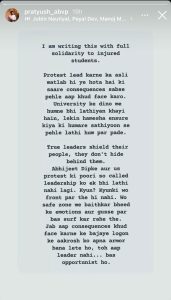
Former ABVP Lucknow University President Pratyush Pandey eventually entered the conversation, though not in the manner many might have expected. In a public statement expressing solidarity with injured students, he argued that true leaders stand at the front of movements and bear consequences before those they claim to represent. He criticized the protest leadership for allegedly remaining in a “safe zone” while others faced police action, concluding that “true leaders shield their people; they don’t hide behind them.”
It was a striking intervention.
Not because it challenged the state. But because it challenged the protesters.
One was left wondering whether the defining question of the moment was the conduct of student leaders or the conduct of institutions confronting those students.
The statement revealed an old political instinct. When unrest emerges, attention often shifts from the grievance to the grieved, from the conditions that produced a protest to the imperfections of those leading it.
The discussion ceases to be about why people are angry. It becomes about whether they are angry correctly.
Perhaps reasonable people can disagree about protest strategy. Perhaps reasonable people can disagree about leadership. But the asymmetry remains difficult to ignore.
The barricades appear. The detentions appear. The allegations of force appear.
And somehow the sharpest scrutiny is reserved not for those exercising power but for those standing on the receiving end of it.
There is an old tendency in politics to demand perfection from protesters while asking remarkably little of institutions. History suggests this is rarely a neutral choice.
After all, student movements are not remembered because their leaders were flawless. They are remembered because they forced societies to confront questions that institutions preferred to avoid.
And history has a habit of remembering where organizations stood during such moments. More importantly, it remembers what they chose to discuss while those moments were unfolding.
One suspects that future generations will be less interested in who won the argument than in who chose not to engage with it at all.

4. Journalism
The deeper problem, however, lies within the information ecosystem itself.
For most of modern history, political communication functioned like a pyramid. Information flowed downward. A handful of newspapers informed millions. A few television channels shaped public conversation.
Editors, anchors, publishers, and proprietors served as gatekeepers, deciding not merely what people knew but, to a considerable extent, what they considered worth knowing.
The arrangement was imperfect. But it was comprehensible.
Today, that pyramid has fractured.
Propaganda has decentralized. But so has resistance.
The same glowing rectangle on the palm of your hand, capable of spreading misinformation across continents can also document a police action from fifteen different angles. The same algorithm capable of amplifying conspiracy theories can unexpectedly become an archive of public memory. Technology, as it turns out, is politically indifferent.
For years, social media was dismissed as a factory of distraction. The kingdom of memes. The republic of brainrot. An endless scroll of dances, arguments, celebrity gossip, and increasingly elaborate methods of shortening the human attention span.
Then something unexpected happened. People began using it to report.
At Jantar Mantar, countless citizens encountered events first through independent journalists, livestreams, student accounts, freelance photographers, and eyewitness footage rather than through prime-time television. Information no longer arrived neatly packaged by institutions. It arrived raw, contradictory, immediate, and often unsettlingly direct.
This does not make social media inherently virtuous. It merely means that information monopolies have become harder to maintain. The significance of this shift is not that citizens suddenly trust social media. It is that many no longer trust traditional media to tell them the whole story. And, let’s be honest, institutions rarely lose trust overnight.
In one video that circulated widely online, a participant alleged that journalists from NDTV present on the ground were presenting a version of events that bore little resemblance to what protesters themselves were witnessing.
While mainstream television continues its remarkable transformation from watchdog to ventriloquist. One almost admires the consistency. Every democracy produces propagandists. India simply industrialized the process. The performance is so familiar that it scarcely requires a script anymore. One can often predict the villains, the patriots, the outrage, and the conclusion before the discussion has even begun.
Journalism’s first responsibility is not patriotism. It is inquiry. The reporter’s duty is not to comfort power but to interrogate it. A free press exists not because governments require applause but because democracies require scrutiny. The moment journalism forgets this distinction, it ceases to function as journalism and becomes public relations with better lighting. And yet the most remarkable development of the present moment may be that citizens have begun responding accordingly.
What makes this especially relevant to my article is that the media’s failure does not exist in isolation.
The university cultural committee preferred celebration to scrutiny.
Student leaders preferred silence to explanation.
Student organizations preferred debating the protesters to debating the conditions that produced the protest.
Large sections of mainstream media preferred managing the narrative to interrogating power.
Different institutions.
Different responsibilities.
Remarkably similar instincts.
Each, in its own way, seemed more comfortable discussing the margins of the crisis than the crisis itself.
This is why the story of Jantar Mantar cannot be reduced to a protest, an examination scandal, or a single confrontation with the police.
It is a story about institutions.
More specifically, it is a story about what happens when institutions that were designed to ask difficult questions become increasingly reluctant to ask them.
The Constitution imagined a republic sustained by competing centres of power: universities, student organizations, a free press, civil society, and democratic politics, each questioning the other.
What Jantar Mantar revealed was something far more unsettling.
The tragedy of the moment is not that power behaved like power. Power has always sought to expand itself. The tragedy is that too many institutions designed to question it appear increasingly comfortable looking away.
5. Conclusion
What happened at Jantar Mantar matters because it disrupts this logic.
The protest is not significant because it is perfect.
No movement is.
It is significant because it demonstrates that a generation raised on algorithmic entertainment has unexpectedly rediscovered citizenship.
They arrived as students. They were treated as a problem. And in that transformation they became something else entirely. A reminder.
That the Constitution is not a document stored in archives.
It is an argument conducted in public.
That democracy is not measured by the comfort of governments.
It is measured by the freedom of critics.
And that every republic eventually faces the same question:
Does power belong to those who govern?
Or to those in whose name they govern?
At Jantar Mantar, and amongst thousands of decentralised protests across India, thousands of young Indians appear to have answered.
Some in the country are still deciding whether they wish to listen.
Yet the protesters continue to gather.
Perhaps that is the most hopeful fact of all.
The instruments at Jantar Mantar were built to observe the sky.
The protesters gathered there are observing something else entirely.
They are measuring the distance between the promises of democracy and the reality of power.
And that distance, at the moment, appears alarmingly vast.
