
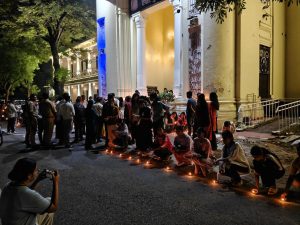
Prime Minister Narendra Modi’s birthday falls on 17 September. Respecting the Prime Minister or organising a programme on his birthday is, by itself, not unusual. Citizens, organisations and institutions may choose to mark the occasion in different ways. But when an educational institution organises a large-scale celebration, brings students together and lights lamps across the campus, it raises a larger question: What should be the relationship between political leadership and the university?
The question is not simply about one individual. Nor is it about whether students should be allowed to admire, respect or even celebrate a political leader. It is about the character of the institution in which such a celebration takes place.
A university is not merely a collection of classrooms, laboratories and administrative offices. It is supposed to be a space where young people learn to think independently, encounter competing ideas, question authority and understand the functioning of democracy. Its culture therefore matters as much as its curriculum. What universities choose to celebrate—and how they choose to celebrate it—can communicate something about the kind of intellectual environment they wish to create.
There is an important distinction between observing the significance of a constitutional office and celebrating the individual who occupies it. The Prime Minister is an important constitutional office-holder, and the office deserves institutional respect. But democratic respect for an office does not require treating the person occupying it as beyond criticism or question.
This distinction becomes especially important in a university because political leaders are not merely public personalities. They are also actors in the political system that students are expected to understand and critically examine. A university may hold a discussion on a Prime Minister’s policies, public career or governance record. It may invite supporters and critics to debate those subjects. Such engagement can have genuine educational value precisely because it allows students to examine political questions from multiple perspectives.
A celebration is different.
Celebration is not inherently undemocratic. Universities regularly celebrate national days, cultural festivals, achievements of students and faculty, and important historical figures. But when the subject of celebration is a serving political leader, the institution has an additional responsibility to consider how the event may be perceived and what institutional message it sends.
This does not mean that every lamp lit or every programme organised around a political figure automatically becomes political propaganda. Intent, context, participation and institutional involvement all matter. Students may participate for many reasons, including genuine admiration, curiosity, social participation or simply because the event is taking place on campus. The important question is whether the university itself maintains sufficient distance to ensure that an academic institution does not inadvertently become an extension of political celebration.
The issue becomes even more significant because universities are spaces inhabited by people with radically different political beliefs. A student may strongly support the Prime Minister. Another may strongly oppose him. Another may have little interest in electoral politics at all. All three are equally entitled to regard the university as their academic home.
That is why institutional neutrality should not be confused with political silence.
A neutral university does not need to avoid politics. In fact, it should encourage political discussion. Students should be able to debate the government’s policies, question opposition parties, examine the record of political leaders and discuss competing visions of the country. What matters is whether the institution creates space for disagreement rather than encouraging one political personality to occupy a position of unquestioned reverence.
This becomes particularly relevant when students are simultaneously dealing with ordinary but consequential concerns: fees, examinations, hostel facilities, academic resources, employment opportunities and the quality of education. Students naturally expect their university to devote institutional energy to these concerns as well. A university’s priorities are therefore worth examining not only through what it teaches, but also through what it chooses to publicly foreground.
There is also a broader phenomenon worth considering. Across India, political leaders have increasingly become subjects of highly personalised public celebration. Birthday events, large-scale public programmes, symbolic gestures and campaigns can transform political figures from office-holders into cultural personalities. Supporters may see such celebrations as expressions of gratitude or public affection. Critics may see them as an extension of personality-driven politics. Both interpretations exist in a democracy.
The university, however, occupies a somewhat different position from a political party, a private organisation or a group of supporters. Its legitimacy comes from its educational and intellectual function. This makes institutional restraint particularly valuable.
A university does not become less democratic because its students admire a political leader. Nor does it become more democratic simply because it criticises one. The real test is whether students retain the freedom to do either without feeling that the institution itself has already taken a side.
The larger question, therefore, is not whether Narendra Modi should be respected, whether his birthday can be observed, or whether students should participate in such an event. The question is what kind of political culture we want our universities to cultivate.
If universities are meant to prepare citizens for democracy, then they should teach students not merely how to celebrate power, but how to examine it. They should provide space for admiration as well as disagreement, support as well as criticism, and participation as well as dissent.
Respect should not replace questions. Celebration should not replace education. And political engagement should not come at the cost of intellectual independence.
A university’s greatest contribution to democracy may ultimately be its ability to produce students who can stand before power—regardless of who occupies the office—and still feel free to ask: Why?
