
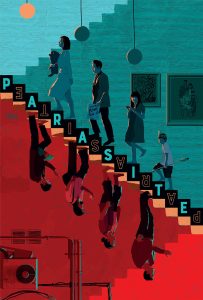
When we read a novel, we look for recurring motifs, treading the pages on our toes to decode the clues before the author can unravel the plot twist. We rarely approach films with the same patience. Parasite (2019), directed by Bong Joon-ho, deserves exactly the kind of study literature is subjected to. There is more being communicated than what the characters say aloud; much of the film’s commentary on class is embedded in what we see.
At its heart, Parasite is built upon the foundations of inequality, but it is scarcely interested in portraying the problem as a statistic or an abstract adversity. The movie forces us to confront how ugly, how uncomfortable the conversation actually gets for the underprivileged.
The House
In many novels, a house becomes an extension of the people living inside it. Think of Wuthering Heights or The Great Gatsby. Parasite follows the same tradition.
The wealthy Park family’s home appears minimalist and elegant, an amenity far removed from the grasp of the middle-class. Sunlight pours through enormous glass panes, and every room is designed for basking under its toasty warmth. The Kim family’s semi-basement apartment, in contrast, is cramped, cluttered, and permanently half-underground. Their window doesn’t frame a beautiful garden. It frames drunken strangers and fumigation smoke drifting inside.
Neither house is merely a backdrop, but rather the physical evidence of their class.
The Staircase
In the film, the characters are constantly climbing or descending. Sounds simple enough, right?
Well, the perspective changes drastically when one delves deeper into the keynotes.
The Kims climb upward whenever they move closer to wealth, descend whenever reality reasserts itself. The hidden bunker lies beneath even the sumptuous house, suggesting that someone can always fall further. The famous rain sequence illustrates this perfectly.
As the Parks enjoy the rhythmic drizzle from their comfortable home, the Kims run downhill through incessant staircases until they reach their flooded neighbourhood. Bong stretches this descent far longer than necessary, much like a novelist extending a paragraph for emotional weight. He forces us to experience exhaustion and dread alongside the characters. The destination matters less than the movement.
The Scholar’s Stone
Early in the film, Ki-woo receives a scholar’s stone, traditionally associated with wealth and prosperity. At first, it feels symbolic in the obvious way.
Then it changes.
As the story progresses, it gets linked with the mass of aspiration instead. Ki-woo carries it with him, treats it as a symbol of his family’s future, and takes it into the hidden basement. There, the symbolism takes a darker turn. Geun-sae picks up the same stone and uses it to strike Ki-woo in the head, turning the bringer of prosperity into an instrument of violence. What begins as a promise of ascending mobility ultimately becomes part of the brutality that pulls Ki-woo back down.
Good novels often transform symbols instead of repeating them unchanged. The green light in The Great Gatsby evolves, the conch in Lord of the Flies evolves, and so does the scholar’s stone in Parasite.
The Window
The film moulds windows into a metaphor of their own, a gateway to brilliant storytelling.
The Parks’ enormous window encases survival. Both families can look outside, but what they see, and how close they are to it, could not be more different. One family watches rain, the other watches sewage rise. One experiences a view, and the other, an intrusion.
This difference echoes a literary technique called focalisation, which is the idea that the perspective where a story is told from shapes what reality looks like. Two windows, two worlds.
The Smell
One of Parasite’s most unsettling motifs cannot be seen at all: smell. The smell associated with the Kim family becomes a sporadic marker of class.
The Parks mention it casually, describing it as something that sets the Kims apart, while the Kims themselves become increasingly conscious of it. This makes smell function like an invisible social boundary. Unlike clothing, education, or manners, it is something the characters cannot immediately perform their way out of.
In literature, recurring sensory details often reveal what dialogue refuses to say. Here, smell articulates prejudice that the characters rarely address openly, but which nevertheless morphs how the Kims are perceived.
The Food
Food in Parasite rarely exists to satiate appetite. An ordinary domestic activity repeatedly becomes a reminder of who belongs at the table and who is expected to remain behind it.
A striking example of that is the famous ram-don, or jjapaguri, prepared with expensive Hanwoo beef. An inexpensive instant noodle dish elevated by an ingredient of luxury. The familiar and the extravagant are brought together in a single bowl, much like the Kims’ own attempt to enter the Parks’ world, but their proximity to wealth does not erase the distinction between having privilege and only having access to it. It becomes the perfect metaphor for imitation.
The Kims learn the Parks’ language, wear their clothes, and work in their house. But like the noodles, they remain expected to accommodate splendour rather than become part of it.
Birthdays, dinners, and meals, all reinforce this hierarchy.
Who serves? Who eats? Who cleans afterward? The answers rarely change.
These disparities may appear insignificant in isolation, but the film repeatedly returns to them until they become impossible to ignore. Food therefore becomes another language through which Parasite communicates class.
The Ending
The ending introduces what appears to be a glimmer of hope: Ki-woo dreams of becoming wealthy enough to purchase the Park house, freeing his father from the hidden basement, and piecing the jigsaws of his family together again. Then, Bong Joon-ho pulls the rug from under his feet and reveals the sequence as a fantasy, like a splash of cold water to the face.
The final return to the basement alters the tone of the ending from optimism into something closer to tragic realism. The dream itself is not mocked as foolish and undeserving, but rather the system surrounding it. Instead of questioning Ki-woo’s desire for a better life, it questions whether individual fervour can overcome circumstances fashioned by an entrenched social structure.
Like the greatest novels, Parasite ends by asking a question rather than offering closure.
Can ambition alone erase systems built over generations?
The film never answers directly. Instead, it leaves us staring at the same window where we began.
