
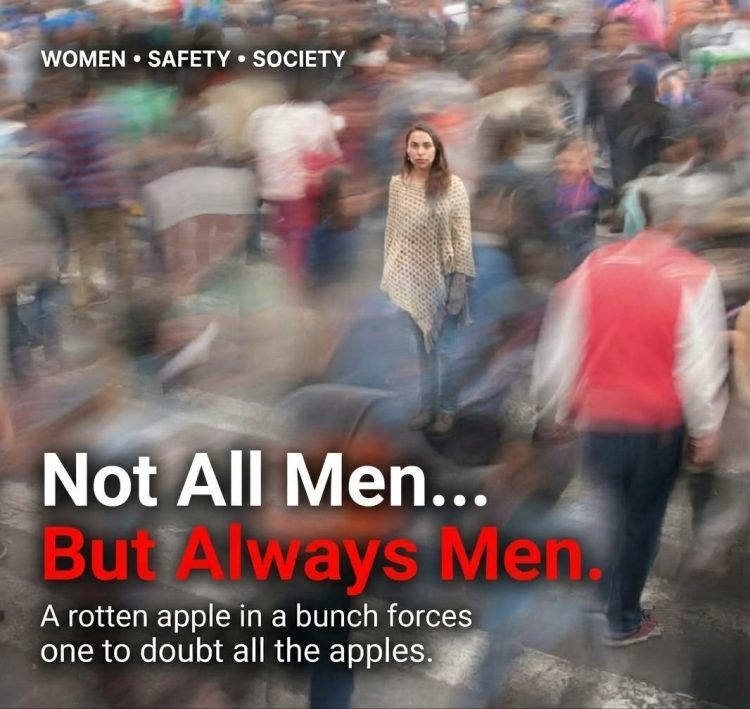
All men?
“Aapko aao chordu madam” “Areyy kaha jana hai? Batao toh”
An auto-rickshaw driver said this when my friend and I were near the Indira Nagar metro station, which is heavily crowded, multiple security guards on duty, a police station within the 50 metre radius, and a working CCTV camera.
We were wearing a top and a pair of jeans and had makeup on.
A drunk auto-rickshaw driver grabbed our hands and nearly fled the auto, we had to jump. Same spot and we were wearing kurtis that day.
Another day,we wore full kurta sets( with a dupatta). We were harassed by some men in Aminabad where three traffic police and one officer in uniform was present.
We were told to stand in one corner while we waited for the signal.
I was wearing my college uniform when a car pulled over and followed me.
Location: Pink booth, Polytechnic
And so many more cases like these. While our clothes were different in each case, one thing was common: it was always a man who had the audacity to harass us right in front of other people who acted like nothing happened. This crowd included women who didn’t seem to notice anything, and several men who would otherwise be the first to join the discussion of how “not all men”.
I agree it isn’t “all men” but it is always “men”. While harassment cases are normalised, you’ll come across a big percentage of people who would not miss a chance to blame the women for their clothes, the time, the place, and whether or not you wore a red lipstick. They would simply either ignore the incident or choose to enjoy the scene because why not?! It is entertaining to see such cases.
We, as a society argue how not all men are wrong and do not argue enough how cases of rape, harassment, and hate crime against women have become a normalised event of the day.
The stats do not always reveal the truth. There are several loopholes in that.
GDP isn’t a true indicator of the development of the country. Similarly, statistics presented about such cases do not reveal the ground reality.
Obviously, when I say I am scared for my life because of men, it does not include the men in my life who are respectful, my male friends with whom I’m comfortable, my father, my brother, etc. Isn’t it obvious that it is my way of calling out the real issue, which is women being objectified no matter what they wear, catcalled in broad daylight, stared at as if we are aliens, and passed comments at, etc.
I’m not even talking about rapes, the real numbers would shock you to the core. The everyday struggle women have to face just because they are women and apparently have different anotomy than men.
“Cover your chest!”
“It’ll attract unwanted attention!”
“Cover your waist!”
“People will stare.”
“Cover your back!”
“You’re showing too much skin.”
“Your legs are showing!”
“You’re wearing cut sleeves!”
“You’re wearing full sleeves but oh,we can see your curves!”
“You’re fully covered but oh you have makeup on and jhumkas,you’re asking for attention!”
“You’re fully covered?! But you’re still a woman!”
That is how frustrating this whole issue is for us. You see news stories where major cases are highlighted. This issue, for men, is somewhat limited to news channels, debates, and statistics, but for women, it is the everyday reality.
Four women together aren’t safe. Even if you have a male friend with you, it still doesn’t stop one from getting harassed.
Yes, a lot of men are respectful enough to not make someone uncomfortable, to help women in such cases, and to provide support. But look at the paradox: some men are protecting women from who? “Men”
The problem isn’t “all men”, the problem exists because men are raping, harassing, and spreading hate crime against women.
Why can’t “these men” be punished in a way that means we, as women don’t have to rely on men to protect us from men.
Isn’t it basic human decency to not rape?
I get the whole outrage of how some people are offended by the slogans and ideas, but the main point here is that the whole movement’s plea for a stricter system, and for basic right not to be killed because of men who choose to take part in such hideous crimes.
If you go through something every single day, won’t you be frustrated? Just imagine if such things happened you every single time, will you trust anyone?
How can women even trust “the good men” or the “allies of feminists”? How do we even distinguish? What is the probability of us getting stuck in a situation where we might not be able to save our lives if we choose to trust the fact “not all men.”
If you hear news about people getting robbed, would you as a man, choose to think “Oh, not all people” and just be carefree about your safety? You will doubt every single person you come across.
We, as women face such things everyday. Travel route, work place, schools, and colleges are not safe, and many women aren’t even safe in their homes.
How can we say who is good and who is bad.
Because of such tricky issue, when there is an outrage, women are frustrated and are in an urgency to bring about a change. They tend to not trust every random man they come across.
According to the National Crime Records Bureau (NCRB) data published via the Centre for Economic Data and Analysis (CEDA), India registered 4,41,534 total crimes against women (averaging 1,210 cases daily, or roughly one every 71 seconds).
This isn’t the reality, the real numbers are much higher than the registered ones.
The cases of staring and verbal harassment do not even reach the registers of the police station.
This is our reality, the life of women in India.
A rotten apple in a bunch forces one to doubt all the apples.
