
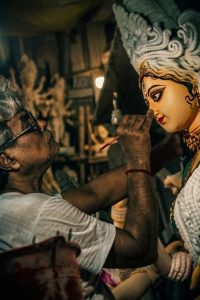
Blessed are the hands that carve God and the idols we worship on so many religious events. These hands painstakingly construct what we worship so vigorously. The toil, the hardship, the sweat and tears, all of it is infused with what we see in front of our eyes yet what we rarely see are the actual people who make this possible. Not even a glimpse of them or their silhouette, they remain invisible while their work shines in the limelight. In a way, they’re artisans of the highest calibre, getting to carve something so auspicious and revered. It must be a privilege right? So I wondered, despite all this, why do these particular hands remain unseen to us?
It is Navratri. Garba nights, pandals, loud DJs and a riot of colours have taken over the city. I have never been particularly enthusiastic about loud celebrations, but I have always been drawn to the larger-than-life idols of deities. The faces, the ornaments, the impossible proportions, the painstaking details. There is something extraordinary about turning a lump of clay into something that an entire crowd will fold its hands before.
Last night, I visited a Navratri pandal in a posh colony. You needed a pass to enter. Inside, the place was dressed for the occasion, and so were the people. Women in their finest sarees and lehengas, men in carefully chosen kurtas, jewellery catching the light, phones held up to capture the spectacle. Everything seemed to have been arranged to make the evening special. The decorations were elaborate, the lights extravagant, and money was visible everywhere, even when nobody spoke about it.
After walking around, I stopped before a huge statue of Durga.
Black curls framed her face. Her eyes were enormous, lined with kajal, her lips red, a bindi shining on her forehead like a tiny star. She was beautiful in a way that felt almost unreal. For a moment, I forgot everything else and simply looked at her.
Then I wondered whose hands had made her.
Who had sat with the clay, shaping her face, carving her ornaments, getting the eyes just right? How many hours had gone into making her look so alive?
I imagined a kumhar, an artisan who had learnt the language of clay through years of practice. Perhaps someone who had inherited the craft from his family. Someone whose hands could create what the rest of us could only stand and admire.
And then, as my mind often does, it wandered somewhere else.
Does the god he creates ever reach his home?
I don’t mean this in a theological sense. I’m an atheist; I don’t believe there is a god waiting inside that statue. But I believe in the hands that made it, and I couldn’t stop thinking about them.
Did the man who sculpted Durga get to stand before her in that pandal? Could he afford to enter? Would he have needed a pass? Would he have felt comfortable among the people dressed in their finest clothes, moving through a space that his labour might have helped make beautiful?
I don’t know who made that particular idol, or what his circumstances were. Perhaps he was there, standing somewhere in the crowd. Perhaps he had been welcomed with open arms. I don’t want to invent a life for a stranger just to make a point.
But the question stayed.
The people inside had come to admire the goddess. Someone, somewhere, had made her. And between the two stood a whole chain of people, money and arrangements that I knew almost nothing about.
I kept looking around. The pass at the entrance, the expensive decorations, the clothes, the ease with which some people occupied the space. Then the thought of the artisan, whose work was central to the spectacle but whose presence I had no reason to expect.
I don’t know if there was a class divide in that particular pandal. I couldn’t tell you the artisan’s income or whether he belonged to a different social class from the visitors. But the contrast was hard to ignore: the people who could afford to enjoy the finished spectacle, and the person whose labour had helped create it. One was visible as a guest, the other existed in my imagination as a maker.
We are often very good at admiring the work and forgetting the worker.
I remembered a line from a theatre play I had watched recently: People in our country remember the win, not the winner.
We remember the victory, not the person who made it possible. We celebrate the warrior, the hero, the god. We rarely ask what it took to bring them into existence. Once the spectacle is complete, the labour that produced it seems to disappear.
There is a story associated with Durga Puja in Bengal that has stayed with me. According to a widely circulated belief, soil is collected from the threshold of a sex worker’s home to make the idol of Durga. The explanations vary, and I don’t know how literally or universally the practice is followed.
As an atheist, I find the idea of sacred and impure soil rather superficial. But even a stereotype can tell us something about the society that keeps repeating it.
How can the soil from a sex worker’s doorstep be considered pure while the woman herself is treated as impure? How does something associated with her become fit for a goddess, while she remains someone society would rather look away from?
We seem to have a peculiar talent for accepting the things we can extract from people while refusing to accept the people themselves.
I found myself thinking of the artisan again. We can worship what his hands create without knowing anything about the life those hands belong to. We can spend generously on a goddess while the person who shaped her remains an afterthought.
Of course, I don’t know what the artisan feels about his work. Perhaps he takes immense pride in it. Perhaps there is devotion in every stroke of his hand. Perhaps it is simply his profession, something he has mastered over years, like a surgeon shaping a nose or a carpenter making a table. What appears miraculous to us may be ordinary to the person who knows how to do it.
I wanted to meet him. Not to ask him about his poverty, or to congratulate him for making something beautiful despite his circumstances. I wanted to know what he thought when he looked at his creation. Whether he saw a goddess, a livelihood, a family tradition, or simply a job well done.
I don’t want to turn him into an object of pity. That would be another way of refusing to see him as a person.
But neither do I want to romanticise his labour. Art does not pay the bills merely because it moves people. Passion is not compensation. And devotion, if there is any, does not make fair wages or ordinary dignity less necessary.
I left the pandal without meeting him.
Outside, the music continued. The lights were still bright. People were still taking photographs, admiring the decorations, making their way through the crowd. Nothing had changed, except that I could no longer look at the goddess without thinking about the hands that had made her.
Perhaps this is what bewilderment does. It interrupts admiration just long enough for you to notice what you had been overlooking.
I don’t know whether the artisan was allowed inside that pandal. I don’t know whether he could afford to visit the goddess he had created. I only know that the question should not feel strange.
There is something deeply unsettling about a world in which we can make a god worthy of worship but struggle to make the life of the person who created it worthy of respect.
The goddess may stand on a pedestal. The hands that carved her should never have to kneel for their dignity.
I wish we could find a moment to celebrate people simply as people, without first turning them into gods, heroes, symbols or ideals. I wish we could look at a person and see more than what they make for us, what they represent to us, or what we can take from them.
Sometimes, I think, the real test of what we worship is not how high we raise our gods, but how we treat the people standing on the ground.
